
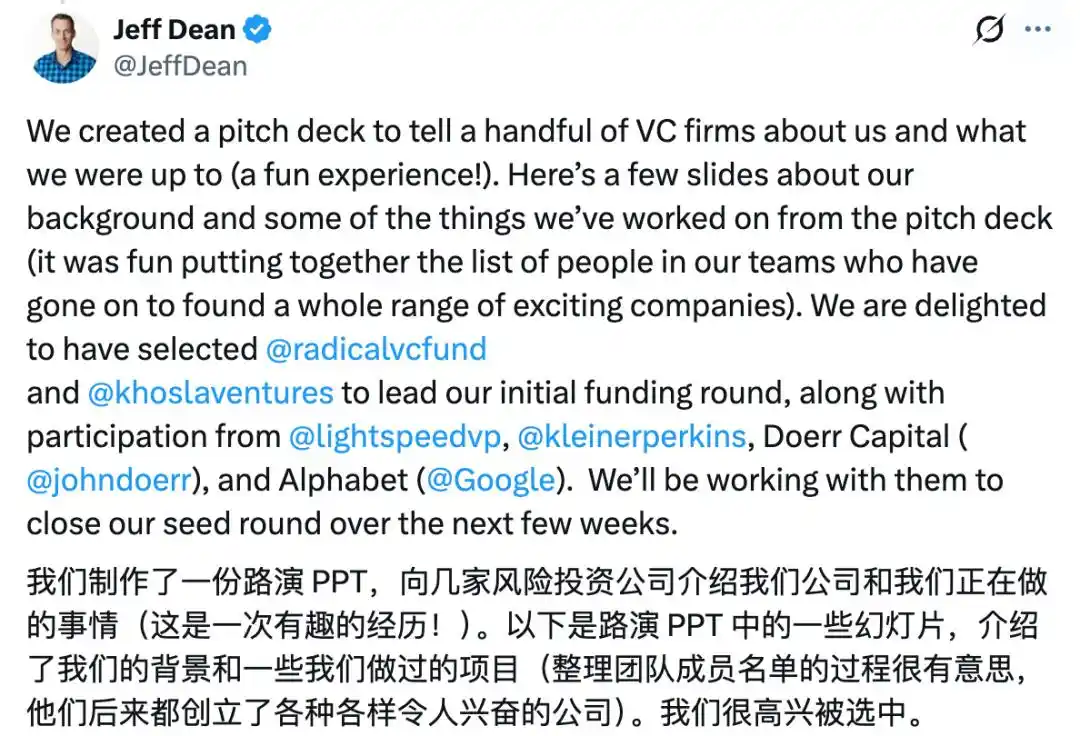
Discovery Loop, the new startup founded by Jeff Dean, has become the focus of online discussion after details from its pitch deck were shared publicly. Instead of following a standard fundraising template built around market size, monetization, and product positioning, the deck leans heavily on the backgrounds of its founders: what they built, how large the teams they led became, and how much influence they carry in AI and distributed systems research.
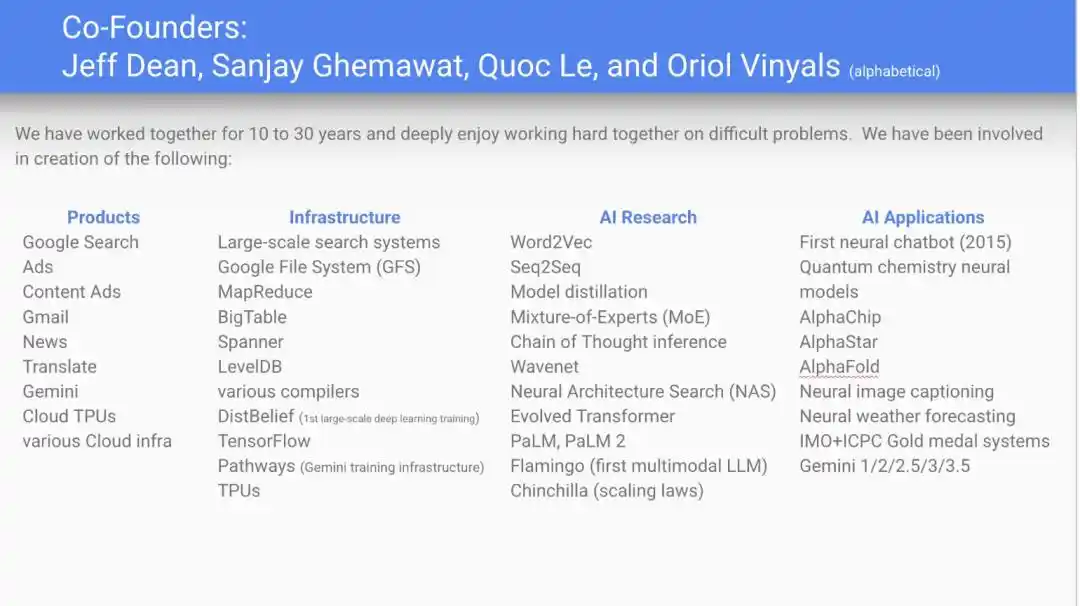
According to the article, the opening section of the deck is essentially a record of the founding team’s past work. One page lists four founders and groups their accomplishments into four categories: products, infrastructure, AI research, and AI applications.
The products listed include Google Search, Ads, Gmail, Translate, Gemini, and Cloud TPU. The infrastructure section includes GFS, MapReduce, Bigtable, Spanner, TensorFlow, and Pathways. The AI research section names Word2Vec, Seq2Seq, Mixture of Experts, model distillation, PaLM, Flamingo, and Chinchilla. The AI applications page includes AlphaChip, AlphaStar, AlphaFold, weather forecasting, and multiple generations of Gemini models.
Pitch deck centers on the founders’ operating history
A second page lays out the size of the teams the founders managed and the AI founders who emerged from those circles.
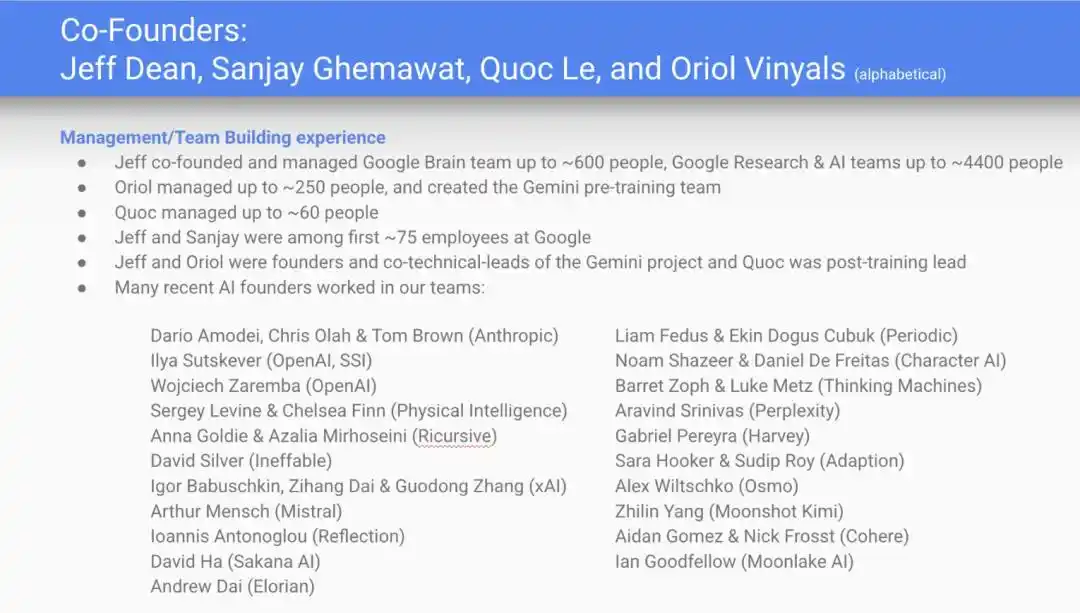
The report says Jeff Dean co-founded and managed Google Brain, which at one point grew to about 600 people. It adds that the Google Research and AI teams under his management reached as many as roughly 4,400 people. Oriol Vinyals managed a team of around 250 and created the Gemini pretraining team. Quoc Le managed a team of about 60. The article says the three also held responsibilities tied to Gemini, including joint technical leadership, pretraining, and post-training work.
The deck also lists a long roster of AI figures associated with that network. Names mentioned in the article include Dario Amodei, Ilya Sutskever, and Noam Shazeer, along with founders tied to Physical Intelligence, Thinking Machines, and Sakana AI.
The report gives special attention to Chinese AI founder Yang Zhilin. It says that while pursuing his PhD at Carnegie Mellon University, Yang joined Google Brain and worked with Quoc Le’s team on language model architectures and pretraining methods. During that period, Yang and Dai Zihang, among others, co-proposed Transformer-XL and XLNet.
As described in the article, Transformer-XL attempted to move beyond the fixed text window used by standard Transformers so models could preserve information across longer spans and across paragraphs. XLNet explored a different pretraining route outside BERT, and the article says the paper reported results that surpassed BERT on 20 natural language processing tasks.
The article then links that period to Yang’s later startup work. It says he went on to found Moonshot AI and build Kimi. One of the capabilities users first associated with Kimi, according to the article, was long-context processing. It also notes that Moonshot AI later disclosed technologies including Mooncake, MoBA, and Kimi Linear to address the inference cost, attention computation, and cache pressure that come with long context windows.
Dai Zihang is also discussed separately. The article says that during his PhD at Carnegie Mellon, he collaborated with Quoc Le’s team at Google Brain and completed Transformer-XL and XLNet together with Yang Zhilin. In both papers, the two were listed as co-first authors.
After completing his doctorate, Dai joined Google Brain as a research scientist and continued to work on language models and efficient Transformer architectures. The report cites FLASH as one example. It says FLASH introduced a new efficient attention structure that allowed longer sequences to be processed in near-linear fashion while maintaining model quality, and that the paper reported training speed improvements of up to about 12x across language modeling tasks. It also notes that Dai appeared on the author list of the first Gemini technical report.
Another name highlighted in the article is Zhang Guodong, identified there as a Zhejiang University alumnus. It says Zhang interned at Google Brain and DeepMind. His representative work included studying which training algorithm choices matter under different batch sizes, minimax optimization, multi-agent optimization, and the use of a prover-verifier mechanism to produce checkable model answers. He was also one of the co-authors of the Deformable Convolutional Networks paper. In 2023, the article says, Zhang joined xAI’s initially disclosed founding team.
Scholar citations are used as a credibility slide
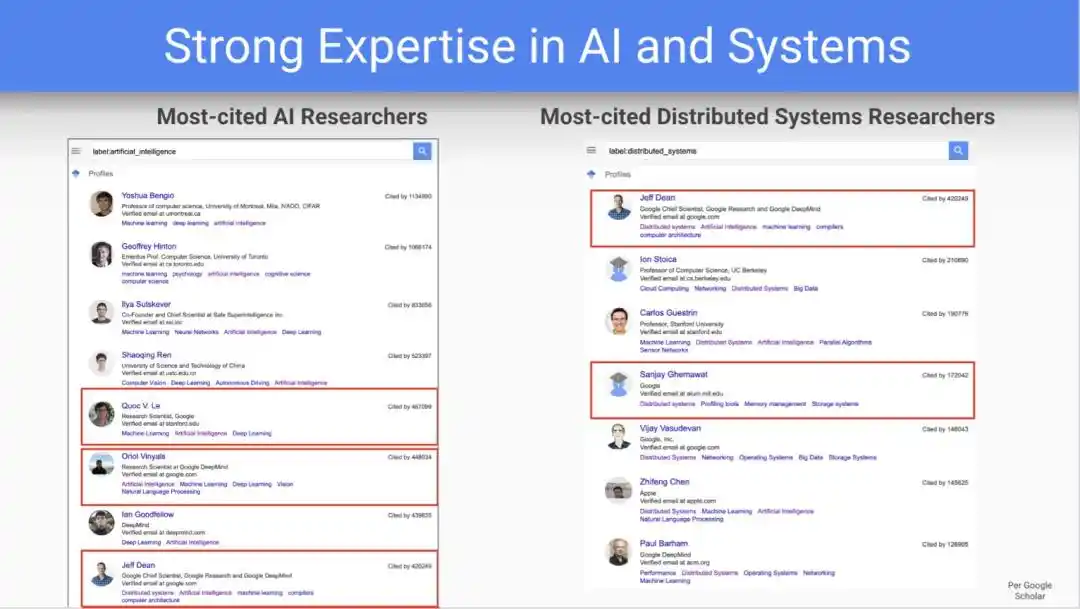
A third page in the deck focuses on academic influence in AI and distributed systems.
On the left, the deck shows a Google Scholar screenshot featuring highly cited AI researchers. Quoc Le, Oriol Vinyals, and Jeff Dean are marked with red boxes. The same page also includes Yoshua Bengio, Geoffrey Hinton, Ilya Sutskever, Ian Goodfellow, and Chinese AI researcher Ren Shaoqing.
The article describes Ren as one of the core authors behind classic computer vision work such as Faster R-CNN, and says he later moved into autonomous driving and AI research.
On the right, the deck shows a page of highly cited distributed systems researchers under related Google Scholar labels. Jeff Dean and Sanjay Ghemawat are again highlighted. The report says Jeff Dean’s total Google Scholar citations have surpassed 420,000, while Sanjay Ghemawat’s have exceeded 170,000.
Based on that slide, the article sketches out the balance inside the Discovery Loop founding team: Quoc Le and Oriol Vinyals are positioned closer to machine learning and frontier model research, while Jeff Dean and Sanjay Ghemawat bring deep experience in building large-scale systems.
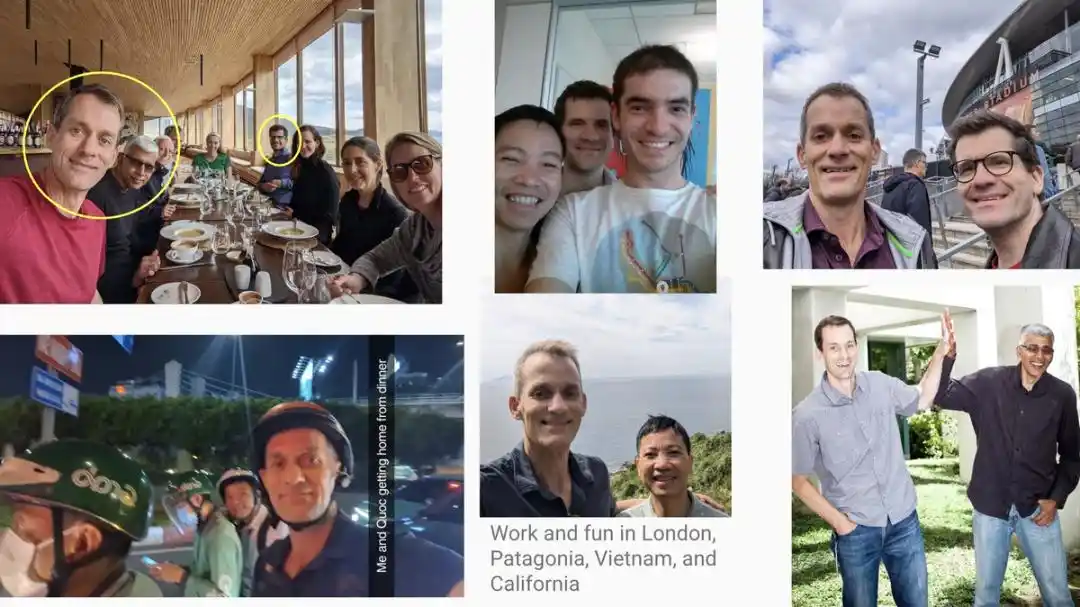
The deck also includes personal group photos
Beyond career history and citations, the pitch deck includes a page of casual group photos. The article says the large yellow circle in the upper left identifies Jeff Dean. Next to him, wearing glasses and with gray-white hair, is Sanjay Ghemawat. A smaller yellow circle at the dining table marks Oriol Vinyals.
Other pictures show the team watching a match in London, having dinner in Patagonia, riding motorcycles in Vietnam, and high-fiving in California. A line at the bottom reads: “We work and play together in London, Patagonia, Vietnam, and California.”
The piece argues that the photos underline how long these founders have worked together. That kind of long-term collaboration is presented as a positive in a startup context.
What Discovery Loop says it wants to build
On strategy, Discovery Loop describes its mission as “automating machine learning, science, and engineering to accelerate discovery and progress.”
Its core concept is an “automated experimentation loop.” The article describes today’s research process as a repeated cycle: form a hypothesis, design an experiment, run it, analyze the result, revise the plan, and start again. Discovery Loop wants AI to sit inside that chain, run large numbers of experiments, and automatically adjust the next round based on results.
The report says the company will initially focus on machine learning research and engineering, the area most familiar to its four founders. Over time, it may extend the same approach to computer hardware, drug discovery, and other science and engineering problems.
Investors named include Khosla, Radical, and Alphabet
The article says several investors have already been confirmed in the round: Khosla Ventures, Radical Ventures, Lightspeed Venture Partners, Kleiner Perkins, and Doerr Capital. Khosla Ventures and Radical Ventures are identified as co-leads.
It describes Khosla Ventures as a long-time backer of high-risk, deeply technical projects and notes that it invested in OpenAI in 2018. Radical Ventures is described as a Canada-based AI-focused venture capital firm with investments that include Cohere, Waabi, and World Labs.
Alphabet, Jeff Dean’s former employer, also participated in the financing and signed a long-term cloud computing partnership with Discovery Loop, according to the report.
The exact size of the financing has not been formally announced. Axios, citing people familiar with the matter, said the round reached several hundred million dollars, though that figure has not been officially confirmed by Discovery Loop or the investors.
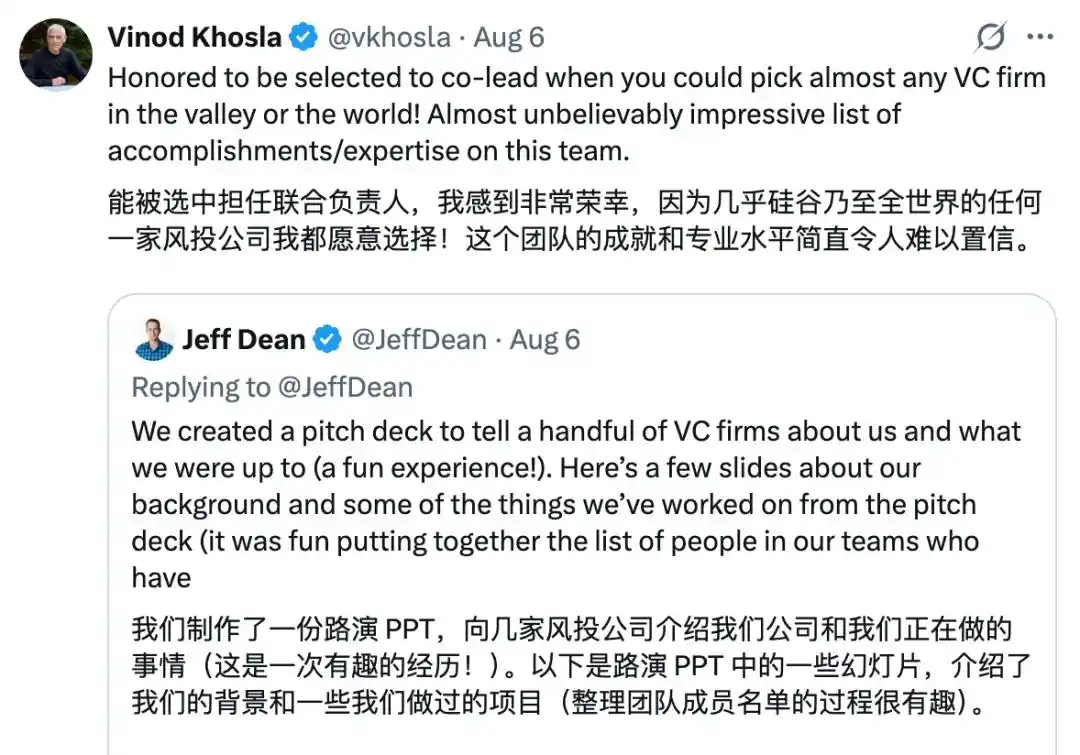
Khosla Ventures founder Vinod Khosla also posted on X: “Honored to be chosen to co-lead Discovery Loop!” The article says he compared the investment to his 2018 backing of OpenAI and said Discovery Loop could have a similar level of impact. It also notes that an investor from Radical Ventures posted about the deal on a Chinese social platform.
Source links cited in the original article
The article includes the company website for Discovery Loop: https://www.discoveryloop.com/
It also lists three reference links to posts on X from Jeff Dean and Vinod Khosla:
- https://x.com/JeffDean/status/2085036253263921218
- https://x.com/JeffDean/status/2085034604172603724
- https://x.com/vkhosla/status/2085034150361453032
The MarsBit piece says the original text came from the WeChat public account “量子位” and was written by 听雨.