
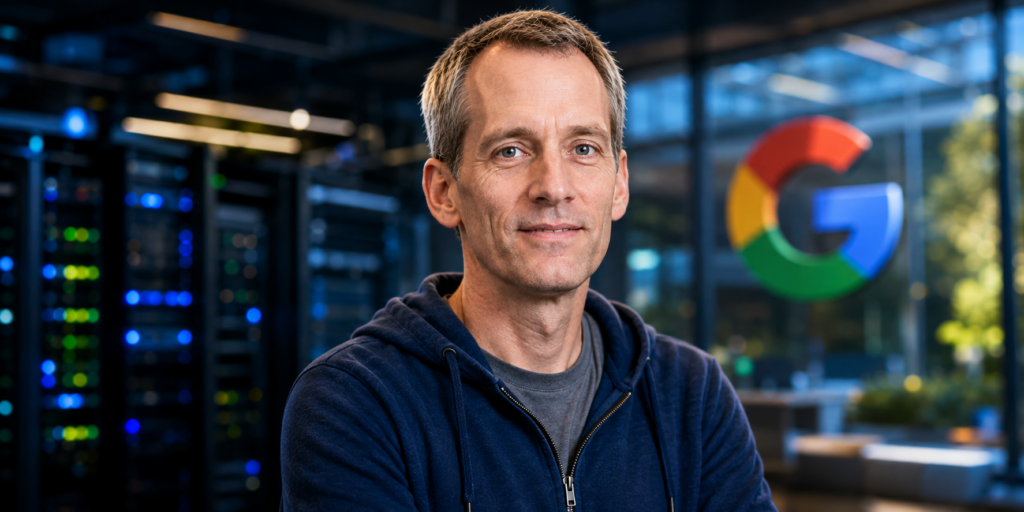
Google Chief Scientist Jeff Dean is leaving the company after 27 years and will start a new AI company, Discovery Loop, with three other senior Google researchers: Sanjay Ghemawat, Quoc Le, and Oriol Vinyals. Alphabet shares fell as much as 5.4% during the session and closed down 4.03% at $362.43, erasing nearly $190 billion in market value in a single day.
The move was not treated as a routine executive exit. Dean will serve as CEO of Discovery Loop, and the market reaction reflected a broader question: why would the departure of four researchers move the valuation of a company as large as Alphabet by that much?
Who Jeff Dean is
Dean is 58 and joined Google in 1999 as employee No. 30. He holds a bachelor’s degree in computer science from the University of Minnesota and a Ph.D. in computer science from the University of Washington. Many people now associate him with Gemini, but his role at Google goes back much further, into the company’s core infrastructure.
In 2004, he co-invented MapReduce, a computing framework that lets large numbers of computers process massive datasets in parallel. The report describes it as a key building block behind Google Search’s ability to return answers from across the web in milliseconds.
In 2005, he co-designed BigTable, and in 2012 he helped build Spanner. Those distributed database systems support data running across data centers around the world while behaving as if it were managed in one place. The report says they still underpin Google Search, Gmail, and YouTube.
Dean was also a key figure in bringing TPU into production. In 2011, he co-founded Google Brain, the team that later produced the TensorFlow deep learning framework. He became head of Google AI in 2018. After Google Brain and DeepMind were merged in 2023, he moved into the chief scientist role and remained a central figure behind Gemini’s multimodal model work.
From search infrastructure to AI chips and Gemini’s core design, Dean had a hand in multiple major technical shifts inside Google. That helps explain why his exit was viewed as more than a standard leadership change.
“Tomorrow will be my last day at Google after 27 years, and watching it grow from 25 people to 190,000+ has been an amazing journey.”
Why the market reacted so sharply
The other three departures mattered as well. According to the report, Google is losing, at the same time, a founder-level architect of distributed systems, a founding member of Google Brain, and Vinyals, a core Gemini researcher who had served as a vice president at Google DeepMind.
The piece frames AI competition as a product of engineering density, compute, and data. Under that view, the loss is not just about replacing a few individuals. It is about losing a rare combination of infrastructure builders and front-line researchers, with no obvious bench of ready-made replacements available in the market.
That is also why the report says investors were not only reacting to who left, but to what the departures might say about internal changes at Google and whether more exits could follow.
Google reshuffles its AI leadership
Google announced leadership changes alongside Dean’s departure. Demis Hassabis is stepping away from the day-to-day operation of Google DeepMind and will become chairman of Google DeepMind and Chief Scientist at Alphabet, while continuing to lead Isomorphic Labs.
Koray Kavukcuoglu, who has spent 13 years at DeepMind, was promoted to senior vice president at Google DeepMind. He will report directly to Sundar Pichai and oversee Gemini model development, frontier research, and developer teams.
Pichai said, “We want to build this in a way that is different from inside Google.” The company’s position, as presented in the report, is that this is a division-of-labor arrangement rather than a sign of talent drain. The stock move suggested investors were not fully convinced.
What Discovery Loop plans to build
Discovery Loop is set up as a public benefit corporation. Its goal is to use AI to automate the experimental loop in scientific research so that thousands of experiments can run at the same time. The company plans to start with using AI to build stronger AI systems, then extend into hardware design, drug discovery, and clean energy.
Dean said, “You get larger quantities and higher quality of experiments, and that leads to scientific breakthroughs.”
On funding, Radical Ventures and Khosla Ventures are co-leading the round. Kleiner Perkins, Lightspeed, Doerr Capital, and Alphabet are also participating. The amount was not disclosed.
Alphabet is losing talent and backing the new venture at the same time
The report notes that Alphabet is also one of Discovery Loop’s founding investors and will serve as its cloud computing partner. In other words, Alphabet is losing a group of high-profile researchers while still retaining economic exposure to the company they are building.
Dean is not joining a rival company. He is starting a new one. The report argues that this is more notable than a conventional job switch because it shows top researchers now have both the ability and the willingness to go around the biggest tech companies and build independent research companies of their own.