
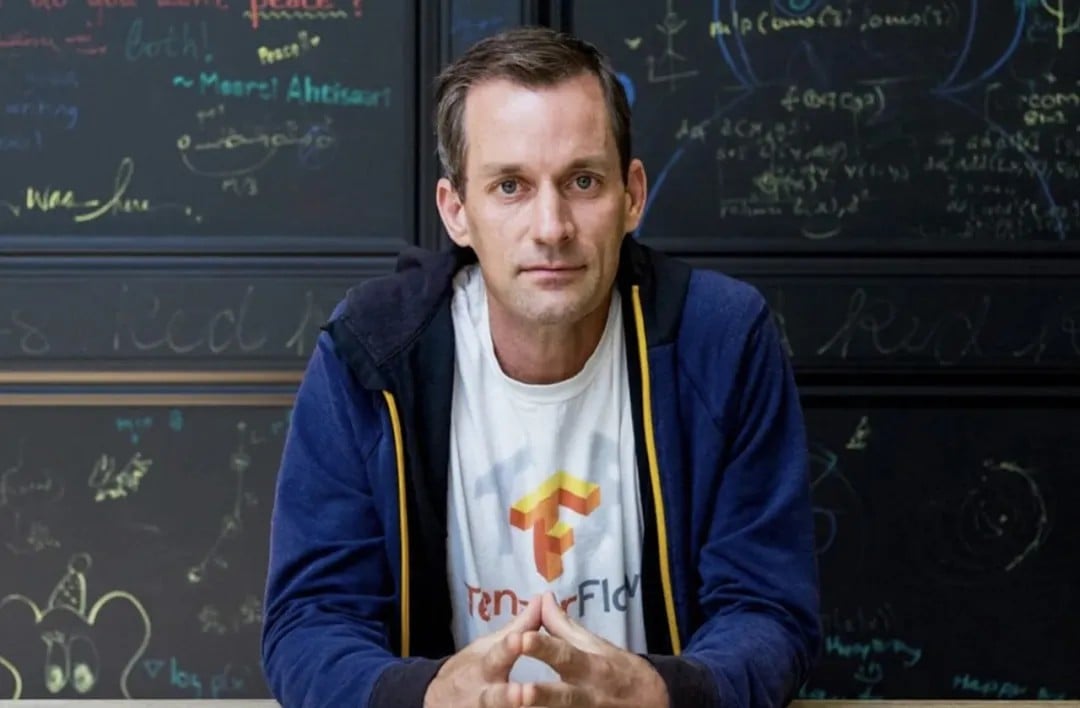
Jeff Dean, Google’s chief scientist and one of the company’s foundational technical figures, has left the company after 27 years and started a new venture called Discovery Loop with three longtime collaborators. The startup says it wants to automate the experimental loop in machine learning, science, and engineering. On the day the news was made public, Alphabet shares fell about 5%.

Dean joined Google in 1999, when the company had 20 employees and operated out of an office above a T-Mobile store in Palo Alto. Over nearly three decades, his name became attached to much of the infrastructure that underpins Google’s operations, including MapReduce, Bigtable, Spanner, TensorFlow, TPU, and Gemini.
Discovery Loop is targeting the research cycle itself
In the words used by the founding team, Discovery Loop aims to “automate the experimental loop in machine learning, science, and engineering.” That loop includes forming a hypothesis, designing an experiment, running it, checking the result, and then using the outcome to shape the next round. The company’s premise is that this process still depends heavily on human effort and is constrained by time and attention.
Its plan is to use AI models and large-scale compute to automate that cycle and run thousands of experiments in parallel.
The roadmap described in the report has three stages.
- First, the company will start with machine learning research itself, using AI to propose experiments, run evaluations, and iterate on models automatically.
- Second, it will use those capabilities to improve its own stack, effectively becoming its own first customer.
- Third, it will extend the same framework into broader scientific and engineering work, including hardware design, drug discovery, and clean energy.
Discovery Loop is registered as a Public Benefit Corporation. The report says that OpenAI, Anthropic, xAI, and Safe Superintelligence, the company founded by Ilya Sutskever, have taken a similar governance route.
The seed round was co-led by Radical Ventures and Khosla Ventures. Lightspeed, Kleiner Perkins, Doerr Capital, and Alphabet also participated. The company did not disclose the amount raised or its valuation.
Google is doing more than investing capital. It will also act as a cloud partner and provide at least the first year of compute support for Discovery Loop.
A four-person founding team with deep infrastructure credentials
Discovery Loop’s founding team consists of four people: Jeff Dean, Sanjay Ghemawat, Oriol Vinyals, and Quoc Le.
Dean was employee No. 30 at Google and spent 27 years there. Together with Ghemawat, he helped create MapReduce, Bigtable, Google File System, and Spanner, systems that formed the base layer for Google’s ability to process data at global scale. He later led Google Brain, pushed forward the development of TensorFlow and the design of TPU chips, and became chief scientist after the 2023 merger of Google Brain and DeepMind.
Ghemawat is a Google Senior Fellow and has worked with Dean for more than 20 years. The report describes the pair as a legendary internal combination at Google, appearing together on many of the company’s most important papers and projects.
Vinyals was a vice president of research at Google DeepMind and one of the technical leads on Gemini. During his time at DeepMind, he worked on projects including AlphaStar and AlphaCode.
Quoc Le is a co-founder of Google Brain, one of the pioneers of AutoML, and a researcher credited in the report with foundational work in sequence-to-sequence learning.
In his departure post on X, Dean wrote: “Tomorrow will be my last day at Google. After 27 years here, having witnessed it grow from 25 people to more than 190,000, it has been an amazing journey.”
He also wrote: “It has absolutely been an honor to work with you and help build some of the most widely used and impactful products ever. As a kid, I dreamed of helping build software used by many people, and Google now has 13 products used by over a billion people (pretty amazing!).”
Dean’s note went on to describe the impact of Google’s products across search, email, document translation, video, learning, navigation, understanding the physical world, web browsing, phones, large-scale computing on Google infrastructure, autonomous vehicles, and complex tasks carried out with the help of AI systems. He thanked Google colleagues for those years.

He ended the note by saying: “Now I’m excited to get started on @DiscoLoopAI with my old friends and colleagues @Sanjay_Ghemawat, @OriolVinyalsML, and @quocleix.”
The report says the four founders have worked together across spans ranging from 14 to 30 years. Discovery Loop’s website says the team includes three of the most-cited researchers in AI and two of the most-cited researchers in distributed systems.
Seen across Dean’s career, infrastructure is the common thread. MapReduce scaled engineers’ ability to process data. TensorFlow scaled researchers’ ability to train models. TPU expanded compute supply for the industry. Discovery Loop is trying to apply that same infrastructure logic to scientific work itself.
Part of a broader AI talent shift
The report frames Dean’s exit as part of a wider pattern rather than a one-off event. This summer, Google DeepMind has gone through what it describes as an unusually intense period of talent loss.
In June, Nobel Prize winner and AlphaFold core contributor John Jumper left and joined Anthropic. Transformer paper co-author Noam Shazeer had also left not long before. In one week in June alone, according to the report, five senior DeepMind researchers moved to Anthropic and OpenAI, and Alphabet at one point lost about $270 billion in market value.
The movement is not limited to Google. The article notes that Mira Murati left OpenAI in 2024 and launched Thinking Machines Lab, which raised $2 billion within five months at a $12 billion valuation. Ilya Sutskever left OpenAI to start SSI, focused on superintelligence safety. Andrej Karpathy also joined Anthropic this year.
The report’s conclusion is that the AI industry’s most important technical talent is moving in a systematic way from large companies to startups.
As for why, it says Dean’s own explanation deserves attention: quarterly earnings pressure at a public company can limit freedom in scientific decision-making. In that context, Discovery Loop’s Public Benefit Corporation structure is presented as a way to preserve a legally protected long-term mission while still pursuing commercial returns.
The report also points out that Alphabet not only invested in Discovery Loop but agreed to provide first-year compute support. That arrangement suggests Google is trying to stay connected to a team it can no longer keep inside the company.
Google reshuffled AI leadership on the same day
Google also announced an AI reorganization on the day Dean’s departure was disclosed. Demis Hassabis stepped back from day-to-day management of Google DeepMind and became president and Alphabet’s chief scientist. CTO Koray Kavukcuoglu was promoted to senior vice president and took over Gemini model development.
According to the report, Sundar Pichai said in an internal note that the changes were meant to inject new momentum into Google’s AI work.
The article also looks back to remarks Dean made at the University of Washington commencement in June, where he told computer science graduates that one worthwhile problem to tackle is “developing tools to accelerate scientific discovery and engineering.”
He also said: “What’s magical about software is that a small group of people can build things that have an enormous impact on the world.”
Twenty-seven years ago, Dean helped prove that point inside a company with 20 employees. Now, at 58, the report says, he is trying to prove it again with a new company built around infrastructure for scientific discovery and engineering research.