
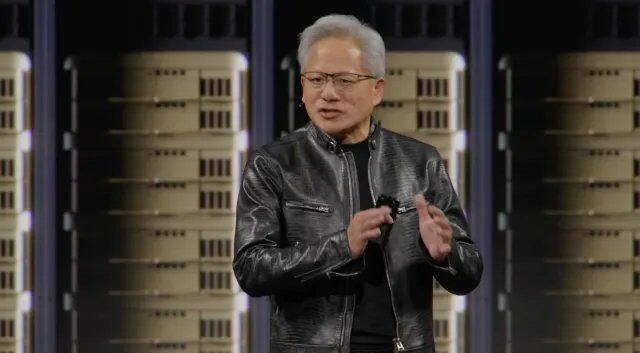
On June 1, 2026, at the NVIDIA GTC Taipei event held during COMPUTEX 2026, founder and CEO Jensen Huang took the stage just three months after the San Jose GTC. Back then, NVIDIA revealed its “chip family bucket” covering Vera CPU, Rubin GPU, Groq 3 LPU, and more. This time, Huang redirected the spotlight from infrastructure raw power to the target being served: agents. He declared, “The era of Agent AI and productive AI has arrived. Tokens are now the units of profit. AI is a GDP ‘generator.’ The number of software engineers is increasing. The talk that AI reduces jobs is complete nonsense—more software engineers are being hired than ever before.”
Huang disclosed that the Vera Rubin platform has entered mass production, Vera CPU is shipping globally, DGX Station comes to Windows for the first time, Cosmos 3 redefines physical AI perception, DSX becomes the operating system for AI factories, and NVIDIA jointly launched the H2 Plus—the first humanoid robot reference design based on Isaac GR00T—with Unitree. NVIDIA is reorganizing its entire technology stack around the agent ecosystem, spanning chips, data centers, models, software, and robotics platforms.
Vera Rubin: A Production Platform Purpose-Built for Agents
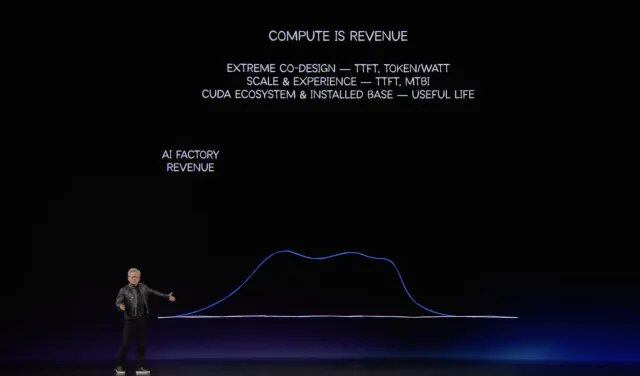
Unlike previous platforms focused on large model training and inference, Vera Rubin was designed from the ground up to tackle agent workloads. A typical agent task doesn’t involve a single inference call but thousands of steps including reasoning, search, tool calling, code execution, and verification. Future data centers must handle not just isolated model requests but large numbers of continuously running, cooperating agent tasks. Vera Rubin is defined as a gigantic, unified compute-unit AI supercomputer optimized for agentic workloads. In identically sized hyperscale data centers, it delivers 10× better efficiency for autonomous AI agent tasks than the prior Grace Blackwell generation.
On the networking side, NVIDIA introduced Spectrum-X Ethernet Photonics, deploying co-packaged optics (CPO) at scale for the first time in AI data centers, integrating optical components directly into the switch to cut power consumption and signal loss. Confidential computing capabilities were also extended across the entire platform, providing trusted execution environments, hardware-attested verification, and end-to-end encryption for sensitive enterprise data. With over 150 partners and 350 factories involved, Vera Rubin will begin shipments this autumn.
Vera CPU: A Processor Designed for Agents
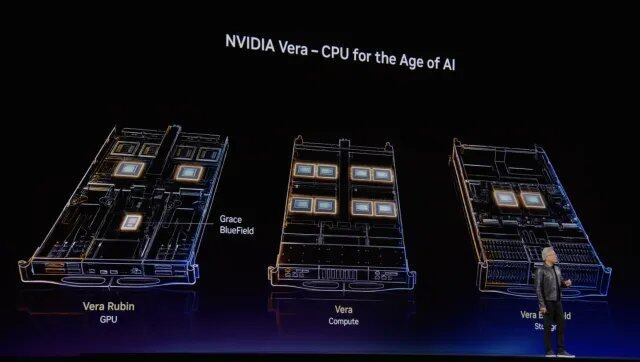
Huang noted that all CPUs to date were built for humans, but Vera is a CPU for the age of AI agents. As the successor to Grace, Vera employs NVIDIA’s custom “Olympus” core architecture, moving from 72 to 88 cores and significantly boosting memory and data processing capabilities. In agent-related workload tests, Vera executes tasks at 1.8× the speed of contemporary x86 server CPUs. Connected to Rubin GPU via second-generation NVLink-C2C with 1.8 TB/s bandwidth, Vera further reduces the overhead of data movement between CPU and GPU during agent operations. Huang also revealed that Vera Rubin uses HBM from Micron, SK hynix, and Samsung, and while deploying a large Blackwell rack takes two hours, Vera Rubin cuts this down to the five-minute range.
DGX Station & RTX Spark SoC: Bringing Agents to Desktops and Laptops
NVIDIA introduced DGX Station for Windows, a desktop-class AI supercomputer powered by the GB300 Grace Blackwell Ultra Desktop Superchip, offering up to 748 GB of unified memory, 20 PFLOPS FP4 performance, and up to 800 Gb/s networking. Enterprises can run multiple agents locally in a secure Windows environment, with OpenShell providing sandboxing and policy controls to prevent credential leaks and unauthorized actions. Simultaneously, NVIDIA unveiled the RTX Spark SoC—a system-on-chip combining its N1X CPU (Arm-based, co-designed with Microsoft, custom-built by MediaTek on TSMC’s 3 nm process) and a Blackwell GPU on a single die, aimed at thin-and-light notebooks. Over 30 models from Microsoft, Dell, HP, ASUS, Lenovo, and MSI will debut this fall.
DSX: The AI Factory Blueprint for Design, Simulation, and Operations
DSX is presented as a unified toolbox for constructing and running AI factories. DSX MaxLPS leverages liquid cooling and in-rack power optimization to run up to 40% more GPUs within the same power budget; DSX OS handles lifecycle management, smart scheduling, health monitoring, fault recovery, and multi-tenancy. Complementary modules include Reference Design for infrastructure layouts, DSX Sim for pre-build simulation, DSX Flex for grid-connected workload scheduling, and DSX Exchange for data integration across IT, operational, and cooling systems. Cloud partners such as CoreWeave, Crusoe, and Lambda are adopting these modules, while manufacturers like Dell, HPE, Lenovo, SuperMicro, ASUS, Foxconn, and Gigabyte are building DSX-supporting systems.
Nemotron 3 Ultra & NemoClaw: Digital Coworkers for the Enterprise
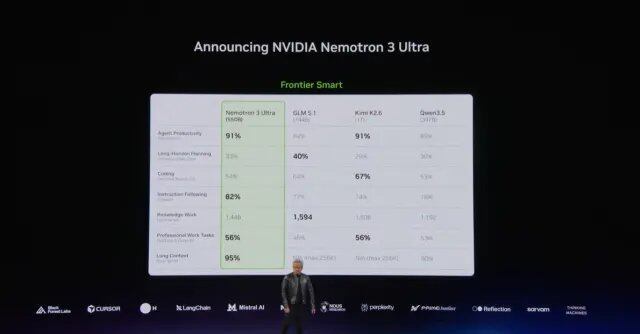
NVIDIA launched Nemotron 3 Ultra, a 550-billion-parameter mixture-of-experts model delivering up to 5× faster inference and 30% lower cost than comparable open-source frontier models. Around it, NemoClaw provides agent orchestration, context, memory, and tool-calling capabilities; OpenShell enforces runtime safety; and Agent Toolkit exposes CUDA-X libraries as callable tools for agents. Together they enable enterprises to build “digital coworkers” that assist employees in engineering, healthcare, software development, and other workflows.

Cosmos 3: The First Omni-Model Unifying Multimodal Understanding and Action
Cosmos 3 is a world foundation model for physical AI, built on a novel hybrid Transformer architecture that unifies visual reasoning, world generation, and action prediction within a single system. Natively capable of understanding and generating text, images, video, environmental sound, and action, it is the world’s first fully open omni-model, potentially compressing physical AI training and evaluation cycles from months to days. Huang predicted that breakthroughs in multimodal reasoning, language, and world models will trigger an imminent “big bang” for physical AI.
H2 Plus Humanoid Reference Design and Open-Source Physical AI Skills
Together with Unitree, NVIDIA unveiled H2 Plus, the world’s first open humanoid robot reference design built on the NVIDIA Isaac GR00T platform. Unitree provides the robot hardware, while NVIDIA supplies the software and compute platform, pre-integrating the stack so research teams can leap directly into skill development. NVIDIA also open-sourced a set of Physical AI Skills, standardizing operations across Cosmos, Omniverse, Isaac, and Metropolis into agent-readable instructions that automate the entire pipeline from task triggering to result validation.

BlueField-4 STX: Encrypting the Agent Data Path
NVIDIA added new security capabilities to the Vera BlueField-4 STX, addressing the risks posed by agents continuously reading, writing, and sharing information across enterprise systems without direct supervision. Using unified DOCA security software and hardware-enforced policies within the BlueField-4 chip, the STX-based platform can inspect and control interactions among agents, data, and context memory in real time, enforcing trust throughout the AI data path. Huang stated, “Agents turn enterprise data into a living, real-time system that must be protected wherever data moves, wherever context is stored, and wherever agents act.”
TSMC: From Foundry Partner to Mutual Interdependence
The nearly three-decade partnership between NVIDIA and TSMC is evolving. Now, TSMC is employing NVIDIA AI and accelerated computing inside its advanced fabs to improve cycle time, energy efficiency, yield, and operational productivity. Huang remarked, “TSMC is bringing NVIDIA AI and accelerated computing into the fab, using simulation, optimization, and AI to tackle the world’s most complex design and manufacturing challenges, increasing the speed, efficiency, and yield of next-generation chips.” The relationship has shifted from a one-way supplier–customer dynamic to mutual interdependency.

Looking back at the entire event, NVIDIA has assembled a complete blueprint around agents: Vera CPU schedules tasks, Vera Rubin supplies compute, BlueField-4 STX safeguards data, Cosmos 3 brings physical understanding, Nemotron + NemoClaw + OpenShell enable organization and governance, DGX Station places agents on employees’ desktops, H2 Plus gives agents a physical form, and DSX plus Skills allow mass production and deployment. Huang is painting a new computing era where agents become AI infrastructure—and NVIDIA is present at every layer.