
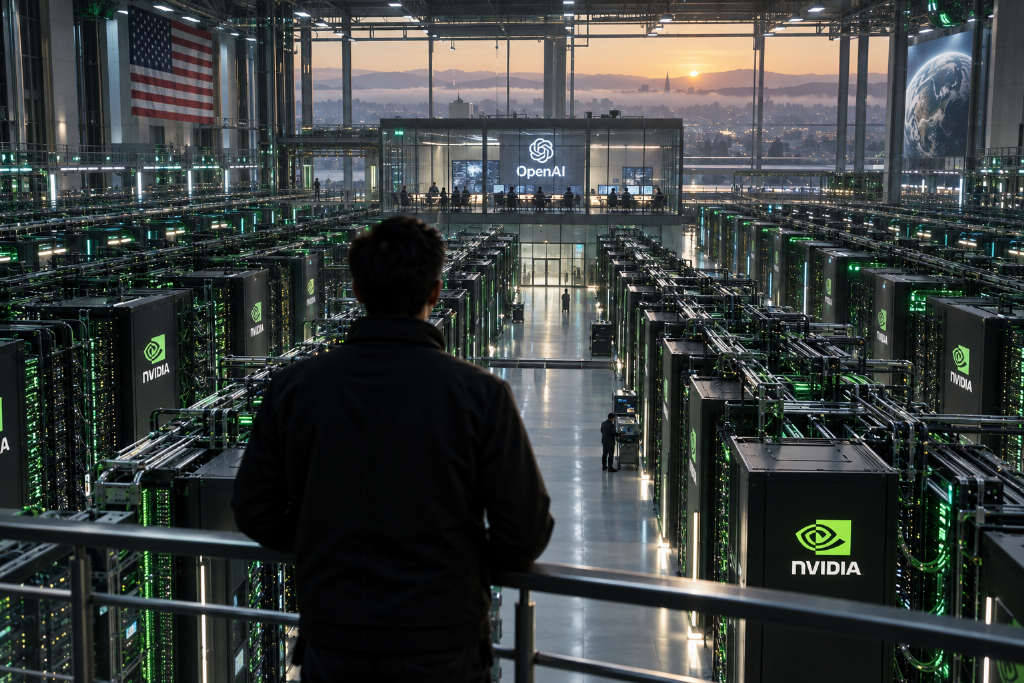
Nvidia CEO Jensen Huang said artificial general intelligence, or AGI, has already arrived, linking that milestone to OpenAI’s newest flagship model, Astra. Huang’s comments put Nvidia back at the center of the AI infrastructure story because, by his account, Astra was trained on Nvidia hardware and a much larger wave of compute capacity is about to come online.
Posting on X on Sunday, Huang congratulated the OpenAI team and wrote that "AGI has arrived." He also said Astra was trained on more than 100,000 Nvidia Grace Blackwell NVLink72 chips. In the same post, he added that "400K GPUs coming online soon," pointing to another major expansion in available compute.
The statement carries immediate market relevance. Nvidia’s data center business has become its core growth engine, and Huang’s preview of 400,000 additional GPUs suggests that demand from top-tier AI customers is still expanding.
OpenAI calls Astra its smartest model
OpenAI unveiled Astra last Thursday and described it as "the world’s smartest model" and the model most aligned with human values. The company said Astra can handle "the most demanding professional work with unmatched speed, precision, and judgment."
At the launch event, OpenAI President Greg Brockman told reporters, "Welcome to the age of AGI." He went on to say that when people look back at history, they may conclude that AGI was born "around this time, and I think maybe this model." Brockman added, "Personally, I really think we’re there." Astra began rolling out to users this week.
OpenAI defines AGI as "highly autonomous systems that outperform humans at most economically valuable work." The company framed Astra as a major research breakthrough, saying it marks a fundamental shift in the boundary of tasks that can be entrusted to AI.
The definition of AGI remains disputed
Not everyone agrees with that conclusion. Gary Marcus, a well-known AI researcher and critic, said Huang was jumping ahead of the evidence.
In a post on Substack, Marcus wrote: "Jensen Huang offered neither evidence nor a definition, which to me looks like an attempt to seize a scientific question by corporate will." He added, "Declaring victory without a definition only makes the issue more confused."
Marcus then laid out his own 10 criteria for AGI and said Astra meets only one or two of them. "By commonly used definitions, Astra still falls short," he wrote.
Even OpenAI CEO Sam Altman has sounded cautious on the term. In a recent appearance on the "Sources" podcast, he said AGI is, at most, "an extremely vague term. I was going to say it is more like an irrelevant marketing term."
Nvidia remains the core supplier behind leading AI companies
Whatever happens in the debate over AGI, Nvidia’s position as the main compute supplier for leading AI companies is not in dispute. In a fundraising announcement in March this year, OpenAI called Nvidia "a cornerstone of our infrastructure" and said, "Our training clusters and most of our inference stack continue to run on Nvidia GPUs."
Meta, Anthropic, and Google also rely heavily on Nvidia’s high-end chips. That demand has translated into strong financial results. Nvidia reported quarterly revenue of $96.2 billion in August this year, up by more than 100% from a year earlier. Of that total, data center revenue reached $89 billion, with AI chip-related business making up the main growth driver.
Huang’s latest X post, with its reference to 400,000 more GPUs coming online, adds to expectations that Nvidia’s compute buildout is still accelerating. From ChatGPT to o1 and now Astra, the technological jump over the past four years has been built on successive upgrades in Nvidia chips.