
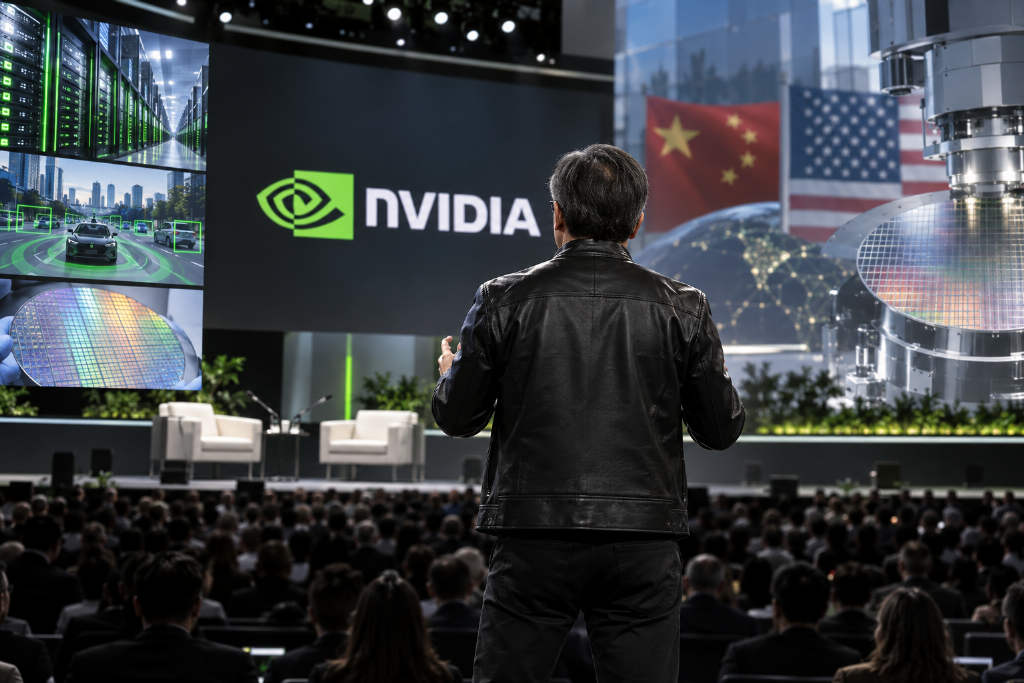
NVIDIA Chief Executive Officer Jensen Huang used a nearly 50-minute conversation at the All-In Summit to lay out his views on AI safety, regulation, open models, U.S.-China competition, data centers, NVIDIA's investment posture, autonomous driving, and China's semiconductor trajectory. He appeared alongside All-In Podcast hosts Jason Calacanis, Chamath Palihapitiya, David Sacks, and David Friedberg.
Midway through the session, the discussion was interrupted by an unexpected phone call from U.S. President Donald Trump, who spoke to the live audience of thousands through Huang's phone for close to five minutes.
Huang says AI extinction claims are not scientific
The conversation opened with questions about a recent article by Anthropic CEO Dario Amodei and broader debate among frontier AI labs over safety and slowing the race.
Huang said the parts of that discussion dealing with internal controls, whistleblowers, and safety governance deserve serious attention. But he sharply disagreed with describing civilization-ending AI outcomes as if they were scientific forecasts. In his words, those claims are "not based on science," yet the public may treat them as evidence-backed predictions simply because they come from researchers.
He pointed to several AI forecasts from recent years, including claims that radiologists would disappear within five years, that 90% of code would be generated by AI within six months to a year, and that 50% of entry-level jobs would be wiped out. Huang said those predictions have not unfolded in the way they were originally presented.
Using radiology as an example, he said AI has clearly become widely used in reading medical images, but the world has not stopped needing radiologists. In his telling, the opposite is true: more doctors are needed. AI has taken over part of the workflow, not erased the profession itself.
He said the AI industry has to take responsibility for earlier exaggerated or mistaken predictions and cannot repeatedly make extreme claims while also asking society to trust experts.
Regulation should start with root cause analysis
On how governments should regulate AI, Huang argued for an engineering-first approach. Regulation, he said, should address real problems that actually exist. Right now, he said, the entities that can genuinely encounter frontier-scale risks are still mainly frontier labs with massive compute resources. High school students, ordinary startups, and even most companies do not have enough compute to run experiments at that scale.
For that reason, he said, if an incident occurs, the first step should not be a blanket ban or a demand to halt development. The right response is to investigate it the way engineers would handle any other failure: what happened, why it happened, and what technical controls, processes, monitoring systems, or sandboxing could stop it from happening again.
Huang said he believes frontier AI companies can gradually bring known issues under control through better runtime systems, sandboxing, monitoring, continuous monitoring, and evaluation procedures. Only when companies themselves admit they do not know what happened or how to control it should outside engineering teams step in.
He added that third-party evaluators or auditors make sense, much like financial audits for public companies. They do not need to know more than the company itself, he said, but they do need to ask the right questions. He also argued that there should be multiple outside evaluators rather than a single firm monopolizing standards.
Recursive self-improvement is being overstated
Asked about Chinese AI company Zhipu putting money into research on recursive self-improvement, or RSI, Huang said the concept is not as mysterious as it is often made out to be.
He described RSI as a combination of techniques that already exist, including in-context learning, skills, reflection, reinforcement learning, synthetic data, and methods such as LoRA. Together, those tools let AI systems improve while performing tasks and generating data.
Huang said using AI to improve the efficiency of building AI is completely reasonable and that labs are already doing this to some degree. The real issue, in his view, is that the term RSI is now being used to create the impression that AI will recursively strengthen itself without limit and spin out of control.
Even if a company allows a model to improve itself internally, he said, any product still has to go through evaluation, testing, regression tests, and verification before release. Those engineering processes are control points in themselves.
Huang backs both closed and open models
On open-source AI, Huang said the world does not have to choose one side. It needs both closed models and open models.
He compared closed models to bottled water. Water is widely available, he said, but people still choose bottled water in certain settings. AI works the same way: for some tasks, the most advanced closed model is the easiest option, while in other cases companies need an open model they can deploy and modify themselves because of sovereignty, privacy, or proprietary technology requirements.
Huang offered one striking figure on stage: roughly $400 billion in venture capital has flowed into AI-native companies over the past six months, and about 80% of those companies use open models.
If the United States wants to win the AI race, he said, success cannot mean only a handful of tech giants coming out ahead. Every company, every industry, researchers, teachers, students, and startups all need access to AI.
The real competition is over who uses AI best
The hosts then pressed him on whether open models coming from China create a strategic problem for the United States.
Huang answered in practical terms. A large share of global open-source contributions already comes from China, he said, because the country has a huge pool of engineers and science and engineering graduates. Even if Linux, Kubernetes, or other open-source software has been modified by Chinese engineers, users can still download the code into their own environment, fork it, improve it, and turn it into their own version.
That is why, he said, the core AI contest is not about who invents every piece of technology. It is about who uses the technology best. Huang pointed to the industrial revolution and said Maxwell, Volta, and Ampere were not Americans. Many major technologies came out of Europe, but the United States was the country that most successfully turned them into industry and social productivity. He said he hopes AI follows that same script.
He also said China's AI narrative is currently more pragmatic than the one heard in the United States. China, he said, talks about AI as a technology that advances economic and social development, while the U.S. keeps returning to civilization-ending and doom-focused narratives.
AI may change coding, but not eliminate engineers
Huang also took issue with the idea that AI will erase software engineering jobs. Looking back on his early years as an engineer, he said software was nowhere near as pervasive as it is today, and engineering work did not mean sitting in front of a computer typing all day. Today's engineers, by contrast, spend much of their time writing code on keyboards.
Engineering is not the same thing as coding, he said. He joked that he often tells NVIDIA software engineers, "You're just typing," and said his favorite key on the keyboard is Backspace because the best software is often the smallest, simplest software.
AI may lead to a future where a great deal of code is no longer typed directly by humans, he said, but that does not mean the world no longer needs engineers.
Trump calls in: Data centers are the oil of the next 20 or 25 years
As the panel was about to turn to NVIDIA's business model, Huang's phone rang. After glancing at it, he said, "Oh, it's Trump." He answered and told Trump he was on stage at the All-In Summit with Jason, Chamath, David, and thousands of people in the audience, adding that "we were just talking about you."
There was a scramble on stage to put the phone on speaker and hold it up to a microphone. Trump opened with a joke at Huang's expense, saying one of the funniest things in life is that Jensen can build the world's most complex chips, chips no one can reproduce for 10 years, yet cannot figure out how to put a phone on speaker.
Trump then said portraying data centers and AI as threats is a "hoax" because data centers bring huge investment and wealth to local communities. He described data centers as "the oil of the next 20, 25 years."
He said AI will be bigger than the internet and added, "whoever wins AI wins," arguing that the United States cannot stop building data centers because of fear-based narratives.
Trump also said robots and AI will not take over the world in the way some narratives suggest. The U.S., he said, can develop AI carefully, but it cannot stop the entire industry. He went on to say that every industry, company, state, and person in America should benefit from the AI race. He also claimed that $20 trillion in investment is now flowing into the United States, far above the level seen under the Biden administration.
When Huang told him the crowd of thousands was applauding, Trump joked again: "They just had to listen to Jensen speak." He then ended the call.
Huang says Trump is focused on reindustrialization and jobs
After the call, Huang said that when he first met Trump, one of the main things Trump cared about was how to bring jobs back to the United States.
Huang said AI is now driving demand across software, data centers, energy, and manufacturing at the same time. The hundreds of billions of dollars going into AI startups are creating large numbers of software jobs, while rising compute demand is also creating demand in data centers, electricity, construction, and infrastructure.
He added that he had discussed the issue with Texas Governor Greg Abbott and said the tech industry should show more empathy toward small communities when building data centers across the country and should listen to local needs.
Why NVIDIA is investing across the stack
The hosts described NVIDIA as "the bank of AI" because the company is no longer just selling GPUs. It has also become involved in land, power, data center shells, financing, and other infrastructure tied to AI.
Huang said that is because AI is fundamentally a new industrial revolution and intelligence itself has become something that must be produced. The internet, he said, let people find anything. AI lets people ask and know anything. But that intelligence has to be manufactured through enormous computing infrastructure, which means data centers, power, land, buildings, fiber, memory, and wafer production all become part of the AI supply chain.
If a supplier needs to expand capacity in advance, NVIDIA will step in, he said. If land, power, or shells become the next bottleneck, the company will also move downstream to help build capacity. He said NVIDIA has long had to plan ahead with partners such as Taiwan Semiconductor Manufacturing Co. (TSMC), memory makers, and Corning. The difference now is that the same supply-chain approach is being extended further into AI infrastructure.
NVIDIA says it only moves up the stack when necessary
Asked whether NVIDIA will keep pushing into higher-margin application layers, Huang said the company's strategy is not to do everything itself. His rule, he said, is: "Go up as far as we need to, and as low as possible."
That means NVIDIA builds higher in the stack only when a missing layer would block the ecosystem from developing. Once the platform matures, it tries to move back down and let others compete above it.
He cited cuDNN and Megatron Core as examples. If NVIDIA had not built those foundational technologies first, many AI frameworks or large-model training efforts might never have emerged, he said. Even so, the company's end goal is still to let "a thousand flowers bloom," not to capture all application revenue itself.
Huang sees room for many more AI cloud providers
Huang also spoke positively about NeoCloud providers such as CoreWeave. Large hyperscalers usually plan infrastructure on an annual cycle, he said, but AI demand is moving so fast that it almost inevitably diverges from what was projected at the start of the year. Regional cloud providers can often secure local land, power, and shells more quickly, which allows them to form a globally distributed AI infrastructure network.
In Huang's view, the industry will need more than just a handful of hyperscalers. It may need 50, 100, or even 1,000 providers of this type.
Why NVIDIA is building autonomous driving models
Huang then turned to the frontier models NVIDIA is building, including its autonomous driving model Alpamayo. He described it as the world's first "thinking self-driving car." By using reasoning, he said, it does not have to rely purely on billions of hours of road data. Instead, it can break new situations down into problems similar to ones it has already encountered.
He said every car, truck, van, and even agricultural machine will eventually become autonomous, but many automakers do not have the ability to build a full AI stack from scratch. NVIDIA can therefore build a shared platform first and let manufacturers handle the last-mile adaptation themselves.
Huang said NVIDIA is not building these frontier models because it wants to overturn every industry. It is doing so because customers need them and the market has not yet supplied the underlying tools.
On China's advanced lithography timeline: 2030
Late in the discussion, one host asked Huang directly how long China would need to develop an advanced lithography system of its own. Huang's answer was blunt: "2030."
When the host replied that 2030 is not far away, Huang said high-volume manufacturing has always been one of China's strengths, so for China it is a matter of time. He said he runs NVIDIA on a 10-year horizon, even the next 10-year horizon, and on that scale, two or three years is "just a click." Viewed that way, he said, China is already very close.
The remark also suggested Huang does not agree with any strategy built on the assumption that China will never be able to make advanced semiconductor equipment on its own.
Huang says AGI has already arrived, and some narrow domains are beyond human level
At the end of the session, the hosts asked whether humanity is already at an AGI moment. Huang answered directly: "I think we're there already." He added that in some narrow domains, superintelligence has effectively already appeared.
His example was autonomous driving. A self-driving system only needs to drive well; it does not need to know how to make an omelet. If its accident rate is one-tenth that of humans, then in the narrow capability of driving, it has already surpassed people. He said protein synthesis and virtual screening show similar patterns.
Huang closed by returning to what had been his central point throughout the session. The future of AI, he said, is not something to fear. It is something worth going toward.
He said many people who no longer need to work still choose to remain at the front edge of technology because this era is simply too interesting to sit out. He said he wants the whole United States, and even all humanity, to move into that future together.
He ended with another appeal for the AI industry to lower the drama and stop using extreme narratives that push society outside the technology revolution. In his view, the United States will not win the AI race because a few labs reach the finish line first. It will win only if the whole country comes along.