


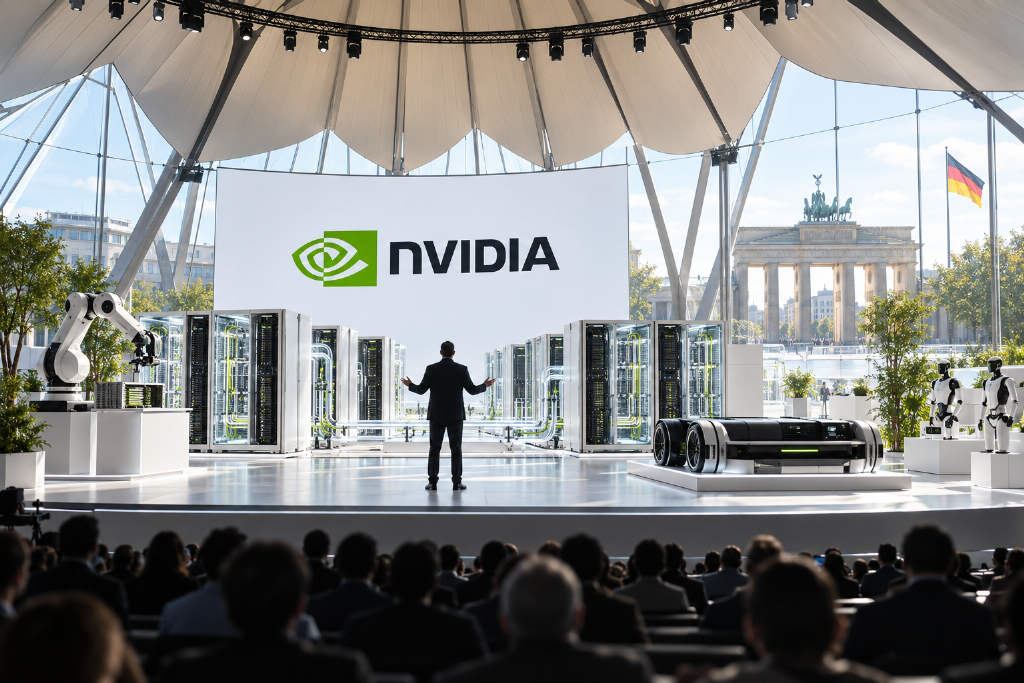
Nvidia CEO Jensen Huang said Europe should move from being an AI consumer to becoming an AI producer, using his GTC Berlin 2026 keynote to position AI factories as the next generation of infrastructure.
According to Nvidia’s official blog, Huang delivered the roughly two-hour speech on Oct. 21 at the Tempodrom in Berlin. He said AI is driving what he called the largest infrastructure buildout in human history, and described the industry as a five-layer cake made up of energy, compute, AI factories, models and applications.
Vera Rubin enters full production
Huang announced that Nvidia’s Vera Rubin platform has entered full production. He said the architecture uses 100% liquid cooling and links 72 GPUs in a single rack to form a supercomputer.
He also said performance is expected to improve another 30x over the next two years, a pace he said would exceed Moore’s Law.
DSX POD aims to speed AI factory deployment
Nvidia also introduced the DSX POD modular AI factory reference design. The system pre-integrates a full AI factory inside a container, cutting on-site deployment time from six months to 14 days.
Huang said the closed-loop liquid cooling design can reduce water use by nearly 100%, while lowering electricity consumption by as much as 30% for the same output.
He added that a 1 gigawatt AI factory costs about $50 billion to build, and that bringing it online three months late can mean billions of dollars in lost revenue.
Agent architecture and OpenShell
On AI agents, Huang laid out what he called five essential components: models, an orchestration shell, a sandbox, knowledge and tools.
Nvidia then introduced OpenShell, a security reference architecture built around that framework. Huang said it includes kernel-level sandboxing, least-privilege access and dynamic policy controls, calling it one of the most important things Nvidia has ever done.
Six open model families and sovereign intelligence
Huang also showcased six open model families across different domains:
- Nemotron for language
- Cosmos 3.5 for world models
- GR00T for humanoid robotics
- Alpamayo 2 Edge for autonomous driving
- Ising for quantum-classical computing
- Earth-2 for physical AI
He said enterprises should use their own data for post-training to build what he called sovereign intelligence.
Humanoid robots, autonomous driving and telecom
In physical AI, Nvidia introduced the Agile ONE SN humanoid robot reference machine. The system was developed with AgiBot, has 31 degrees of freedom, and is scheduled to launch in the first quarter of next year with computer hardware and software preinstalled.
For autonomous driving, Nvidia unveiled the Hyperion platform, which combines 14 cameras, 9 radars, 3 lidar units and dual GPUs. Volvo, Volkswagen, JLR and Mercedes-Benz will use it in their next-generation vehicles.
In telecom, T-Mobile and Nokia completed what Huang described as the first AI-driven commercial call in nearly eight years. On stage, he said, “Now CUDA can make phone calls.”
Google Cloud plans and the RTX Spark demo
Huang said Google Cloud will launch A5X instances powered by Vera Rubin NVL72 next month, with plans to deploy as many as 960,000 Rubin GPUs.
He also showed the RTX Spark laptop that Nvidia unveiled last week. The machine delivers 1 petaflops of compute and 128GB of memory, with a starting price of $2,399.
Huang compared it with the DGX-1 that he gave OpenAI in 2016. Both systems offer 1 petaflops and 128GB of memory, he said, but the DGX-1 required two people to carry. “The only difference is that now I can lift it with one hand,” he said.
The keynote also included a live demonstration with four “Microduck” robot ducks, showing how they were created on RTX Spark, trained in the cloud and taught skills through simulation.
European push and recent commitments
Huang closed by saying that every company in Europe will become an AI company, ending the event with Eurovision-style music.
The presentation followed a week-long tour of Paris, London, Stockholm and Dublin. During that trip, Huang pledged nearly $10 billion to Europe’s technology ecosystem and said Nvidia is working with more than 12,000 partners there.
In Berlin, he also held a discussion with German Chancellor Friedrich Merz at Kraftwerk on an industrial AI roadmap.
Other projects and commitments mentioned in the report included:
- A Swedish consortium including AstraZeneca, Ericsson, Saab and SEB is building the Sferical One supercomputer.
- The UK received a five-year donation of $250 million in compute resources for AI safety research.
- Siemens is investing 500 million euros in a digital twin center at its Erlangen factory, with a target of reducing manual engineering work in circuit board inspection by 85%.