
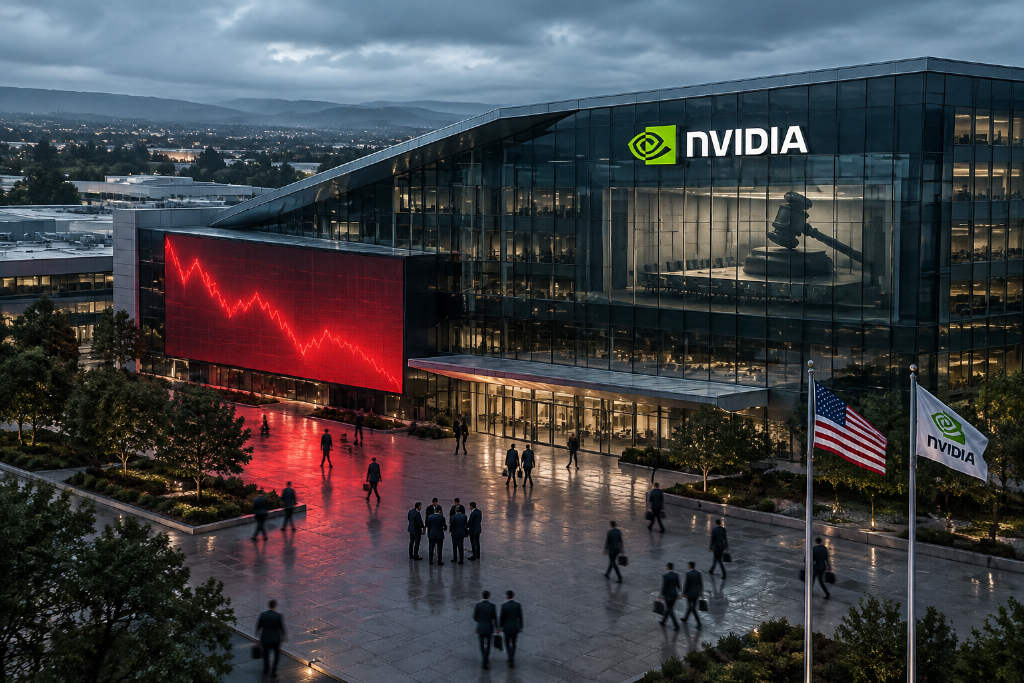
Nvidia CEO Jensen Huang has been forced to leave the company after acknowledging two extramarital affairs. Chief Financial Officer Colette Kress has been named interim CEO, while Harvey Jones will become Nvidia’s first board chairman. The company said it will consider both internal and external candidates for the permanent CEO position.
Nvidia shares quickly extended their decline to about 10% in U.S. pre-market trading after the announcement. The company said Huang’s contribution 「was enormous」. His sudden departure has left one of the world’s highest-valued companies facing a leadership vacuum and has raised fresh concern about the stability of the artificial intelligence industry.
Founder leaves after scandal
Huang was one of the three engineers who founded Nvidia in 1993. He was also the only person to serve as the company’s CEO since its creation. The immediate trigger for the crisis was his admission that he had been involved in two extramarital affairs. Public pressure then intensified, ultimately leading to his departure.
The depth of Nvidia’s crisis is tied in part to weaknesses in its own governance. The technology giant, whose market value once exceeded $5 trillion, had never established a clear succession plan. At 63, Huang had concentrated much of the company’s management around himself, creating a pronounced key-person dependency risk.
On the eve of Huang’s departure, Thomas Ferguson, an investor at Blue Bear Capital, said at the BNEF conference in Houston: 「As a student of economic history, I’m not sure there has ever been a single key figure who has carried so much of an entire industry on his own.」
Kress takes interim role as search continues
Kress joined Nvidia from Microsoft and Cisco 13 years ago and has spent her career in finance. She has represented Nvidia at Wall Street-related events, but her public role had largely focused on financial data. Huang had previously led much of the company’s communication with capital markets.
Investors remain cautious about whether Kress can fill the strategic and public-relations gap left by Huang. Nvidia said it would search inside and outside the company for a successor, but it has not disclosed a permanent choice. The uncertainty surrounding the transition itself is a direct test of investor confidence.
Huang’s reach across the AI economy
Huang’s influence extended well beyond Nvidia. Backed by the company’s financial strength, he provided funding support to frontier AI laboratories including OpenAI and Anthropic. Through investments and financing support, he also became deeply involved with cloud computing company CoreWeave. Those links helped form an AI industry ecosystem built around Nvidia as a central node.
The resilience of that ecosystem has faced questions in recent years. Bloomberg previously reported that prominent Wall Street investors, including Michael Burry, the figure associated with The Big Short, had warned that related circular trading arrangements were artificially inflating AI demand and carried bubble risks.
Since Nvidia went public in 1999, its share price has risen by more than 700,000%. The article said the wealth creation attributed to the company had reportedly surpassed the historical achievements of Steve Jobs at Apple, Bill Gates at Microsoft and Jeff Bezos at Amazon, considered separately. Huang, the central figure behind that extraordinary growth, has now left abruptly. The market is watching how Nvidia and the broader AI industry handle the vacancy.
The article was written by Shu Qing Bu of Wall Street News and published by ChainCatcher.



