
Huang’s departure becomes the market’s main risk variable
Nvidia’s board said Jensen Huang has resigned as the company’s president, chief executive officer and director, effective immediately. CFO Colette Kress will serve as interim CEO, and Harvey C. Jones will become Nvidia’s first board chairman. The company has begun selecting a permanent successor. Nvidia’s third-quarter FY2027 results remain scheduled for Nov. 17 after the market close.
The leadership change became the central pricing event for global risk assets. Traders began reassessing key-person risk at the AI chipmaker, along with the possibility of customer switching and a weaker Nvidia ecosystem.
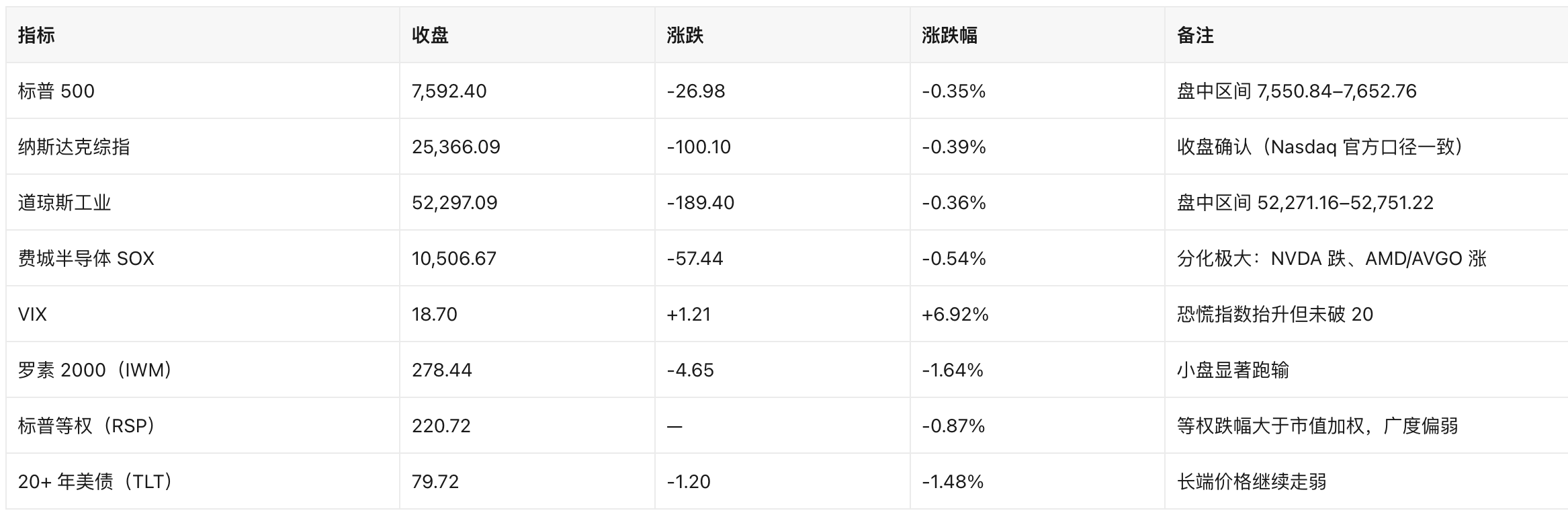
NVDA fell as much as 14.4% intraday. It opened at $151.005, 13.1% below the previous close of $173.73, touched a low of $148.80 and reached a high of $167.14. The stock closed at $166.19, down 4.34%, on volume of 747.7 million shares. The sharp rebound from the opening low showed that selling was concentrated at the start of the session, but the close did not indicate that investors had fully priced out governance risk.
AMD gained 5.86% and Broadcom (AVGO) rose 5.54%. The divergence reflected a market reassessment of second-tier AI chip suppliers and the possibility that customers could revisit their sourcing decisions.
Three issues now stand out: whether Kress can stabilize major customer orders and the GTC roadmap, how long the board’s search will take, and who will lead the Nov. 17 earnings call. Axios listed 11 possible candidates. Reports about the reasons for Huang’s departure and other personnel details have differed, and some claims remain unverified. The briefing relies on the company announcement and board appointments.
Limited index declines hide sharp internal moves
U.S. equities posted modest headline declines at the Nov. 12 close, but the internal rotation was substantial. Alphabet’s GOOGL rose 1.79%, Tesla gained 1.69% and Microsoft added 0.36%, partly offsetting weakness elsewhere. Equal-weighted indexes and small-cap shares were weaker, producing a session in which indexes looked relatively calm while individual stocks moved sharply.
October CPI, released on Nov. 10, rose 0.4% month over month, while core CPI increased 0.3%. Both readings exceeded expectations. Year-over-year figures were not released because of last year’s government shutdown. Reuters later reported that Federal Reserve officials had opened the door to a faster round of rate increases, while Goldman Sachs raised its expected rate path.
Initial jobless claims for October came in at 200,000, above the 194,000 estimate and the prior 191,000. Continuing claims were 1.697 million, against expectations of 1.710 million. Existing-home sales ran at an annualized 3.75 million units, down 5.5% from the prior month and weaker than the expected 3.5% decline. The previous reading was 3.97 million units. A 7.21% 30-year mortgage rate continued to weigh on transactions.
Williams said after the Nov. 12 session that inflation was “stubbornly high” and that monetary policy still had work to do. Barr, Goolsbee, Daly and Schmid also spoke that day. Kalshi pricing put the probability of a 25-basis-point hike in December at 87%, up from an 84% level cited earlier by BeInCrypto.
Weak long-term Treasury demand keeps yields elevated
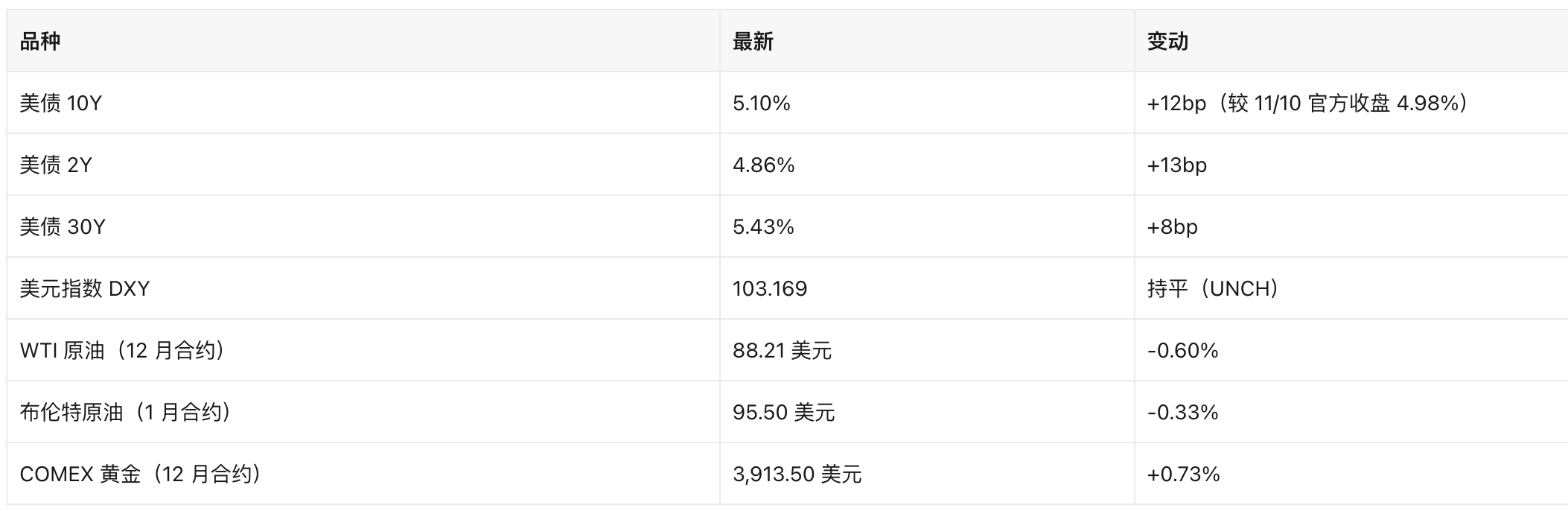
The 30-year Treasury auction cleared at a 5.441% yield and showed a tail, pointing to weak demand. It was the second poor long-end auction of the week. The official close put the 10-year yield at 5.10%, up 12 basis points from 4.98% on Nov. 10. The 30-year yield stood at 5.43%, up 8 basis points, and the two-year yield reached 4.86%, up 13 basis points.
The dollar index was little changed, making the session primarily a rate-driven move rather than a dollar-driven one. Gold rose, reflecting both real-rate conditions and a geopolitical risk premium. The briefing’s transmission chain was higher-than-expected CPI, an 87% December hike probability, weak long-end auction demand and a 10-year yield above 5.10%. That combination raised discount rates for high-valuation growth stocks. NVDA, ASML and Taiwan Semiconductor Manufacturing (TSM) fell 4.34%, 2.43% and 1.90%, respectively.
AI chips, cloud compute and energy stocks diverge
AMD closed at $585.30, up 5.86%, while Broadcom closed at $364.36, up 5.54%. The Philadelphia Semiconductor Index fell 0.54% and SMH dropped 1.03%, showing that the sector did not rise as a whole. Capital was rotating within AI hardware rather than adding to the sector’s total exposure. TSM declined 1.90% and ASML fell 2.43%, reflecting caution over possible changes in customer strategy.
AI cloud provider Nebius (NBIS) closed at $128.64, down 16.84%. CoreWeave (CRWV) fell 6.86% to $56.60. Nebius lowered its 2026 revenue guidance because of delayed capacity deliveries and raised its 2026 capital-expenditure outlook. Reports from the Wall Street Journal, CNBC and Bloomberg pointed to concern over a combination of roughly $45 billion in AI investment and higher financing costs. CoreWeave’s decline suggested that the pressure extended beyond one company.
Cerebras (CBRS) closed at $97.75, down 3.29%, before rising 18.34% after hours to $115.68. The company reported quarterly revenue above expectations and announced a partnership with Microsoft, according to CNBC on Nov. 13. Cerebras has fallen sharply from its post-listing high of $386.34, leaving the stock with substantial valuation sensitivity.
Energy and AI power names moved higher. Exxon Mobil (XOM) rose 1.84%, Chevron (CVX) gained 1.44% and XLE added 1.51%. Constellation Energy (CEG) rose 2.79%, while Vertiv (VRT) gained 1.52%. Brent crude was at $95.50. Nuclear power, liquid cooling and power-supply names continued to attract capital, indicating that the AI capital-expenditure theme had not disappeared but was being redistributed across the supply chain.

Microsoft closed at $523.00, up 0.36%, despite a widespread outage affecting 365 services during the session. Cisco (CSCO) rose 1.24% to $102.01 after saying after hours that its AI infrastructure revenue would double in the fiscal year; the stock fell 0.50% after hours. Applied Materials (AMAT) fell 3.58% to $380.95 before rising 0.69% after hours. Nu Holdings (NU) declined 3.98% to $11.83 and rebounded 3.14% after hours.
MSCI removes Strategy as passive-fund pressure builds
Under a new non-operating-company rule, MSCI will remove Strategy from its global investable market indexes on Nov. 30. Strategy holds 850,364 BTC. Reuters, the Wall Street Journal and investingLive said the review covered 25 securities. JPMorgan estimated that the change could force $2.8 billion of passive selling in MSTR. That figure was a sell-side estimate cited by 24/7 Wall St., not an official MSCI number. Investors are also watching whether the Nasdaq 100 will take a similar step, although no such action had occurred at the time of the briefing.
Strategy’s latest purchase came on Nov. 9, when it acquired 1,036 BTC for $81.9 million, an implied average price of $79,054 per coin. The company’s total holdings stood at 850,364 BTC. At Kraken’s latest price of $70,174, the holdings were worth about $59.67 billion.
Nasdaq disclosed a market value of $48.32 billion based on a prior close of $122.35. That implies about 394.9 million shares. Applying the Nov. 12 closing price of $114.41 produces an ordinary-equity value of about $45.19 billion, below the value of the BTC holdings. The simple ratio of ordinary-equity value to BTC value was 0.76, indicating a discount. The calculation excludes debt and preferred stock and is not a standard mNAV measure.
Bitcoin Magazine said on Nov. 9 that Strategy’s average BTC purchase price had been breached. The former cycle of issuing stock at a premium, buying BTC and increasing BTC per share can operate in reverse when the stock trades at a discount; issuing shares to buy more BTC can dilute holders. This is part of the backdrop to MSCI’s rule change.
The review of major overseas sources covering Nov. 11 and Nov. 12 found no U.S.-listed company that announced its first purchase of BTC or ETH as a reserve asset, or announced a restructuring, name change or conversion into a crypto DAT that day. The watchlist therefore had no new additions. CoinDesk reported in July that several bitcoin treasury companies had begun reducing holdings. As BTC fell from $74,000 to $70,174, discounted DAT companies also lacked the momentum to issue more stock.
Crypto-linked equities and spot ETF flows
U.S. spot bitcoin ETFs posted a fifth consecutive trading day of net outflows, totaling $1.44 billion. BlackRock’s IBIT recorded net outflows for nine straight sessions, totaling $2 billion. Decrypt, CoinDesk and Bitcoin Magazine reported the figures on Nov. 12, with data through Nov. 11. IBIT closed at $40.36, down 4.45%, and Fidelity’s FBTC closed at $62.03, down 4.39%.
Strategy fell 6.49%, underperforming BTC’s 24-hour decline of 5.60%, indicating that the MSCI event received a separate valuation. Coinbase (COIN) fell 4.11% and Robinhood (HOOD) declined 3.82%, both outperforming BTC and showing no panic discount in exchange stocks. Cipher Mining (CIFR) rose 0.56%, the only crypto-linked name to gain on the day. Its transition from mining to AI data centers is changing the stock’s valuation anchor.

Traditional financial infrastructure continued to move toward tokenization. DTCC said it plans to bring tokenized securities to Solana in the second half of 2027. Visa added Western Union’s USDPT stablecoin to its settlement network through a partnership with Anchorage. Securitize and Ethena launched a $100 million BlackRock BUIDL liquidity tool.
Regulation, enforcement and index rules
Trump nominated four SEC and CFTC commissioner candidates, including Democrats, the first such set of nominations in roughly a year. Bloomberg and CoinDesk reported on Nov. 12 that full commissions could help advance crypto market-structure legislation and rulemaking.
The U.S. Department of Justice is seeking the forfeiture of $1.2 billion in the Binance theft case and disclosed a plan targeting North Korea-linked deepfakes. The New York Department of Financial Services issued new advertising standards for crypto companies. Louisiana sued prediction-market platforms including Kalshi and Robinhood.
The briefing described the MSCI non-operating-company rule as the day’s most important institutional development. Fair-value accounting had made corporate crypto holdings measurable; the index change could weaken passive-fund support for a model based on raising capital at a premium to buy crypto assets.
Crypto-market backdrop and geopolitics
Prices were sourced from Kraken as of 11:05 a.m. Beijing time on Nov. 13, with 24-hour moves calculated from hourly data at the same time. The briefing identified four sources of pressure: Nvidia’s governance shock and the resulting deleveraging in risk assets; five straight days of spot bitcoin ETF outflows totaling $1.44 billion; an 87% December hike probability and higher real rates; and MSCI’s removal of Strategy, which weakens structural demand for DAT premiums. CoinDesk said the bitcoin decline had erased the bullish technical signal from September, while The Block called it a 12-week low.
The Strait of Hormuz remained closed. Al Jazeera reported on Nov. 11 that Iran denied contact with the United States and said the strait would remain closed until its demands were met. Reuters reported on Nov. 12 that an attack on Saudi energy facilities helped lift international oil prices by $3 in the Nov. 11 settlement. Trump said on Nov. 12, “We don’t need to make a deal with Iran,” after which oil prices rebounded, according to the Wall Street Journal. CNBC said on Nov. 13 that oil could still post a second straight weekly decline as markets expected the United States to maintain a “blockade but no escalation” stance.
Brent crude was at $95.50 and WTI at $88.21, creating a $7.29 spread that reflected shipping and regional premiums. The combination of a closed strait, higher oil prices and stronger energy stocks appeared alongside rising inflation expectations, a firmer rate stance and pressure on long-duration growth stocks and crypto assets. XLE gained 1.51%. The briefing said a prolonged closure could produce a second inflation wave and force faster Fed hikes, while a negotiating breakthrough could lower oil and inflation expectations. The direction depends on political developments.

Other geopolitical signals included China’s goods-trade surplus exceeding $1 trillion for a second consecutive year, rising external rebalancing pressure and continued tariff risk. The U.K. economy grew 0.7% quarter over quarter in the third quarter, with AI-related investment contributing to the increase. The Bank of England had raised rates in November and warned that inflation could approach 5%. U.S. midterm election results were set, but polling showed rising voter dissatisfaction with the economy and living costs. U.S. officials also named North Korea-linked hacking and deepfake plans, keeping pressure on exchange compliance.
What to watch over the next 24 hours
U.S. October PPI is due at 21:30 Beijing time. The market expects a 0.4% month-over-month increase and a 6.6% year-over-year increase, up from 6.3% previously. Core year-over-year PPI is expected at 5.0%. Some institutions expect the largest annual increase since 2022. The report will offer a second test, after CPI, of whether a December rate hike is necessary.
Federal Reserve speakers are scheduled as follows: Collins at 22:10, Logan at 22:40, Bowman at 23:50, Daly at 1:00 the following day and Jefferson at 8:00. Any language supporting a December hike could reinforce current pricing. Baker Hughes rig-count data is due at 2:00 the following day, with a previous reading of 463 rigs.
Nvidia’s third-quarter FY2027 results are confirmed for after the close on Nov. 17, with interim CEO Kress scheduled to lead the call. Home Depot (HD) reports before the open on Nov. 17; Target (TGT) and Lowe’s (LOW) report before the open on Nov. 18; and Walmart (WMT) reports before the open on Nov. 19. The New York Fed manufacturing index and a speech by Fed Chair Warsh are scheduled for Nov. 16.
Nov. 30 is MSCI’s effective date. Passive rebalancing could keep pressure on MSTR through month-end, making volume and the discount important indicators. Data on Nov. 12 spot BTC ETF flows is due later in the day; a sixth consecutive net outflow would provide more evidence that passive buying is absent. Investors are also watching for a DAT company to halt issuance because of a discount or announce buybacks or sales, which the briefing identifies as a confirmation of a reversal in the former flywheel.
The listed risks are an upside PPI surprise that pushes the December hike probability above 87% and drives another valuation reset in growth stocks and crypto; negative governance news during Nvidia’s succession process that sends NVDA back toward $148.80 and weighs on AI; an escalation in the Strait of Hormuz involving shipping attacks that lifts oil and inflation expectations; and an MSCI-related liquidity shock in MSTR that could reach spot BTC through forced selling.
Index, stock, ETF, futures, yield and DXY data came from Msx market data. Treasury yields came from the U.S. Treasury’s daily yield curve. Crypto prices came from Msx market data, and market capitalization and earnings calendars came from Nasdaq. The material is an information summary and analysis, not investment advice.



