
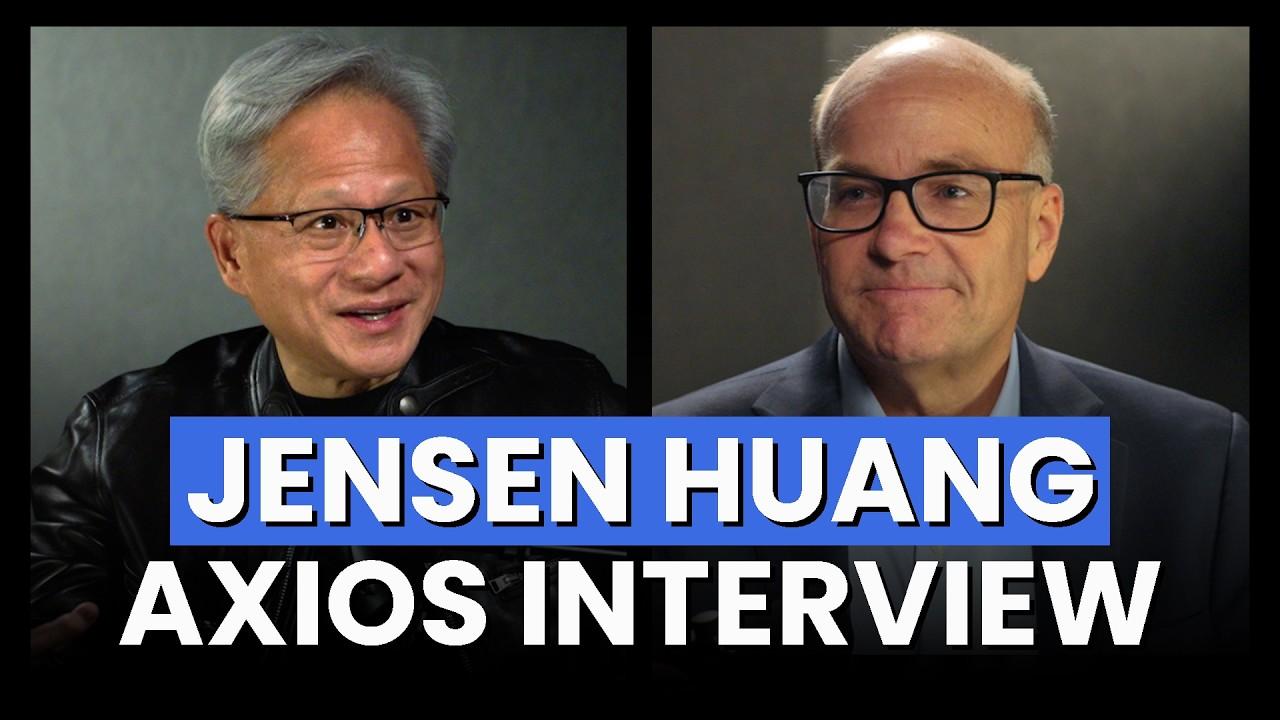
Jensen Huang said the semiconductor industry will need to grow by 5x to 10x over the next decade and argued that Wall Street has misunderstood what Chinese AI models mean for demand, according to a TechFlow write-up of his appearance on Axios Behind the Curtain.
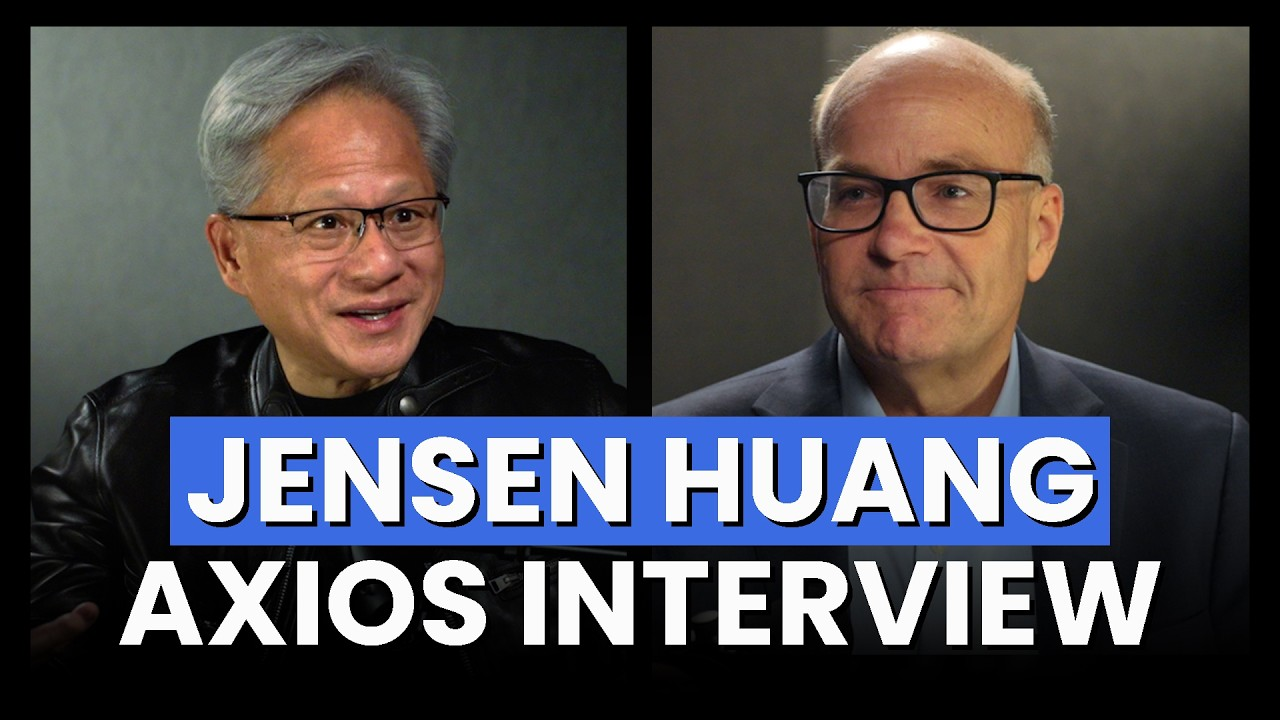
The 70-minute interview was recorded at NVIDIA’s factory in Fort Worth, Texas. Huang, NVIDIA’s co-founder and CEO, also said China has more AI researchers than the rest of the world combined, called the country’s rise in AI inevitable, rejected AI extinction claims as “nonsense,” and said NVIDIA’s sales in China are currently “approximately zero.”
Huang says Wall Street got China AI wrong
Host Mike Allen opened with one of the most sensitive topics in the interview. He referenced a Financial Times report that China is considering tighter export controls on AI models and semiconductors. He also noted that NVIDIA shares fell sharply after the release of the Chinese model Kimi, while chip stocks were down 18% over a month.
Huang said the market had already made the same mistake with DeepSeek and is now repeating it. In his view, stronger models lead to more usage, and more usage means more NVIDIA computers sold, more data centers built, and more services delivered across industries.
“The market misunderstood DeepSeek’s impact and misunderstood Kimi,” Huang said. “Great models lead to more usage, and more usage means selling more Nvidia computers and building more data centers. The starting point is: good models lead to good applications, and good applications lead to growth.”
Asked whether Chinese models such as Kimi should be banned, Huang said they should be used. He said that after downloading a model, users can fine-tune it, improve it, and add guardrails. He described models as running inside a harness, with that harness inside a sandbox that includes privacy protection, security controls, and access controls.
He compared open AI models to Linux. In Huang’s telling, Linux is trusted because millions of people around the world review it, test it, and harden it. He said open AI models follow the same logic.
Huang also pushed back on the idea that open and closed models are in direct conflict. He said the people most likely to upgrade to services from companies such as Anthropic or OpenAI are those already using AI. Free models lower the barrier to trying AI, and once users see value, they are more likely to pay for stronger systems.
On NVIDIA’s China business, Huang gave a striking answer: “We’re approximately zero” in sales there today. He said he has already told investors not to expect revenue from China. If China’s government and market welcome NVIDIA back, he said, that would be “a great honor.” Until then, he said, investors should think of that revenue as zero.
He calls AI doomsday warnings “nonsense”
The sharpest exchange in the interview came when the discussion turned to AI risk. Huang said warning people is acceptable, and warning them with solutions is better, but inventing facts is not.
He then directly rejected several common claims. “To say AI is going to destroy humanity is nonsense. To say AI is going to eliminate half of all American jobs is nonsense. All the facts and all the evidence point in the opposite direction,” he said.
To back that up, Huang cited several figures in the conversation. He said the number of radiologists has increased by about 20%, legal assistants by about 10%, and manufacturing jobs by about 50% in recent years. His explanation was that AI automates part of the work, lets professionals handle more demand, and ends up creating more jobs rather than fewer.
He argued that common sense points in the same direction: higher productivity creates opportunity. Looking across history, Huang said, technology has made society more efficient and has created more jobs, not fewer.
He also took aim at some AI leaders for spending too much time on science-fiction outcomes. When asked whether he meant CEOs at major AI companies, he did not deny it. Instead, he said that if the goal was to make the world aware of the technology’s extraordinary capabilities, that had already been achieved, and the focus now should be on making AI safe.
On the contrast between Asia and the U.S., Huang said people in Asia tend to embrace AI as a tool and an opportunity. In the U.S., by comparison, public debate often frames it as a threat.
Why he thinks a bubble is not imminent
Huang did not say a bubble will never form. He said it will happen one day, but not now. He placed the lower end of that risk horizon at more than five years, saying a bubble is unlikely within five years and harder to judge in the five-to-10-year range.
His reasoning was centered on supply constraints. He said the industry is limited by shortages of chips, memory, land, electricity, and even construction workers. In his view, those bottlenecks are slowing the translation of strong demand into deployed productive supercomputing capacity.
“The semiconductor industry needs to grow 5x to 10x,” Huang said. “Everything is in shortage today — chips, memory, land, power, construction workers. That shortage is actually good because it gives us time to build infrastructure.”
He argued that this cycle differs from older semiconductor booms because it is not seasonal, not consumer-led, and not driven by ordinary demand patterns. He described AI as a new layer of industrial infrastructure, built on top of existing infrastructure in the same way societies rely on energy, the internet, roads, and railways.
Asked whether he worries about customers taking on debt to buy NVIDIA systems, Huang said he is not very concerned because these are “extraordinary companies” that generate substantial cash. He also said the AI monetization flywheel has already started turning, especially in coding agents, which he described as highly valuable because they can perform useful work in high-paid roles. He said many companies are willing to spend hundreds of millions of dollars a year to improve their coding capabilities.
Token economics, capital intensity, and AI infrastructure
One of the more technical parts of the conversation focused on token economics. Huang described a token as an embedding of knowledge and intelligence. Unlike a fixed mathematical value, he said, the intelligence encoded in tokens can get smarter over time.
That matters because smarter intelligence is more useful, and greater usefulness makes it more valuable. If it becomes more valuable, people will pay more for it. That was Huang’s basic argument for why tokens can become more profitable over time.
He contrasted the AI era with the older software industry. Traditional software was relatively light on capital and could sustain high gross margins. AI software, he said, will be far more capital-intensive because generating modern intelligence requires machines like the supercomputers sitting in front of him. In his framing, every industry becomes more capital-intensive in the AI era, but the payoff comes in intelligence, productivity, and growth.
Huang called the current buildout “the largest industrial infrastructure buildout in human history.” He dismissed the idea that AI has already peaked, saying the technology is only beginning to spread through society and industry. He also pointed to $300 billion invested in venture capital and startups in the U.S. over the past six months.
Trump, regulation, and government ownership
Huang’s comments on Donald Trump were unusually specific. He said Trump is smart, remembers everything, and has a strong command of numbers. Huang said Trump is the only president he has met who can remember NVIDIA product names such as H20, H200, and Blackwell, and who also knows the next-generation platform is called Rubin.
He said their first meeting centered on restoring U.S. manufacturing capacity, reindustrializing the country, building secure and resilient supply chains, and bringing semiconductor production back to the U.S. Huang said the Fort Worth factory where the interview took place was a direct result of that conversation.
When asked what kind of mistake the government should avoid, Huang said he worries about overregulation and overcorrection. He said some companies want the government to shape rules in their favor, but his own view is that competition should stay open.
He also rejected the idea that AI competition is like a 100-meter sprint in which the first company to finish wins forever. Huang called that idea “nonsense.” In his view, long-term success depends on whether society adopts the technology, not on who invented it first.
Allen also asked how Huang would respond if Trump called and asked for an ownership stake in NVIDIA. Huang said there was no need. He argued that the U.S. already has an economic stake through taxes, jobs, and broad participation in the stock market. He said NVIDIA paid $10 billion in taxes last year and will pay more this year.
On Anthropic’s Mythos model, which Allen said is currently available only to certain institutions, Huang said it should be opened to everyone. He said making the technology safe is Anthropic’s responsibility, just as software companies are expected to fix vulnerabilities quickly. Referring to a reported jailbreak incident involving Mythos, Huang said, “Everything was fine. You and I are still here talking.”
Asked about open-model companies distilling closed models and reselling services built on them, Huang said the answer depends on the terms of service. If a provider is unhappy, he said, it should contact the company involved, and traditional legal tools are available. At the same time, he argued that learning from other sources is fundamental to intelligence itself.
Robotics, ChatGPT moments, and a trillion-agent future
When Allen asked when robotics will have its own ChatGPT moment, Huang said that moment has already arrived. He then qualified the point: the arrival of ChatGPT in 2022 was a moment of surprise and fascination, but it took years before the technology became broadly useful. He said robotics is now at that earlier stage of surprise.
As an example, Huang said a robot can already be told to put an apple in a drawer and infer the full sequence of actions needed to complete the task, including opening the drawer first. Seeing a physical robot do that, he said, changes how people imagine the future of robotics.
He said he would not be surprised if robots become genuinely useful in three to four years.
Huang was even more expansive when talking about AI agents. He said there are about 1 billion people using computers today, but those machines sit idle much of the time. In the future, he said, each person will be supported by many agents that use computers around the clock.
“We’ll have 100 billion, trillions of agents running 24/7,” Huang said. “Intelligent agents, not-so-intelligent agents, specialized agents, super agents — all kinds of agents running all the time. So the number of computers we need will increase dramatically.”
On being a CEO, pain, and life without a watch
The interview closed on Huang himself. Allen noted that Huang founded NVIDIA at age 30 and now runs a company valued at $5 trillion with 50,000 employees. Huang said the workforce might only reach 75,000 in 10 years because he wants the company to stay “as small as possible.”
He defined the CEO’s job as strategy: using limited resources as efficiently as possible to realize a future vision. Huang said he has been doing this work since age 30 and described it as his craft.
On the idea that pain and adversity are central to greatness, Huang said it is less about one defining incident and more about a continuous condition. He compared it to elite athletes practicing when no one is watching, failing repeatedly, and building resilience through repetition. That process, he said, sharpens skill, shapes character, and creates confidence under pressure.
Asked what he would tell his 9-year-old self arriving in the U.S., Huang gave an emphatic answer: “America is the greatest country in the world, period.” He added that the country was built by immigrants and will continue to need extraordinary immigrants in the future.
Allen also asked about Huang’s habit of not wearing a watch. Huang said he does that because the present moment is the most important time. He does not want schedules or a watch to manage his life. If he is late, he said, someone will tell him. Until then, he wants to be fully present.
Conflict disclosure and source caveats in the TechFlow notes
TechFlow included a disclosure section in its write-up. It said Huang holds about 3.5% of NVIDIA, or roughly 860 million shares, and that his personal wealth was about $181 billion based on Bloomberg data from June 2026. TechFlow noted that the interview topics — AI industry expansion, rising chip demand, and lighter regulation — are directly tied to Huang’s financial interests.
The notes also added a caveat on Huang’s statement that China sales are “approximately zero.” They said export controls have reduced NVIDIA’s high-end chip sales in China to a very low level, but that “zero” is Huang’s phrasing and the actual figure should be verified against public filings.
TechFlow made the same point about Huang’s employment figures. The reported increases of 20% for radiologists, 10% for legal assistants, and 50% for manufacturing jobs were presented as Huang’s spoken claims in the interview, with no source cited during the conversation.