
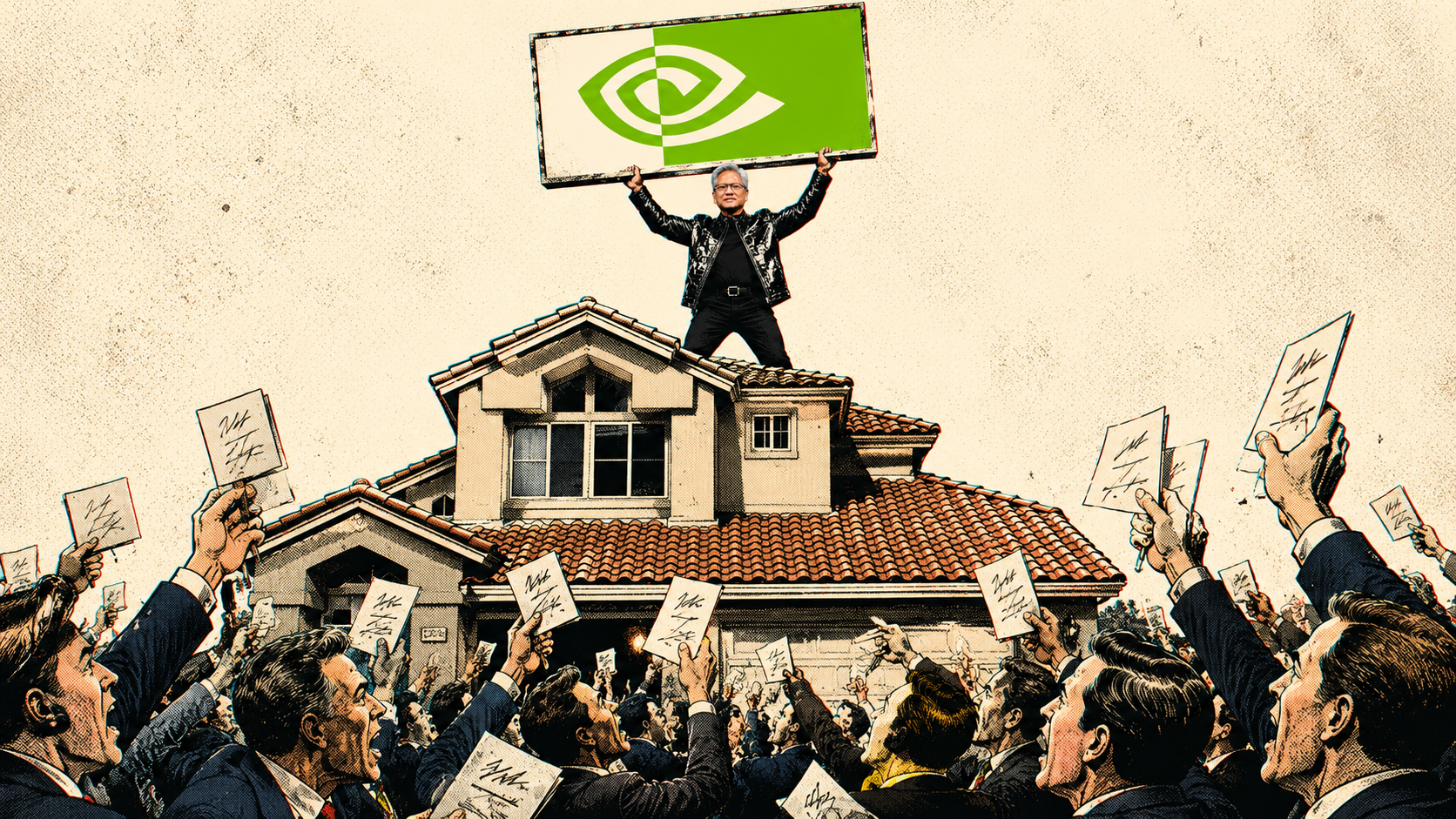
NVIDIA CEO Jensen Huang said earlier this week that he had persuaded six major financial institutions — Apollo, BlackRock, Blackstone, Brookfield, Goldman Sachs, and KKR — to raise more than $500 billion so NVIDIA customers can keep buying the company’s chips.

The financing pitch turns on Huang’s view that GPUs should be treated as an investable asset class. As cited in the source article, his argument is that GPUs share several traits associated with financeable assets: they can generate substantial revenue, they serve a broad customer base, and their depreciation cycle can last more than 10 years. On that basis, they can, at least in theory, be used as collateral for borrowing.
Why more than $500 billion is being raised
The article’s answer is straightforward: building out AI infrastructure has become so expensive that even companies with enormous cash resources cannot easily fund the expansion on their own. It says hyperscalers have already committed a record $2.6 trillion for future spending on data centers, chips, and power. Google alone, the piece says, has roughly $900 billion in bills to cover.
That spending reflects a belief that AI will produce more revenue down the road. Companies such as Microsoft, Google, and Amazon are paying now to lock in the compute capacity and GPU supply they expect to need later. Once internal capital is no longer enough to keep pace, Wall Street becomes a funding source. The article argues that Huang is not raising $500 billion because conditions are deteriorating, but because spending has outgrown what companies can comfortably finance themselves.
Why the structure draws 2008 comparisons
The source breaks the arrangement into several steps. First, take an asset — in this case GPUs. Bundle those assets. Borrow against them. Slice the debt into layers with different risk profiles. Then sell those pieces to investors looking for yield.
That, the article notes, bears a clear structural resemblance to the way Wall Street handled mortgage-backed products before the 2008 financial crisis: turn difficult-to-value assets into financial products, add leverage, and distribute the risk across holders.
Still, the piece adds an important qualifier. The financing Huang is pursuing depends on NVIDIA customers meeting a long list of conditions. Lenders are not simply handing over $500 billion. They want to see that customers have the means to repay and that those customers are actually making money from the GPUs they use. Huang is also offering guarantees of up to 25% to the lenders, according to the article.

Demand data points in a different direction
The article argues that similarity in structure does not automatically mean similarity in outcome. In 2008, the collapse came after the system was built on the assumption that housing prices would never fall. That assumption failed.
For AI, the demand picture presented in the piece looks very different. GPU rental prices have climbed about 40% since October because capacity keeps getting absorbed, and the latest chips are already sold out for next year, it says.
The article also points to revenue growth. It says Anthropic’s revenue rose from about $10 billion to $47 billion in one year, with talk that it could reach $100 billion by the end of 2026. NVIDIA, meanwhile, has quarterly revenue guidance of roughly $91 billion. The piece adds that major cloud providers’ earnings reports also show strong top-line growth.
What the market needs to watch
The article does not say a repeat of 2008 is inevitable. Instead, it narrows the risk to a few variables: whether AI chips keep their value, whether they continue to generate income, and whether the financing terms become too restrictive.
Its bottom line is narrower than the headline comparison. A 2008-style break would require demand to disappear. For now, based on the figures cited in the piece, the data is still moving the other way.