
Written by Xiaobing, DeepFlow Tech
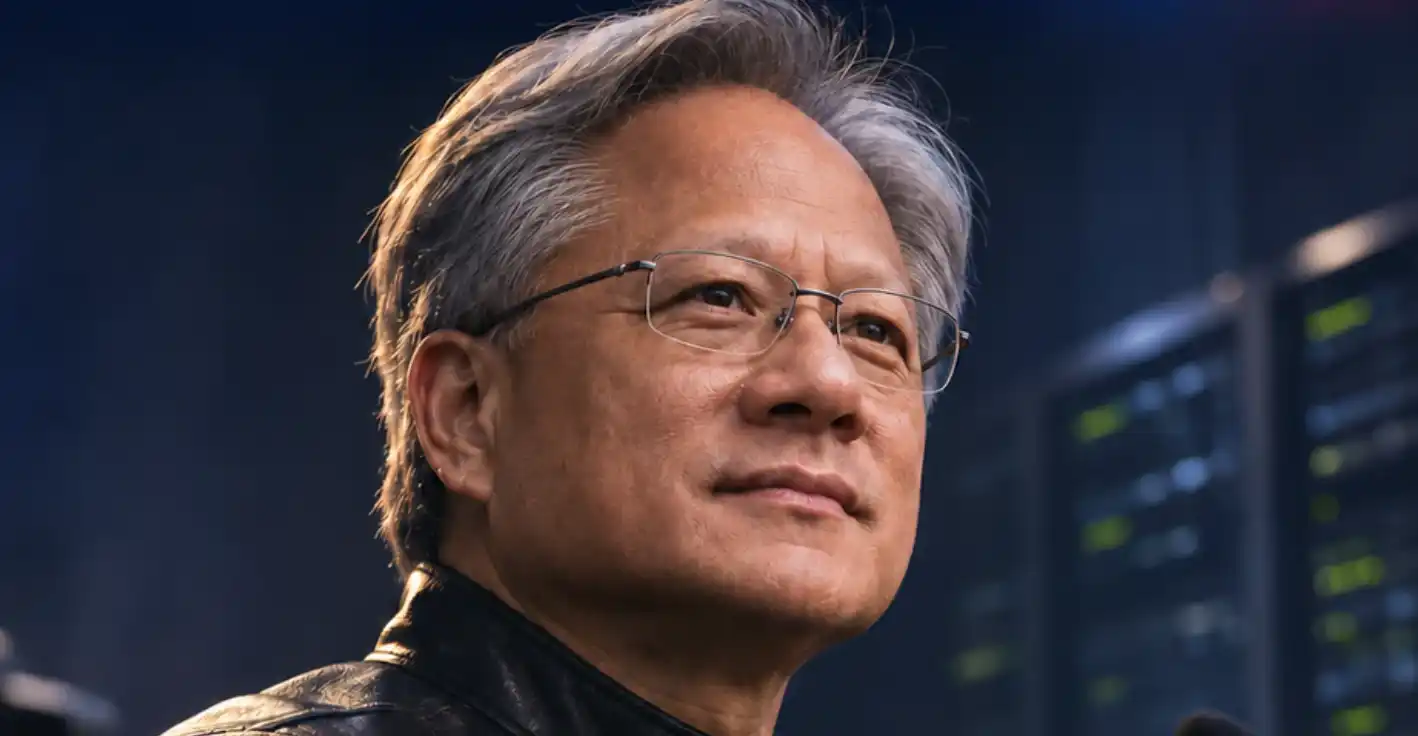
When Jensen Huang was nine, he had to cross a suspension bridge on his way to school every day.
Wooden planks were missing from the bridge, and deep water ran below it. Boys waited for him on the other side. Some shook the bridge hard. Others called him by slurs. He was small, spoke poor English and was one of the few Asian faces at school. There was no counselor and nobody to explain what anti-bullying meant. Each day, the only thing he could do was cross.
In 1973, Huang and his brother were sent to the Oneida Baptist Institute in eastern Kentucky. His uncle thought it was an elite boarding school. It was actually a religious reform school for so-called problem children. Students smoked, carried knives and showed little interest in studying. Huang was called “Chink” by classmates and was assigned to clean the boys’ dormitory bathrooms every day.
His roommate was 17 and could not read. On the first night, the roommate lifted his shirt and showed Huang the knife wounds he had received in fights. Huang later taught him to read, while the roommate taught Huang how to bench-press. At 14, Huang appeared in Sports Illustrated after his table-tennis performance drew attention.
A nine-year-old Chinese immigrant learned to survive in an unfamiliar, rough and sometimes dangerous environment. He did not retreat.
From Scrutiny to a Campaign Against an Ethnic Group
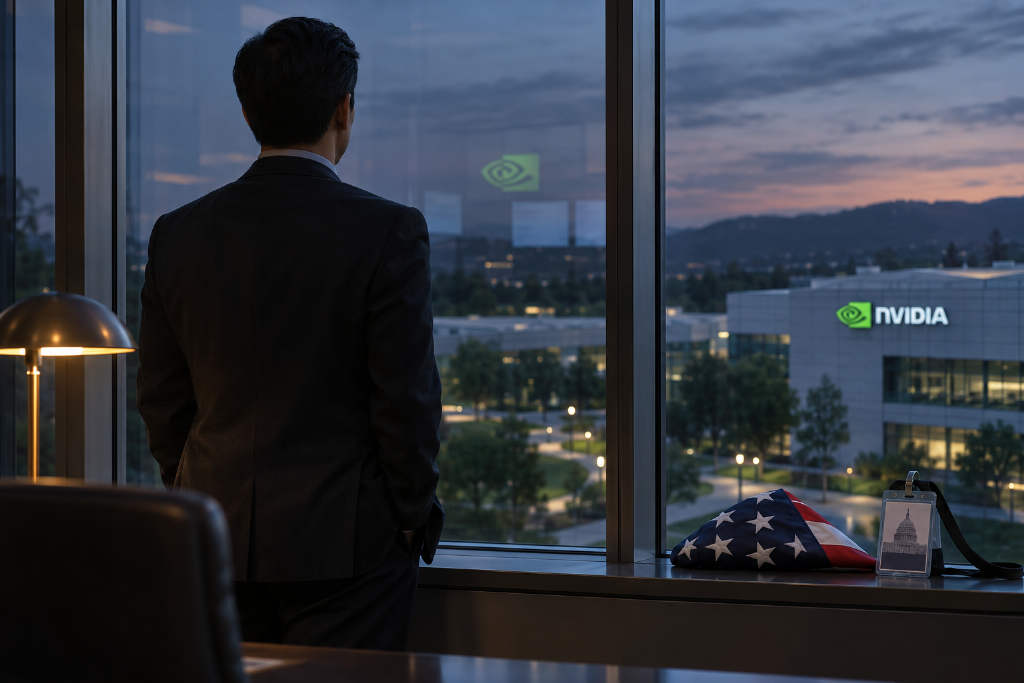
More than five decades later, Huang found himself on another unsteady bridge. This time, the abyss below mixed private morality, corporate power, national security, geopolitics and ethnic prejudice.
In an internal letter sent to employees on Nov. 8, 2026, Huang acknowledged that he had been unfaithful to his wife. “There is no excuse,” he wrote.
The matter also touched national security. The New York Times had previously reported that Huang was close to Alice Huang, a former executive at Singapore data-center company Megaspeed. Between June 2024 and February 2026, a Malaysian affiliate of Megaspeed purchased more than $4.8 billion worth of equipment containing Nvidia chips. The case had been transferred from the Commerce Department to the Justice Department.
Nvidia’s board opened an independent investigation. Three House committee chairs asked Huang to attend a closed briefing on Nov. 18. The FBI became involved. Shareholders filed a lawsuit. Nvidia shares fell as much as 8% after the market opened on Nov. 9, briefly erasing more than $300 billion in market value.
Those questions are legitimate. Marital misconduct, disclosure, conflicts of interest and possible export-control violations can all be investigated, and should be.
But the distance between scrutiny and a public hunt can be no more than a headline.
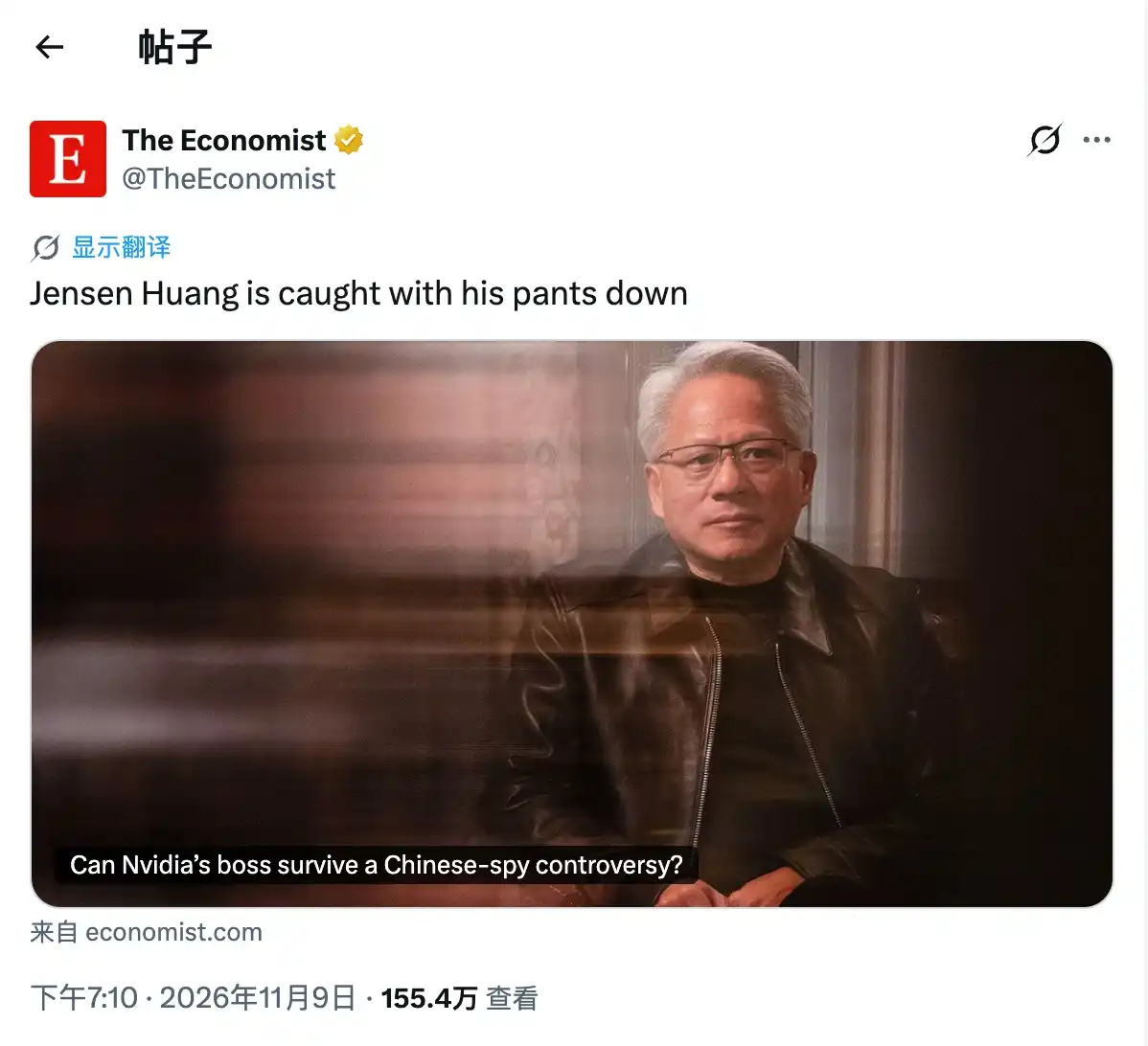
In its coverage, The Economist used the headline “Jensen Huang is caught with his pants down.” Its subheading read “Two Huangs don't make a right,” turning Huang and Alice Huang’s shared surname into a pun on the English expression “Two wrongs don't make a right.”
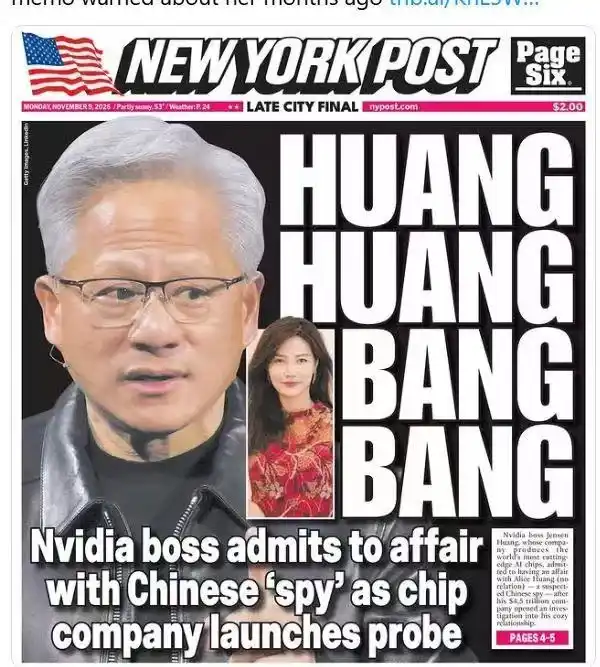
The New York Post was more direct. Its front page carried the large headline “HUANG HUANG BANG BANG,” combining a sexual insinuation with the sound of gunfire.

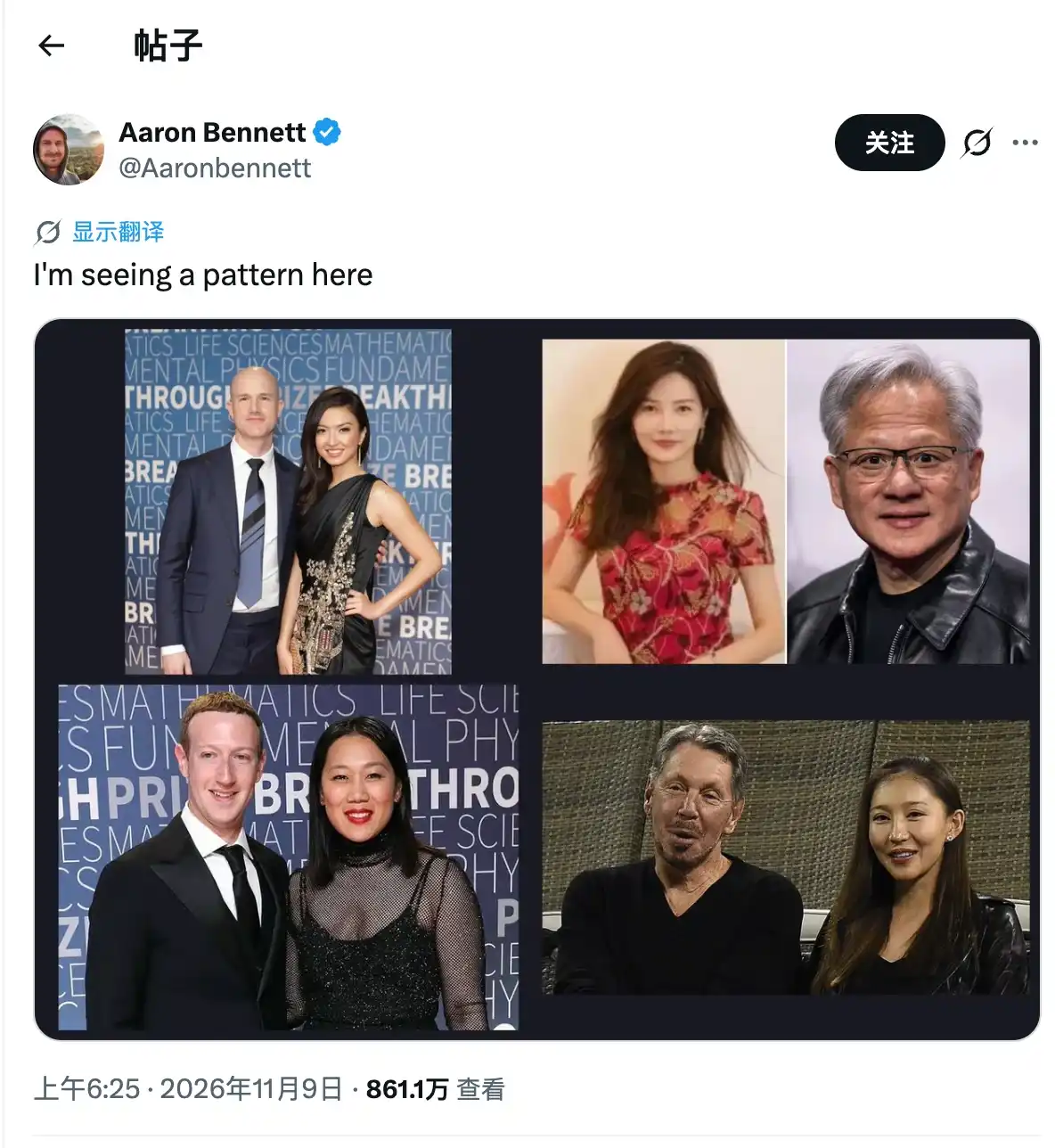
Social media went further. One widely circulated post placed photographs of Mark Zuckerberg with Priscilla Chan, Brian Armstrong with Angela Meng and Larry Ellison with Jolin Zhu side by side. Its caption read: “I'm seeing a pattern here.”
The partners of these technology executives are Asian women, but none of them has been linked to an intelligence allegation. Another post created a flowchart titled “How To Tell If Your GF Is A Spy,” using questions such as “Is she Asian?” and “Does she work in tech?” as decision points. It paired photographs of Asian women with the caption “How your Chinese gf looks at you before asking for state secrets.”
Within hours, one person’s scandal had been diluted into a collective examination of Asian women.
On Nov. 11, the Asian American Journalists Association, or AAJA, issued a public statement naming The Economist and the New York Post. The statement said that turning Asian surnames into wordplay and jokes could “reinforce harmful associations between identity and suspicion, misconduct and divided loyalties.” AAJA said it would contact the editorial leaders of both publications to discuss the language.
At the end of his apology letter, Huang wrote that he loved the United States, supported U.S. national security and was proud to be an American. He came to the United States at nine and had lived there for more than half a century. He founded one of America’s most important technology companies and placed his life’s work in the U.S. innovation system. He also personally led Nvidia to become the first company in human history to reach a $5 trillion market value. At 63, he still found himself having to publicly restate his loyalty.
Huang can be criticized. That does not turn every Huang into a joke or every Asian woman into a suspect.
The China Hawks’ Patience and Long Memory
The scandal was not simply a moral controversy unfolding on its own. It also released political energy that had been building for some time.
Semafor used the headline “Revenge of the China hawks: Jensen Huang's enemies take a victory lap” in a Nov. 11 report.
The timeline is clear.
On Sept. 25, 2025, comments Huang made on the Bg2 podcast angered Washington’s China hawks. He said China was “just nanoseconds behind” the United States in chip technology. He said the label “China hawk” was not a “badge of honor,” but a “badge of shame.” He also said that destroying the pipeline to the American dream was “not patriotic at all.”
The comments immediately angered some people. Steve Bannon called Huang a “CCP influence agent” on his podcast War Room and said Huang “should be arrested today.” Florida Sen. Rick Scott reposted a clip from the interview on X.
The hawks remembered.
Semafor quoted Eric Sayers, a former congressional defense staffer who is now managing director at lobbying firm Beacon Global Strategies: “Let’s just say this: The China hawks are patient, and they have long memories.”
The report presented a cold fact: Huang was not in trouble only because of an extramarital affair. He was also at the center of an ideological battle over controls on chip exports.
Several people familiar with the hawks’ policy agenda told Semafor that Huang’s departure would make the coming fight over export-control legislation “much easier.” Nvidia also believed that the controversy had effectively destroyed the company’s ability to lobby over chip exports to China.
As for who leaked the national-security documents used against Huang, Semafor’s wording was careful: “It is not currently clear.”
A personal moral failing met a political force that was “patient” and had “long memories.” It met a dispute over the direction of U.S.-China technology decoupling and a moment in which someone was needed to serve as a warning. The original article places these elements in the same account.
The Ceiling for the Chinese “Exam-Taker”
In one sense, Huang represents the highest point a Chinese “exam-taker” can reach.
He followed an approach familiar to many Chinese people almost to its limit: endure, study, become technically unimpeachable and work harder than everyone else to earn a position that was not originally meant for you.
At nine, he cleaned toilets. Later, he washed dishes in restaurants. At 30, he founded Nvidia with two partners at a Denny’s restaurant, using $600 in initial capital to begin making graphics cards.
When Nvidia introduced CUDA in 2006, Wall Street was not interested. Putting general-purpose computing into gaming graphics cards increased chip costs by about 50%, and Nvidia’s market value fell to roughly $1.5 billion at one point.
Nvidia executives later recalled that Wall Street took nearly a decade to believe the CUDA investment was worthwhile.
Huang did not leave. He continued betting when few people understood the strategy and refused to give up when the company came close to the edge several times. AlexNet set off the deep-learning revolution in 2012. In 2020, data-center revenue surpassed gaming revenue to become Nvidia’s largest business. In October 2025, Nvidia became the first publicly traded company in history to exceed a $5 trillion market value.
By then, the combined market values of AMD, Intel, Broadcom, TSMC, Qualcomm and Arm were only roughly comparable to Nvidia’s. People finally recognized that the “unpopular answer” chosen in 2006 had been one of the most important strategic bets in technology over the previous two decades.
Huang’s success was never simply a victory for chasing the next trend. He kept betting when nobody understood him and eventually placed a Chinese name at the center of global technology power.
That is why the hostility becomes especially complicated when his image develops a crack and people rush toward it.
There is anger over his private conduct, legitimate questions about corporate governance and genuine financial anxiety among investors. But mixed in with those concerns is an excitement that is difficult to hide: You finally made a mistake. You are no longer perfect. You can finally be pulled down.
The more successful a person is, the stronger that excitement can become.
When the person is Chinese American and controls strategic technology assets in the United States, a personal scandal can more easily become a judgment of identity. Corporate accountability can also be absorbed into a geopolitical witch hunt.
Some critics are no longer asking only, “What did Huang do wrong?” They are asking, “Why does Huang get to stand there?”
Chips, but No Microphone
Placed within Silicon Valley’s map of power, Huang’s position reveals a structural difference.
Elon Musk owns X, formerly Twitter, one of the world’s most important public forums.
Jeff Bezos owns The Washington Post, a leading outlet for political reporting in the United States. The Murdoch family controls Fox News, The Wall Street Journal and the New York Post. Mark Zuckerberg controls Facebook and Instagram.
Google’s founders own YouTube, which 35% of Americans use as their main source of news. The Ellison family has taken control of CBS and is also pursuing CNN and TikTok’s U.S. business.
What does Huang have?
He has the world’s most powerful AI chips, the CUDA ecosystem, a $5 trillion market value and the ability to make every technology company in the world wait for supplies.
But he has no microphone.
When a scandal breaks, Musk can control the pace of the narrative on his own platform. Bezos can keep The Washington Post silent or make it publish the voice he wants. Murdoch’s media empire can turn a front page into a weapon, as it did with Huang.
Huang could send an internal letter and then wait to be defined by someone else’s headline.
This is a structural absence of power. A person can take every exam well, earn the highest score in the world and receive a report card worth $5 trillion, while the rules outside the examination room remain set by others.
At the table of power, chips are merely the currency. Narrative control is the dealer.
The Conflict Has Always Been There
Chinese people can easily place their faith in a particular kind of security: If I am excellent enough, hardworking enough and law-abiding enough, and if I leave nobody a weakness to exploit, I will be treated equally.
At this point, it is worth remembering Vincent Chin, a Chinese American who was not a public figure.
In 1982, Chin was beaten to death in Detroit by two white auto workers. The U.S. auto industry was in decline, and anti-Japanese sentiment was running high. The attackers mistook a Chinese man for Japanese and directed anger over industrial competition at an Asian face. Neither killer ultimately spent a day in prison.
Chin had no role in Japan’s auto industry and had harmed nobody. He simply had a face that could be blamed at that moment.
So the issue today is not whether Huang must always be right.
He should be accountable for what he did wrong. But unproven claims cannot be completed with his ancestry. An admitted mistake cannot become a license for racial humiliation. One person’s responsibility cannot be expanded into the original sin of an entire group.
For Chinese people accustomed to taking exams, the real world contains more than test papers. It also contains power tables. There are interests, factions and narratives alongside standard answers.
At nine, Huang faced bullying and crossed the bridge alone.
More than five decades later, he has wealth, status and a company that is close to irreplaceable. Yet he still has not completely escaped the position that demands he be more perfect than everyone else before he can be trusted.
Abandon the illusion. The conflict has always been there.



