

A new paper from PhAI Labs and researchers from Oxford, Stanford, Princeton, and the Chinese University of Hong Kong puts two unlikely subjects inside the same modeling story: patient-derived organoids and planetary orbits.
The work, called JEPA-Anything, asks a broad question in a concrete way. Cells, molecules, weather systems, patients, robots, and planets all evolve under different rules. The paper examines whether AI can still rely on a shared lower-level method to learn how those systems change.
A cross-domain latent world model
The paper describes JEPA-Anything as a framework for learning predictive models across different “worlds.” Each domain keeps its own observation format, context-target construction, and encoder. What is shared is the predictive core and a unified latent world-state interface.
In the paper’s definition, a world model does not refer to one narrow class of tasks. If a model can use available context to build an internal state and then predict another state of the same system, it falls under the scope of a latent world model. That other state may be a future point in time, a hidden spatial region, a different view, or the outcome of an intervention.
The authors place JEPA-Anything in a line of recent work. DreamerV3 focuses on building an environment model and then imagining action outcomes inside it. V-JEPA 2 combines video representation learning with robot control so a robotic arm can estimate physical feedback before acting. JEPA, short for Joint-Embedding Predictive Architecture, is one of the central approaches in this area.
Rather than reconstructing a target directly in raw space, JEPA predicts in representation space. Observations are encoded into latent representations first, and prediction happens there. That setup is intended to devote more modeling capacity to structures that matter for prediction, while reducing the influence of texture, noise, and other low-level details.

Why one prediction path may not be enough
Standard JEPA typically routes information into a single target embedding and a single prediction path. The paper argues that this is a poor fit for many real systems, where multiple kinds of change unfold at once.
A molecule may translate as a whole while its atoms vibrate internally. A large-scale weather pattern may evolve slowly while local disturbances remain violent. Biological systems can be even harder to separate, with multiple scales and pathways changing in parallel.
When signals with different scales, entities, and difficulty levels are forced into one route, easier and stronger signals may consume more predictive capacity. Weaker but still important signals can be canceled out by gradient conflict or buried under dominant ones. The paper frames this as a problem of how predictive capacity gets allocated.
JEPA-Anything addresses that with Orthogonal Predictive Factorization, or OPF. The mechanism cuts a full target state into complementary subspaces, lets separate prediction branches handle them independently, and then recombines the outputs into a full world state.
To keep those branches from learning the same thing repeatedly, OPF adds orthogonality constraints so different factors occupy non-overlapping predictive directions as much as possible. The method also uses factor activity constraints and encoder variance constraints to reduce inactive factors and lower the risk of representation collapse.
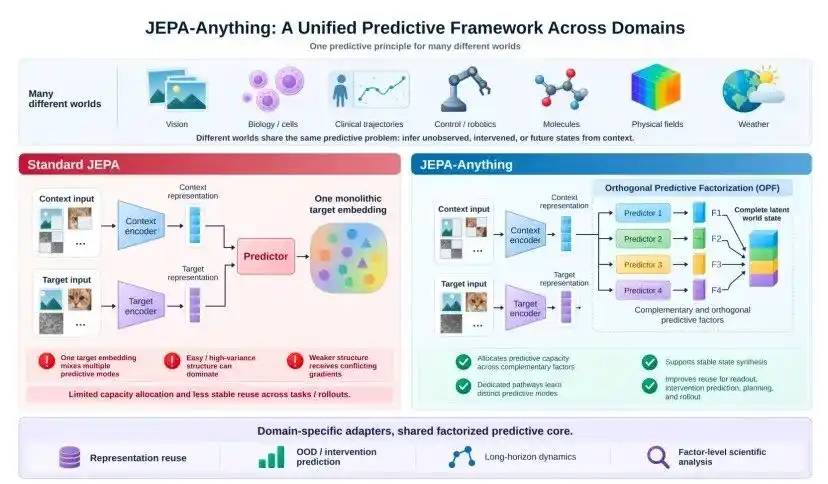
The factors are not assigned human labels in advance. No branch is told to model speed, temperature, or a specific biological pathway. What each factor learns depends on predictable structure in the data. After training, those factors remain as an internal interface that can be inspected later.
Tested across seven classes of systems
The paper does not stop at video or robot control. It places the same predictive core into seven classes of systems: vision, biology, clinical data, control, molecules, physical fields, and weather.
The “Anything” label does not mean all data are forced into one input format. Images, single-cell sequences, molecular structures, and weather data keep their own encoders and native forms. The shared part begins after data enter latent representation space, where the prediction model and training rule are aligned.
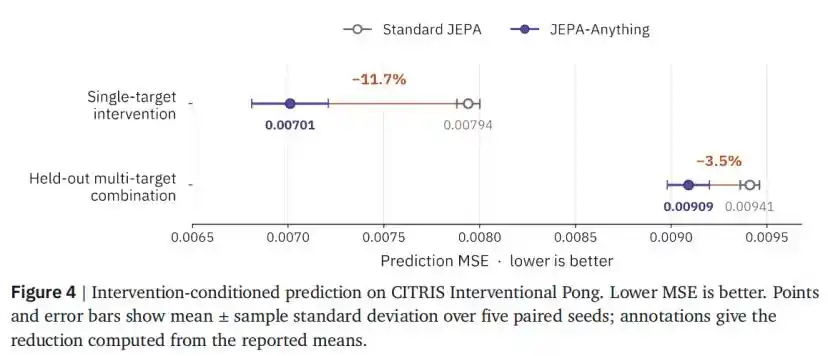
The first controlled experiment uses CITRIS Interventional Pong, a simplified Pong-style dynamic environment, to test whether the model can decompose composite changes and then recombine them. During training, the model sees data in which only single factors vary. At test time, it faces multi-factor intervention combinations that never appeared before.
If the model only memorized full patterns from the training set, those new combinations should break it. If it learned reusable state-transition rules, it should be able to recombine them. The reported result shows about an 11.7% drop in prediction error against standard JEPA on in-distribution single interventions. On unseen multi-factor intervention combinations, mean squared error fell by about 3.5%, with improvements in all five paired training seeds.
Results on the matched dynamics benchmark
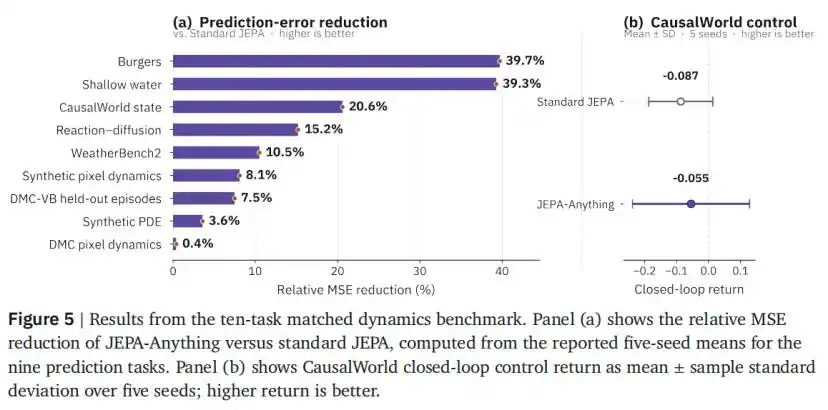
The paper then moves to more complex real systems with a Matched Dynamics Benchmark. Across 10 tasks, standard JEPA and JEPA-Anything use the same training data, encoders, state-transition backbone networks, compute budget, and evaluation splits.
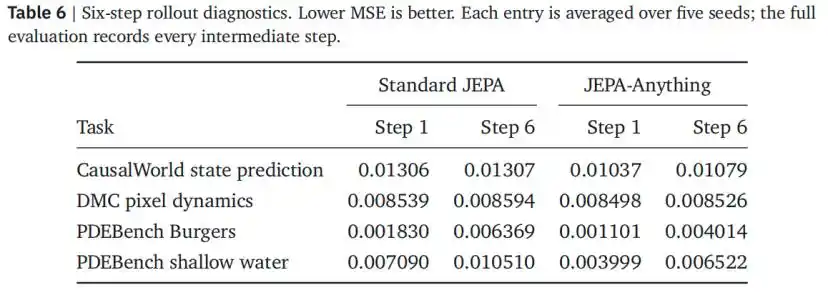
JEPA-Anything improved the metric in 9 of the 10 prediction tasks. The paper highlights several examples: MSE dropped 39.7% on the Burgers equation in PDEBench, 39.3% on shallow water equations, and 10.5% on WeatherBench 2.
The study also runs multi-step rollouts, where each prediction becomes the next input, to see how errors behave as they propagate.
Molecular systems extend the horizon much further. In liquid water, α-quartz, paracetamol, and benzene, the model repeatedly predicts future atomic positions and velocities while feeding its own outputs back into the next step. The paper reports that JEPA-Anything delivered the lowest error across all four molecular systems, both for one-step MAE and for final-position RMSD after 100-step free rollouts.
Not a clean sweep across every task
The results are not presented as universal domination by one mechanism.
In continuous control tests, JEPA-Anything did not win everywhere. Its average score was higher than standard JEPA on Walker2d and HalfCheetah, but standard JEPA performed better on Hopper.
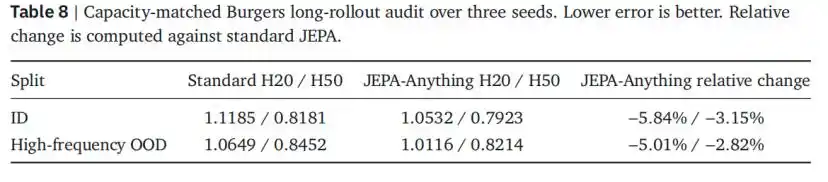
Longer prediction horizons also still accumulate error. In an additional Burgers test, when the horizon increased from 20 to 50 steps, JEPA-Anything remained ahead, but the margin narrowed noticeably.
That distinction matters. The paper says these findings support the cross-domain applicability of a common predictive principle. It does not claim that a single unified world model for all domains has already been achieved.
Can the internal structure be used for science?
The third set of experiments goes beyond prediction accuracy and asks whether the factors formed in latent space have scientific value. This is where the paper’s two most striking examples appear: liver cancer and planetary motion.
Case 1: From internal factors to a candidate intervention
In the liver cancer study, the researchers did not treat JEPA-Anything as a black-box predictor. They analyzed its internal Orthogonal Factor Coordinates and identified a candidate combination: IL-18 plus NT5E/CD73 blockade.
The team moved that candidate through a Huh7-PBMC co-culture system, patient-derived hepatocellular carcinoma organoids, tumor tissue fragments, and then immunocompetent mice.
The reported data show that in three patient organoids and three tumor tissue fragments, the combination of IL-18 and a CD73 blocker produced the strongest tumor-cell killing, along with significantly stronger immune-cell activation.
In the paper’s framing, this turns the model’s latent factors into more than a tool for lowering error bars. They become an interface for analyzing system state, proposing experimentally testable hypotheses, and linking internal model structure to domain analysis, candidate intervention, and experimental validation.
Case 2: From latent modes to Kepler’s third law
The planetary-orbit example goes in the other direction. Instead of using the model to suggest a new intervention, the researchers used an established physical law to check whether the model’s internal structure carries physical meaning.
The model was trained only on simulated planetary position and velocity trajectories. It was not given Kepler’s law. After training, the researchers performed spectral analysis on the model’s latent modes and paired the extracted frequencies with orbital semi-major axes.
The result was a recovered scaling relationship that closely matched the known law. The fitted slope came out to -1.4991, very close to the theoretical value of -1.5 implied by Kepler’s third law, with R²=0.99999999.
One case starts from internal factors and leads to wet-lab testing. The other starts from internal modes and checks them against established physics. Together, they are used as evidence that internal model structure may serve as an interface for scientific analysis, not only as a machine for producing a final prediction number.
Where JEPA-Anything fits in PhAI Labs’ roadmap
The paper also places JEPA-Anything inside PhAI Labs’ broader idea of Discovery Foundation Models, or DFM. In that framing, AI should move beyond narrow prediction and take part in a more open-ended scientific process: identifying unknowns, forming hypotheses, designing interventions, and revising those ideas as outside evidence arrives.
JEPA-Anything is positioned at the world-model layer of that stack. The goal is to compress predictable parts of scientific trajectories and real-world change into a form that can be queried more quickly, providing an approximate judgment layer before slower and more expensive real experiments take place.
That gives the paper’s span, from cancer cells to planetary orbits, a more specific meaning. The question is not simply whether the contrast looks dramatic. It is whether AI can share one way of learning evolving logic across systems with very different mechanisms, and whether the resulting internal states can be inspected and checked against experiments or known laws.
The paper does not claim that AI now “understands everything.” What it offers is narrower and more concrete: structures learned inside a world model may support prediction and remain open to scientific analysis and external validation.
Paper and code links
- Technical report: https://arxiv.org/abs/2609.20800
- GitHub: https://github.com/Gen-Verse/JEPA-Anything
- Hugging Face: https://huggingface.co/collections/Gen-Verse/jepa-anything
This article is based on a post from the WeChat public account QbitAI, written by Heng Yu.