

Jev, a new AI model from TypeSafe AI, has spread quickly across X, GitHub, and agent developer communities over the past few days.

Public examples shared by developers show Jev being used to analyze 724 live ads in 40 seconds, clean up context inside Claude Code, handle task acceptance for AI agents, and guide browser agents by deciding which button to click or which page to open next.
LangChain moved quickly as well. On Sept. 20, it published a Jev-as-a-Judge experiment to test the model as an evaluator for agent outputs. OpenAI figure Tibo, described in the source as the "reset god," also promoted Jev.
What Jev is
TypeSafe AI formally released Jev on Sept. 15 and grouped it under what it calls "System One Models." In TypeSafe's definition, these models take a piece of program state or text input and return a structured judgment together with a probability.
In simple terms, Jev is built for judgment tasks. It is meant to answer questions such as whether an email is a sales lead, whether a user message needs human intervention, what category an issue belongs to, or what quality tier a result should receive.

The model drew attention when it launched, and interest climbed again a few days later. Related posts have now drawn 37 million views, according to the source material.
One example in the source describes a customer support system receiving an email. A developer can ask Jev several questions at once: Is this a sales lead? Is the user's tone intense? Does it require human intervention? Is it a billing, technical, or sales issue? Jev may return a set of probabilities such as sales lead: 0.91, human intervention needed: 0.12, technical issue: 0.83. An application can then move directly to the next step based on those values.
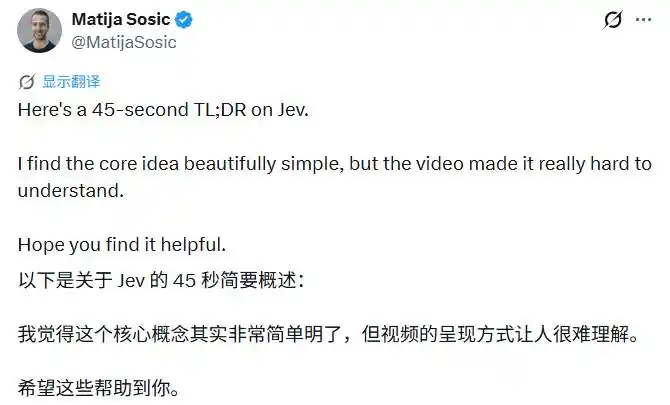
Wasp co-founder and CEO Matija Sosic also posted a 45-second video on X explaining Jev.
Three core judgment formats
Jev currently offers three core judgment formats: Noul, Choice, and Score.

- Noul handles yes-or-no decisions.
- Choice selects an answer from a predefined set of options.
- Score rates an input against preset criteria.
Each output includes a probability or confidence level, and multiple questions can be evaluated against the same input at the same time.
Why agent developers are paying attention
One of the clearest growth areas for Jev is its role as a judge for agents.
Many AI agents now run through dozens or even hundreds of steps in sequence. After writing code, calling tools, searching the web, or editing files, the system still needs to decide whether the task is actually complete. That kind of question fits Jev's design.
Developers can pass an agent's execution trace to Jev and ask whether the goal was completed, whether the output meets the requirements, whether anything is missing, and what quality level the current result belongs to.
LangChain's latest experiment followed that pattern. It asked Jev, GPT-5.6 Luna, GPT-5.6 Terra, and Claude Sonnet 4.6 to repeatedly score fixed agent outputs. In that small-scale test, Jev averaged about 0.44 seconds per call at a cost of about $0.00035, while standing out for consistency across repeated scoring runs.
LangChain also said the work is still early and limited in scale, and that more testing is needed across additional agents and real production tasks.
Ad analysis helped push Jev into wider discussion
A separate set of numbers from ad analysis gave Jev another boost in visibility.
Developer Matthew Berman shared an experiment in which a Jev-based system analyzed 724 live ads from 37 brands. The system classified each ad by hook, format, offer, CTA, user awareness stage, and consistency between the ad and its landing page, producing 8,724 judgments in total.
According to the data shared by the developer, the batch finished in about 40 seconds, with token costs of about $0.09 and a median processing time of about 216 milliseconds per ad. The case has already been added to the Jev community case library.

Claude Code and browser agents are also testing it
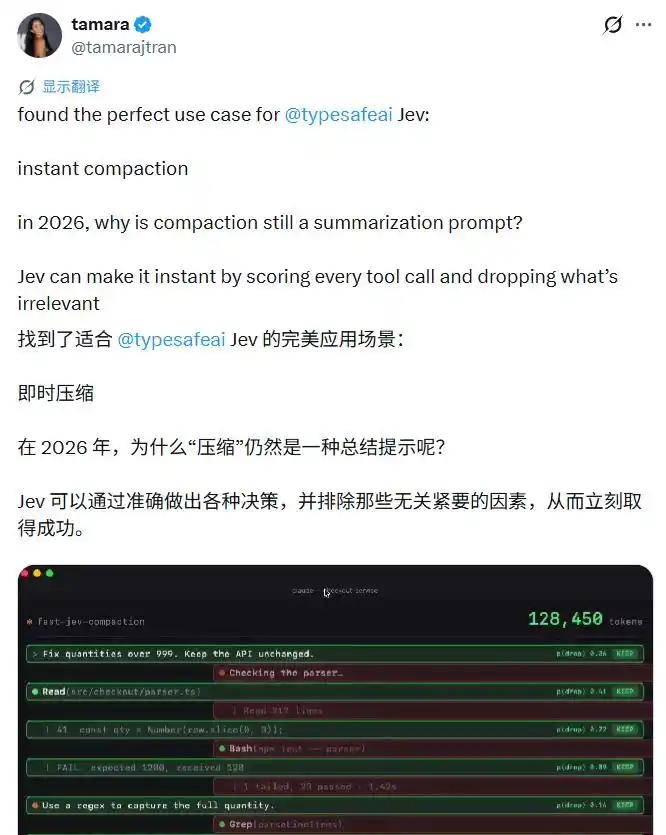
Another project that spread quickly among developers is called fast-jev-compaction.
The Claude Code plugin sends large volumes of tool calls and terminal output to Jev for scoring. Jev then decides which parts are still relevant to the current task, and the system compresses the context sent back to the model based on that result. The project drew heavy attention soon after launch and has already produced multiple ports.
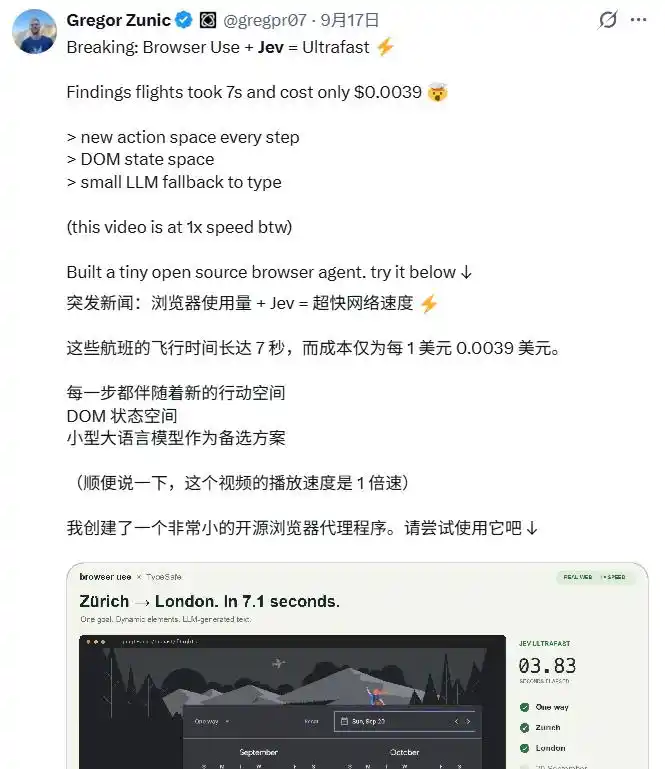
Browser agents have become another active testing ground. Several open-source projects now use a loop in which the browser reads a page, generates candidate actions, Jev selects one of them, and the browser executes it.
In one public flight search demo, the developer reported that the full search took about 7 seconds and cost about $0.004.
Latency and cost are central to the pitch
These examples help explain why Jev has caught the attention of agent developers so quickly.
Many agent steps are really high-frequency decisions: which button to click, which tool to call, whether a piece of information is relevant, whether a task is finished, or whether a result passes acceptance. When those decisions happen hundreds of thousands or even millions of times a day, latency and cost become part of system design.
In its own workflow benchmark, TypeSafe said Jev reached up to about 193.6x speed gains and 444.6x cost advantages on some tasks. The company also said those figures sit at the high end of its expected real-world gains, and that the test set was produced by its own model capability team, making the numbers better suited as an early reference point for the technical direction.
The meaning behind the name
"System One" comes from the System 1 concept introduced by Daniel Kahneman in Thinking, Fast and Slow, referring to fast, intuitive judgment.
"Jev" comes from economist William Stanley Jevons. TypeSafe borrowed the idea behind the Jevons paradox: when the efficiency of using a resource rises sharply, total usage can also increase quickly.
Applied to AI, the implication is straightforward. If the price of a single intelligent judgment falls by orders of magnitude, developers may start inserting AI into places where model calls previously felt too expensive.
Whether a log matters, what type of email has arrived, whether an agent completed a task, what awareness stage an ad belongs to, or which button a web agent should choose next — those small decisions can add up to a very large volume of calls in the next generation of agent systems.
Still in early access
Jev remains in early access. Community experiments around browser agents, coding agents, ad analysis, evaluators, and context management are only beginning.
TypeSafe's broader idea is to make Jev the infrastructure behind what the source describes as "intelligent if statements" embedded inside software workflows. Whether that holds up across more real production tasks will depend on later validation.