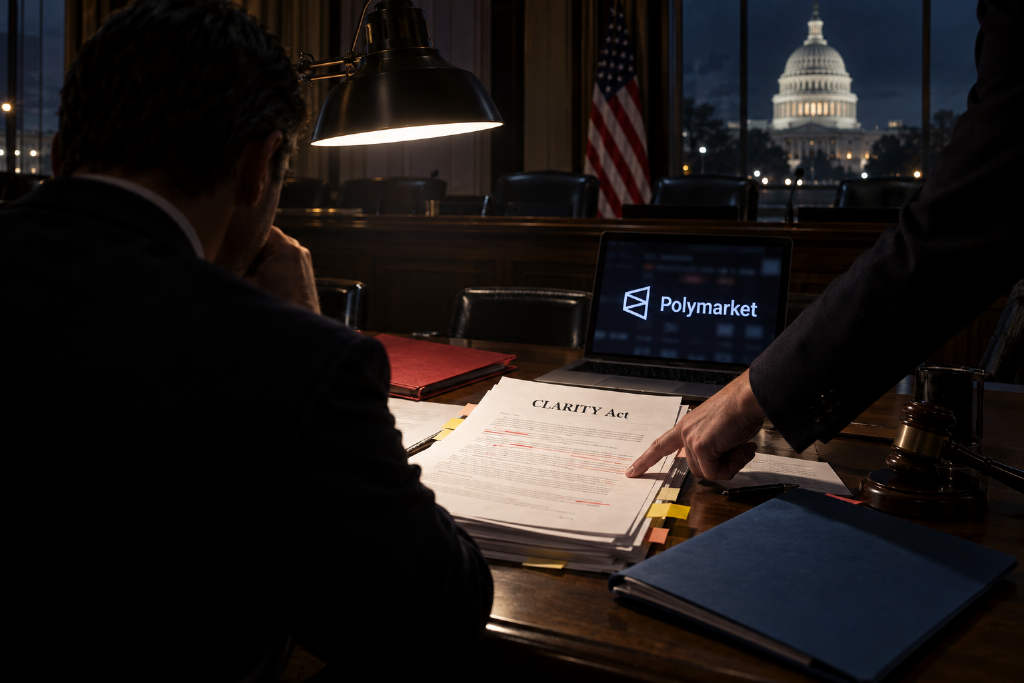
Jiang Zhuoer, founder of BTC.TOP, said the Republican Party’s newly released CLARITY Act text likely gives Democrats much less than the claimed "80% of disputed provisions," even though the update pushed the bill’s odds on Polymarket from 14% to 28%. In his view, the real level of compromise is closer to 60%, and several of the most contested items remain only partially addressed.
He pointed to ethics provisions as one example. Democrats had previously sought restrictions covering federal officials, spouses, children, and affiliated entities, while the revised text expands the scope only to officials and spouses. Zhuoer said that leaves out children and affiliated entities, limiting the practical significance of the change.
On enforcement, he said Republicans had previously accepted prosecution only by the Department of Justice, while Democrats wanted state attorneys general to have enforcement authority. The new version allows state attorneys general to sue, but only in cases involving exchanges listing non-compliant tokens. Zhuoer argued that does not address weak enforcement of ethics provisions and does not enable action against the president personally. Based on that reading, he said the procedural vote scheduled for 2:15 a.m. Beijing time on Sept. 16 is unlikely to pass, and warned that a failed vote could trigger a pullback in the current BTC rally.
On Sept. 14, Jiang Zhuoer, founder of mining pool BTC.TOP, said the latest text of the Republican-backed CLARITY Act does not amount to the widely touted "80% compromise" with Democrats, even though the revision pushed the bill’s passage odds on Polymarket from 14% to 28%.
Jiang said the actual level of compromise may be closer to 60%, adding that concessions in several key provisions do not materially resolve the underlying disagreements.
He cited ethics rules as one example. According to Jiang, Democrats had previously sought restrictions covering federal officials, their spouses, children, and affiliated entities. The new text expands the scope only to "officials + spouses," leaving out children and affiliated entities. In his view, that makes the concession limited in practical terms.
He also pointed to the enforcement section. Jiang said Republicans had previously agreed only to prosecutions handled by the Department of Justice, while Democrats wanted state attorneys general to be given enforcement power. Under the new text, state attorneys general would be allowed to bring cases, but only in situations involving exchanges that list non-compliant tokens. Jiang said that would not allow action over insufficient enforcement of ethics provisions, nor would it permit lawsuits targeting the president personally.
For that reason, he argued that a proposal in which "key provisions are only halfway compromised" is unlikely to satisfy Democrats’ core demands. He added that Democrats have little reason to hand what he called a "big gift" to the Trump administration before the midterm elections, and are therefore unlikely to accept the current version.
Jiang said the procedural vote scheduled for 2:15 a.m. Beijing time on Sept. 16 is unlikely to pass. He also warned that if the CLARITY Act vote fails, it could become a trigger for a pullback in the current BTC rally.
This article was originally published by Bit.Fan. For more cryptocurrency news and market insights, visit www.bit.fan. Disclaimer:
The market information, project data, and third-party content displayed on this platform are for industry information sharing only and do not constitute any form of investment advice or return commitment.
Cryptocurrency trading carries high risks. Users should fully assess their risk tolerance and make independent decisions. All profits, losses, and legal responsibilities are borne by the users themselves.