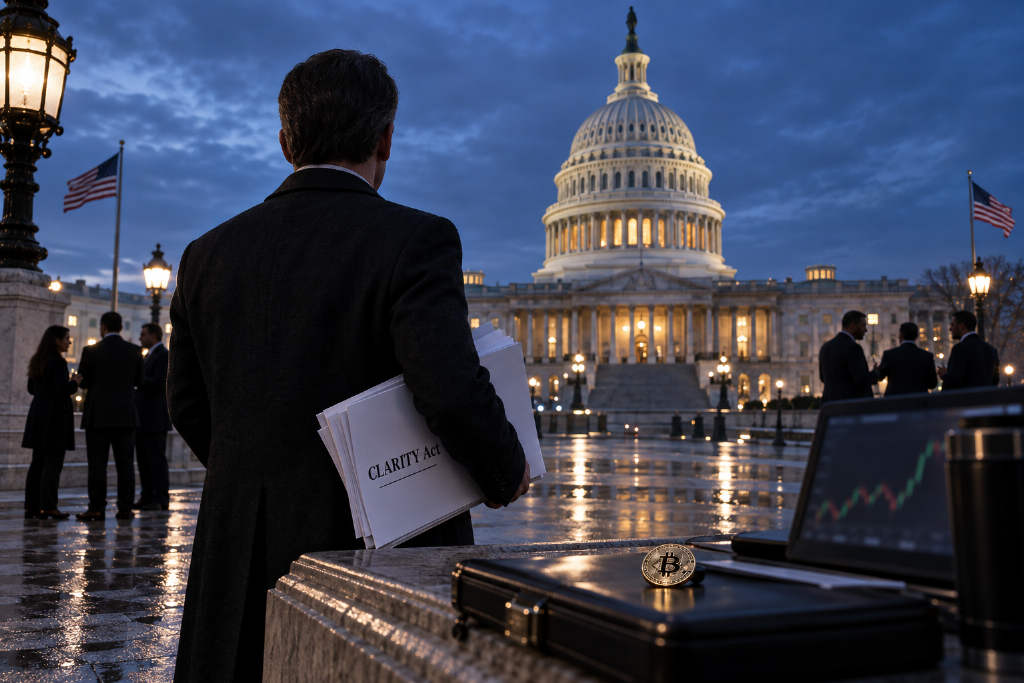
B.TOP mining pool founder Jiang Zhuoer said on X that the Republican Party’s revised CLARITY Act does not offer as much ground as claimed. While Republicans said they had conceded on 80% of disputed provisions, Jiang estimated the real figure at about 60% and argued that the most sensitive parts were only weakly revised.
He pointed to two examples. On ethics rules, Democrats had sought restrictions covering officials, spouses, children, and affiliated entities. The new draft, he said, only extends the restriction to officials and spouses, leaving out children and affiliated entities. On enforcement, state attorneys general are given authority to sue, but only over exchanges listing non-compliant tokens. They would not be able to sue the Department of Justice for failing to enforce the law, nor sue the president personally.
Jiang said such concessions carry little practical value for Democrats. With the midterm elections approaching, he argued, Democrats have no reason to hand Donald Trump a political gift at this stage. Based on that view, he said the procedural vote scheduled for Sept. 16 at 2:15 has almost no chance of passing. If the CLARITY Act fails in the vote, he added, that could mark the start of a pullback after the current round of Bitcoin gains.
According to ChainCatcher, B.TOP mining pool founder Jiang Zhuoer said in a post on X that the Republican Party has released a revised text of the CLARITY Act and claimed it had conceded on 「80% of disputed provisions」, but he believes the actual level of compromise is closer to 60%, with key provisions still seeing too little movement.
Two provisions highlighted in his post
Jiang used the ethics section as one example. He said Democrats had asked for restrictions covering officials, spouses, children, and affiliated entities. Under the new text, the concession only goes as far as restricting officials and spouses, without including children or affiliated entities.
He also pointed to the prosecution provision. State attorneys general are granted the power to bring cases, but only in matters involving exchanges listing non-compliant tokens. They cannot sue the Department of Justice for failure to enforce the law, and they also cannot sue the president personally, according to his description.
He sees little reason for Democrats to back the bill
Jiang said these concessions lack real substance from the Democratic Party’s perspective. With the midterm elections drawing closer, he argued that Democrats have no reason to give Donald Trump what he described as a political gift at this point.
He said the procedural vote set for Sept. 16 at 2:15 has almost no hope of passing. If the CLARITY Act fails in the vote, he added, it could become the starting point for a correction after the current Bitcoin rally ends.
This article was originally published by Bit.Fan. For more cryptocurrency news and market insights, visit www.bit.fan. Disclaimer:
The market information, project data, and third-party content displayed on this platform are for industry information sharing only and do not constitute any form of investment advice or return commitment.
Cryptocurrency trading carries high risks. Users should fully assess their risk tolerance and make independent decisions. All profits, losses, and legal responsibilities are borne by the users themselves.