
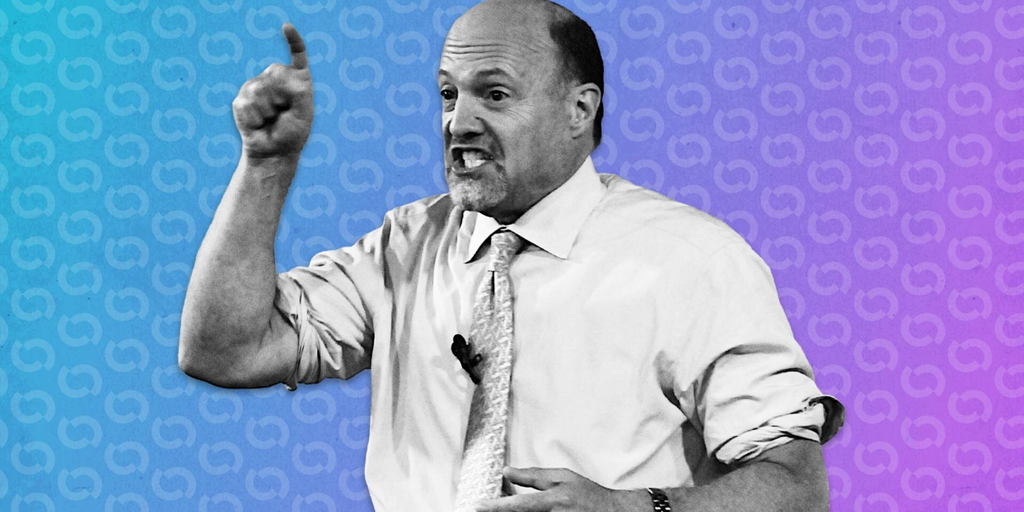
CNBC host Jim Cramer said he is selling his Bitcoin after raising concerns about quantum computing during an on-air interview with IBM CEO Arvind Krishna, according to Decrypt’s Aug. 5 Morning Minute newsletter by Tyler Warner. The newsletter said the views in the piece were Warner’s own and did not necessarily reflect Decrypt’s position.

Cramer says quantum risk is behind his Bitcoin sale
During the interview, Cramer asked Krishna whether quantum computers could one day crack the cryptography that protects his coins. Krishna replied, “I think that you should give yourself three or four years, and at that point, I would get rather paranoid about it.” Cramer answered with a decision of his own: “Arvind Krishna knows quantum incredibly. He knows Bitcoin and quantum. And I’m going to sell mine.” He added that Ethereum might be “even worse.”
Bitcoin rose about 1.6% on the day Cramer made the comment.
Crypto Twitter leans into the “inverse Cramer” joke again
Traders responded with open amusement, reviving the familiar “inverse Cramer” trade, the joke that the profitable move is often the opposite of whatever Cramer recommends. One of the top replies simply read, “Thank you Jim!”
The newsletter also pointed to Cramer’s history of selling at poor moments. In December 2022, with Bitcoin near $16,800, he said he had dumped all his crypto and would not touch it “in a million years.” Over the next three years, Bitcoin gained more than 400%.
The newsletter argues the quantum threat is real
Warner wrote that, whatever Cramer’s track record may be, the quantum threat is not imaginary for crypto. The piece said AI was credited with the recent Coldcard exploit, which has now passed $100 million in losses. It also said the incident followed a run of DeFi hacks and exploits totaling well over $300 million.
The harder point to ignore, the author wrote, is that “this is the worst these models are ever going to be.”
The newsletter also took a more constructive view of the fallout. A serious security event such as the Coldcard exploit may be what crypto teams needed to start treating the quantum threat seriously and taking concrete action. It cited ZEC as an example, saying the protocol used frontier AI to search for exploit vectors in its own cryptography, found them, and patched them. ZEC sold off after that process, the piece said, but later rebounded quickly. Warner wrote that other protocols should move in the same direction, and fast.
The newsletter closed that section by saying Cramer is right to worry about quantum computing, while leaving open whether he has again sold near a cycle low.
Macro, crypto, and market snapshot
Major crypto assets were slightly green while U.S. stocks hit fresh all-time highs. BTC was up 0.5% at $64.1K. ETH was flat at $1,868. SOL was flat at $73.70, and HYPE rose 3% to $57.
Among leading altcoin movers, PUMP gained 13%, ZEC rose 6%, and LIT added 3%.
In commodities, oil fell 5% to $76.20 while gold rose 1.9% to $4,230. Stock futures were green again after new all-time highs on Tuesday, with the DOW up 0.4% and the Nasdaq up 0.2%.
SpaceX marks down its Bitcoin holdings
The newsletter said SpaceX beat Wall Street revenue forecasts but recorded a $540 million Bitcoin markdown. Its 18,712 BTC fell in value to $1.10 billion from $1.64 billion.
EIP-8361 would reduce issuance as Ethereum staking grows
Justin Drake and five other researchers proposed EIP-8361 as a way to curb Ethereum inflation. The mechanism, described as a “Tapered Issuance Burn,” would destroy a growing share of validator rewards as staking expands.
At today’s roughly 33% staked level, the proposal would cut yield to about 1%. If half of all ETH were staked, the yield would fall to 0%, according to the newsletter.
Cloudflare launches wallets for AI agent payments
Cloudflare launched Cloudflare Wallets, a product designed to let AI agents autonomously pay for APIs and content using x402 stablecoin micropayments inside human-set spending guardrails.
Circle posts $701 million in Q2 revenue
Circle reported $701 million in second-quarter revenue as USDC circulation rose 19% to $73.3 billion. Adjusted EBITDA increased 8% to $143 million. The newsletter also said Arc mainnet is scheduled for Sept. 16, and CRCL was up 5%.
Wallet security and on-chain settlement infrastructure
Ledger commented on the Coldcard exploit as AI begins to reshape wallet security. The company argued that the attack marked a turning point, one where AI-driven vulnerability hunting is forcing hardware makers to rethink how they audit and defend firmware.
Wells Fargo will offer tokenized deposits for 24/7 corporate payments, joining JPMorgan and Citi in the push to move Wall Street settlement rails on-chain.
The newsletter also said analysts see Samsung as a potential dominant stablecoin distributor because its wallet reaches hundreds of millions of devices and could become a major on-ramp for stablecoin payments.
BitGo’s WBTC moved to Chainlink, pushing the LayerZero-to-Chainlink tally close to $15 billion.
ETF flows stay positive
In the newsletter’s top-line briefing, Bitcoin ETF inflows reached $380 million across the first two sessions this week. For Tuesday alone, spot Bitcoin ETFs recorded $211 million in net inflows, while ETH ETFs added $53 million.
Meme coin tracker: Robinhood Chain rebounds, CASHCAT leads
Meme coin leaders were mostly red. DOGE fell 1%, SHIB dropped 3%, PEPE lost 2%, PENGU slipped 1%, TRUMP fell 1%, and BONK was flat.
Robinhood Chain was broadly green, led by CASHCAT, which jumped 40% to $96 million. Tendies rose 38% and Frong gained 78%. PONS held steady at $20 million after releasing V2.
Among Solana names, Cupsey gained 58%, Stonk jumped 165%, and Kimchi rose 90%. CATE fell another 40% to $18 million, while ANSEM dropped 7% to $170 million.
Token, airdrop, and protocol updates
Uniswap teased a new product called “pools dot trade,” set to launch today.
New Solana launchpad StonkFun picked up momentum on Tuesday by pairing pre-IPO stocks with memecoins.
Proof of Play is winding down after failing to find a sustainable business model. The project is open-sourcing its code and releasing the Pirate Nation IP under CC0, while the PIRATE token will continue independently. The newsletter put PIRATE at a $1 million valuation after it had previously reached more than $100 million.
The Eliza project, founded by Shaw Walters, is also shutting down and winding down its foundation. Its token and remaining treasury will be handed over to a group of holders.
NFT market softens, with a few sharp movers
NFT leaders were slightly red. CryptoPunks fell 1% to 31.7 ETH. BAYC slipped 1% to 8.33 ETH. Pudgy was flat at 3.87 ETH, while Stonkbrokers dropped 8% to 5.9 ETH.
Top movers included Merry Men, up 550%, pyo, up 50%, and Zaibatsu, up 15%.
TokenWorks announced 30% buybacks for FWA using historical platform fees, in addition to 80% go-forward buybacks. The token started trading at 3 p.m. ET yesterday, and FWA fell 20% to $7 million.