

Jito’s valuation framework is shifting after the July 14 launch of JTX. In an analysis written by ake Koch-Gallup and Sam Schubert, the argument is that the market still prices Jito like a Solana back-end infrastructure business, one that takes prices set by blockspace activity. JTX changes that setup. The product turns Jito toward pricing user flow instead. On the analysts’ base case, JTO is worth $1.18, implying about 57% upside from roughly $0.75. On a probability-weighted basis across three scenarios, the target rises to $2.75, which points to about 267% upside.
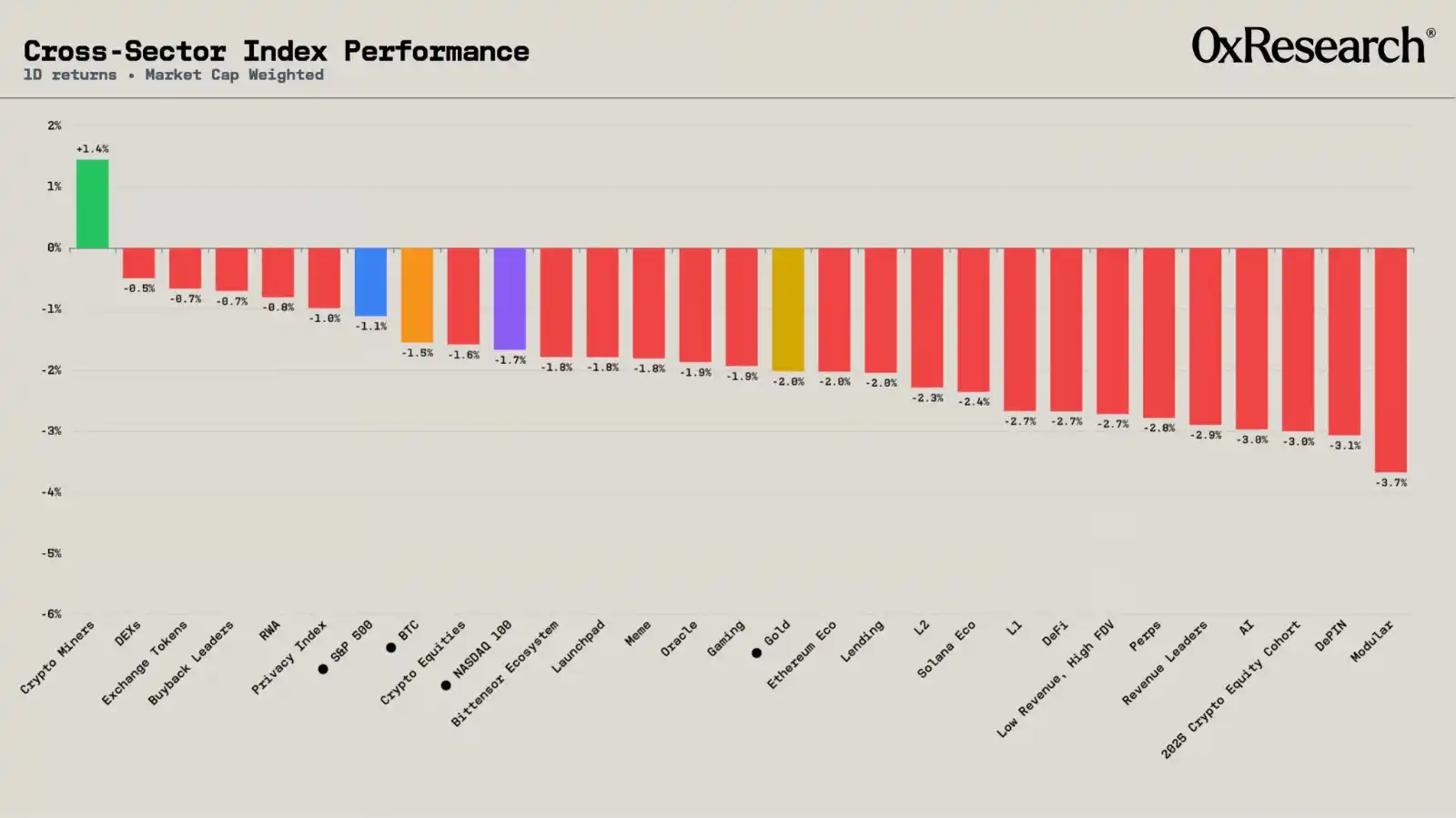
The note also sets that call against a broader market backdrop. While the crypto market has pulled back, crypto miners were one of the few areas in the green, helped by AI data center deals.
Crypto miners outperformed over the past week
Over the past week, crypto miners rose 27.0%, outperforming every other crypto segment mentioned in the report. DEXs followed with a 4.6% gain, the Bittensor ecosystem rose 4.3%, and the Ethereum ecosystem added 3.9%. The broader equity market was nearly flat over the same period.
The analysis ties that rally to a series of AI infrastructure announcements and says investor thinking around Bitcoin mining companies is changing.
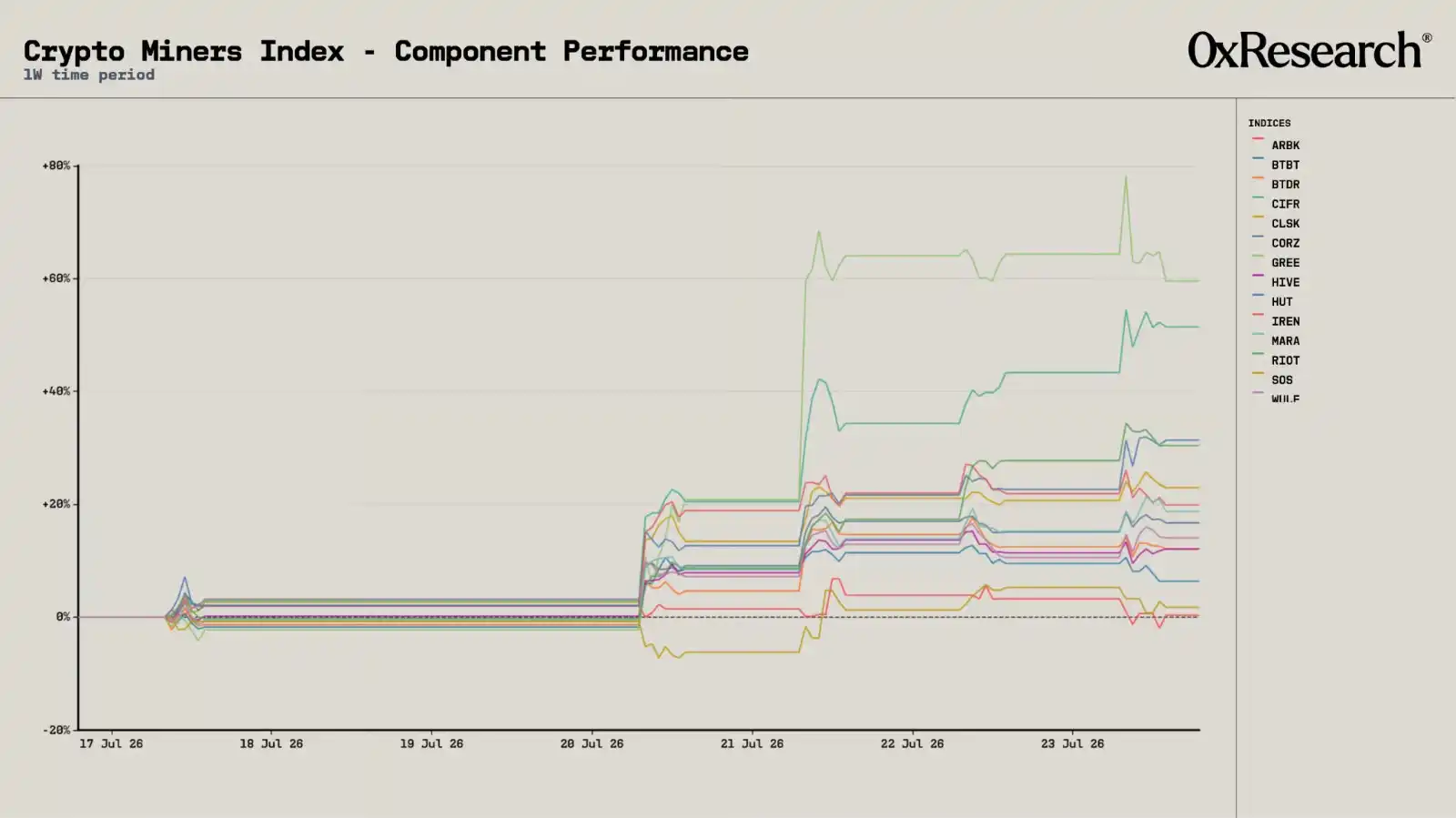
On July 20, Hut 8 announced another 15-year lease at its Beacon Point campus worth $9.8 billion and covering 352 megawatts of power. That deal doubled contracted capacity to 704 megawatts and lifted total base contract value to $19.6 billion. On the same day, IREN signed another $2.8 billion AI cloud contract and raised its year-end run-rate target from $3.7 billion to more than $4.0 billion. About 85% of its capacity has been contracted to customers including Microsoft, Nvidia, and Perplexity.
The market moved quickly. Over the past week, Greenidge rose 59.6%, Cipher gained 51.4%, Hut 8 climbed 31.4%, Riot added 30.4%, and CleanSpark advanced 22.9%. The report says investors are increasingly viewing these companies as owners of scarce power and data center infrastructure rather than only as Bitcoin miners. As long as demand for AI compute stays ahead of supply, the authors say that narrative could remain the main catalyst for the sector even if Bitcoin itself stays range-bound.
Why JTX changes the Jito valuation debate
The JTO section goes deeper into what kind of business Jito is becoming. The market, the authors argue, still values it as Solana infrastructure. But since JTX went live on July 14, Jito has started moving from being a price taker tied to blockspace activity to a business that can price user flow. That is the center of the buy thesis in the piece. The call does not rely on a rebound in the legacy business. It depends on whether Jito can actually capture that flow.
Execution data is still early, but the initial read is constructive. Since launch, JTX has processed more than 77,000 trades. Median execution came in just 5.5 basis points away from the oracle midpoint. About 77.6% of trades landed within 25 basis points, and 29.1% of trades actually beat the oracle price.
Trade quality tracked liquidity closely. SOL showed median deviation of 3.9 basis points, while JitoSOL came in at just 0.5 basis points. Long-tail assets with thinner liquidity were wider. The report also says BAM’s edge is not yet obvious in the data: blocks led by BAM showed median deviation of 4.6 basis points, compared with 4.8 basis points in other blocks.
Short-term revenue tradeoff for long-term market structure
The report says this trading structure reflects a deliberate choice by Jito. The company has given up near-term revenue in exchange for improving Solana’s longer-term market structure. It shut off predatory MEV flow and prioritized BAM, a move that directly cut into Jito tip revenue, which had once been a high-margin stream.
The model stays conservative on the legacy business. It does not assume tip revenue returns to prior peaks. It does not assume a recovery in the JitoSOL liquid staking token, or LST, business. It also does not assume BAM is fully monetized.
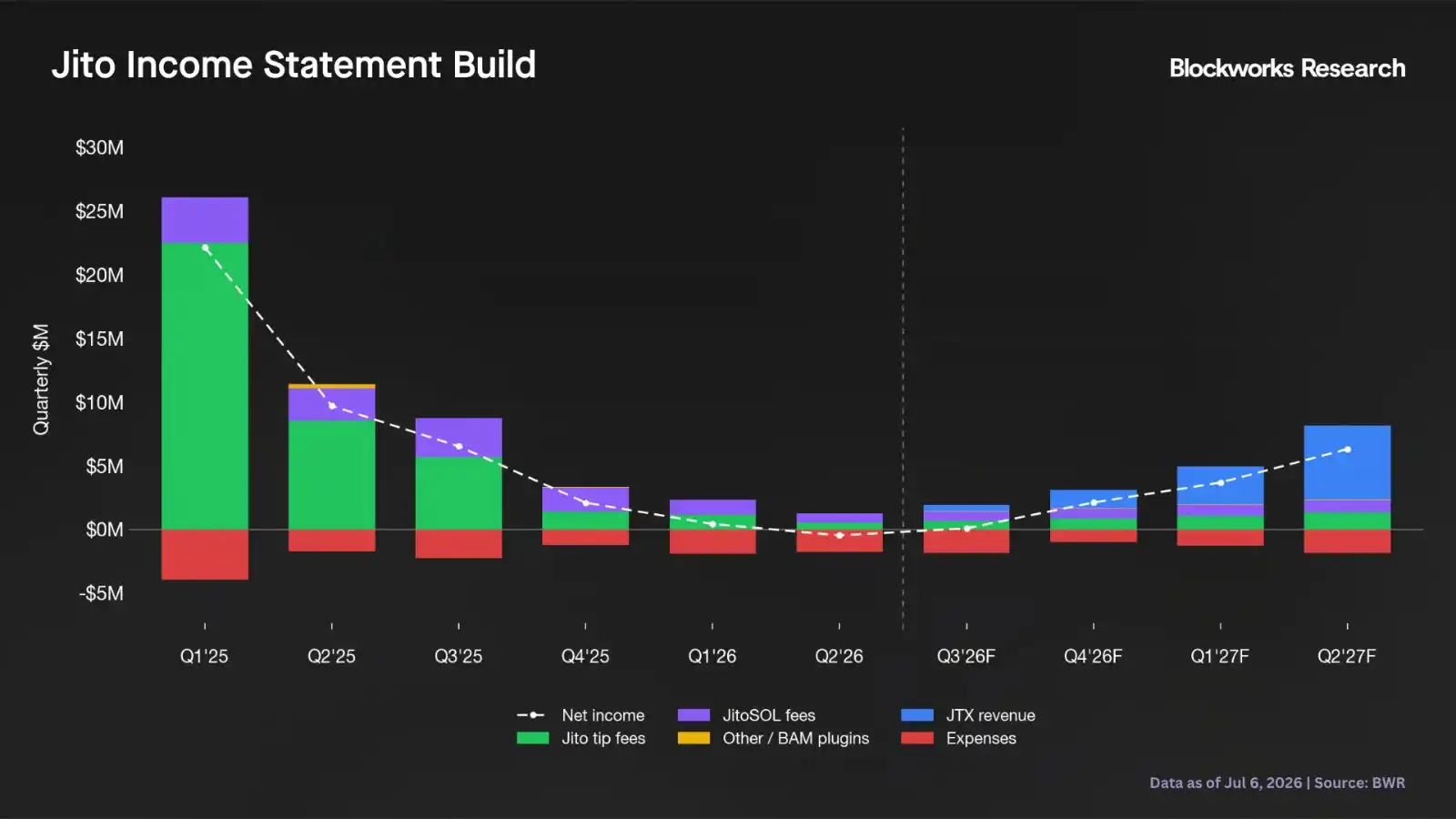
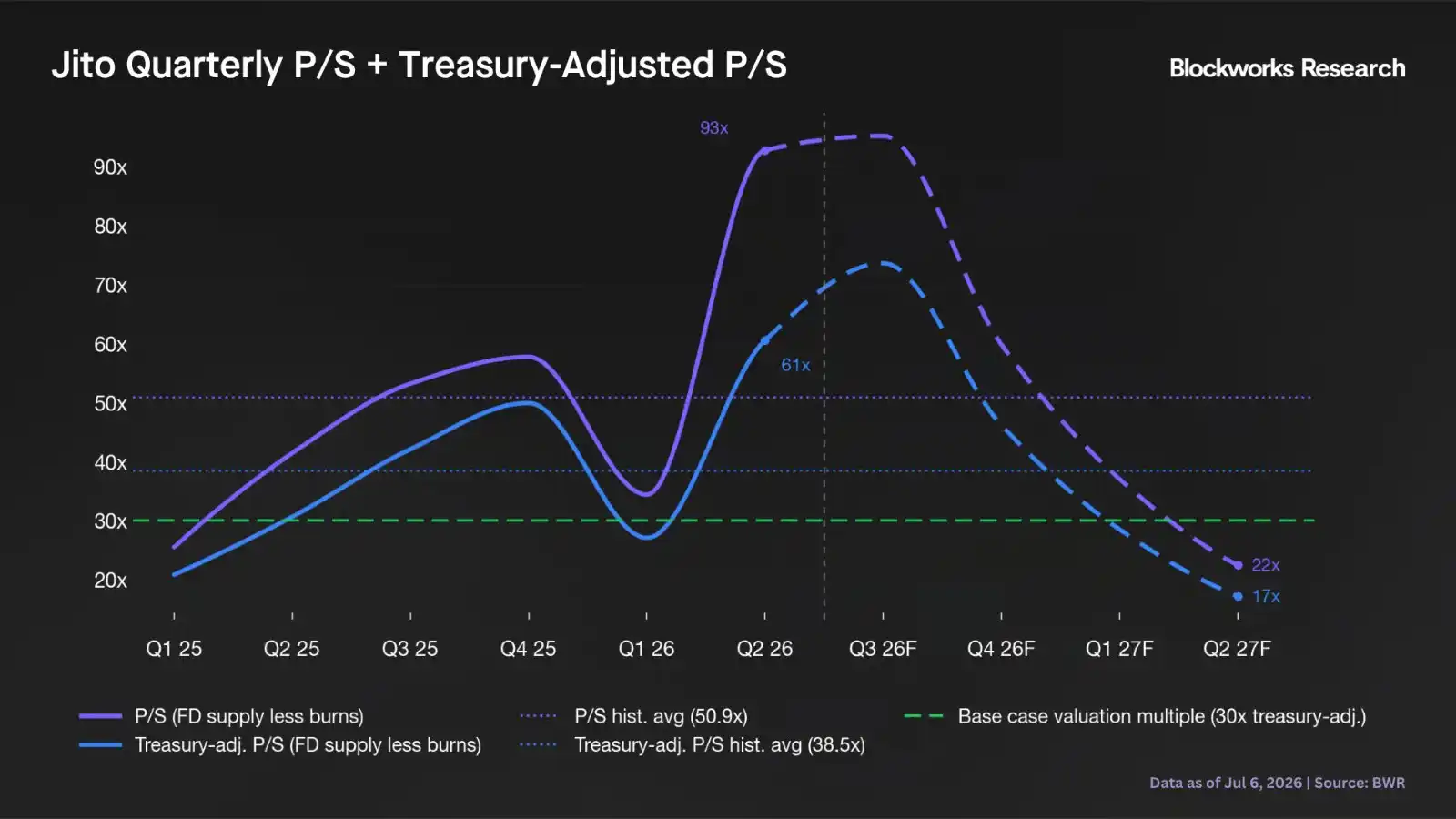
Instead, the base case assumes JTX captures 15% of Solana DEX trading volume by the second quarter of 2027. That would generate $5.8 million in quarterly net revenue and $8.2 million in total quarterly revenue, equal to roughly $32.7 million on an annualized basis. JTX would account for about 72% of that total. On that annualized revenue for the second quarter of 2027, the treasury-adjusted price-to-sales multiple would be below 15x.
Base, bull, and bear cases for JTO
The authors argue that level looks cheap against history. Even with revenue declining, back-end infrastructure businesses have traded at an average price-to-sales multiple of about 38x since the start of 2025. Applying a more conservative 30x multiple to the base-case annualized revenue yields a JTO price of $1.18, or about 57% upside from roughly $0.75. The report says 30x is not demanding for a business that is still growing and has a stronger front-end economic model, especially when compared with a shrinking business that still commands around 38x.
The scenario range is wide. In the bull case, which carries a 40% probability in the model, JTX reaches 25% market share and receives a 45x multiple. That produces a $5.31 price target, implying a 600% gain. In the bear case, which is assigned a 10% probability, share stalls at 5% and the price-to-sales multiple falls to a commoditized 15x. That points to $0.36, or a 52% decline. Weighting the three scenarios together gives a target of $2.75, about 267% above roughly $0.75.
The note says the valuation is highly sensitive to Solana DEX volume. The probability weighting leans bullish because the authors expect tokenized stocks and real-world assets to scale on-chain, lifting both trading volume and JTX share.
Buybacks make value capture clearer
JTX also sharpens the value-capture path for JTO, according to the report. The analysis expects 80% of JTX revenue to go to buybacks. In the base case, buybacks over the next 12 months would total about $8.6 million, equal to roughly 1.5% of treasury-adjusted supply being retired. In the bull case, that figure rises to about 5.7%.
The flywheel is still small for now. But the authors say it would scale directly with JTX’s success.