

Jordi Visser, head of AI cross-asset macro research at 22V Research and founder of Visser Labs, said his highest-conviction crypto positions are Bitcoin, Ethereum and Solana, with Bitcoin by far the largest allocation.
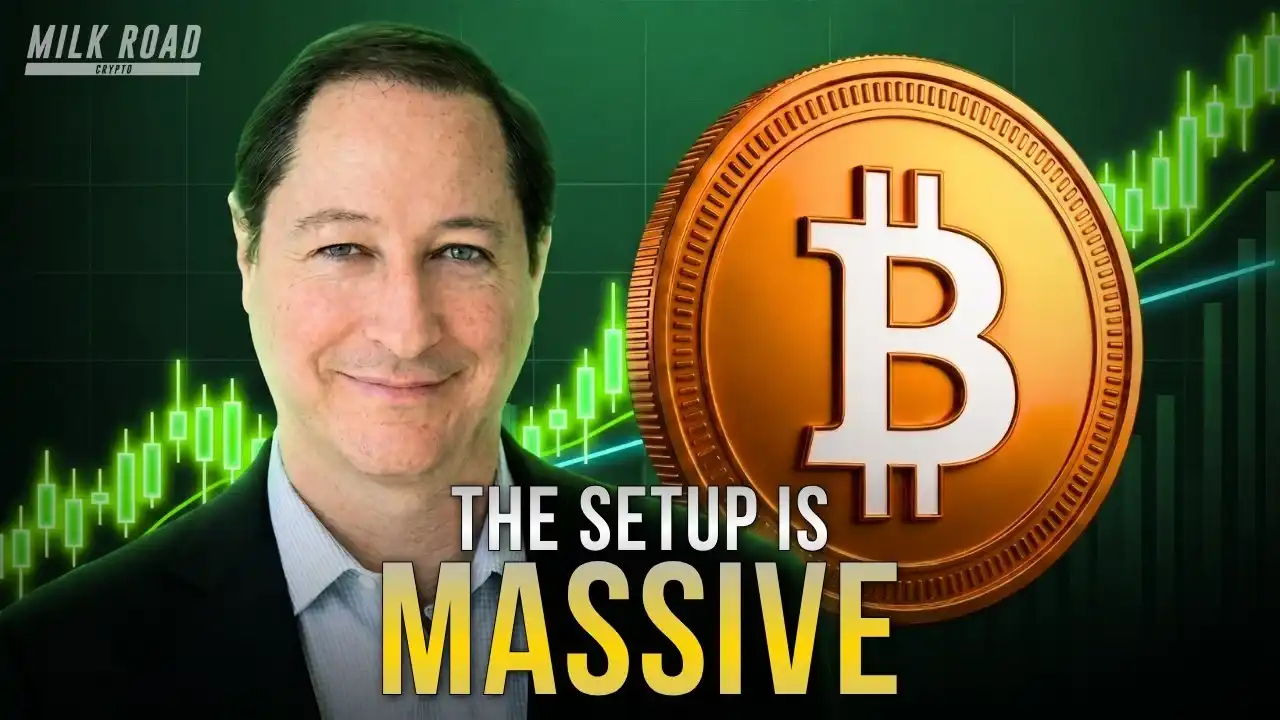
Speaking on a Milk Road Crypto podcast hosted by John Gillan, Visser said he has never sold any of his Bitcoin. Ethereum is his second-largest position and is much larger than Solana, which he described as the smaller third piece. He also said he sees BitMine as a leveraged Ethereum vehicle.
The episode, sourced from Milk Road Crypto on YouTube, aired on Sept. 9, 2026 and ran for about 34 minutes. Visser disclosed in the program that he is a long-term Bitcoin holder, owns BitMine stock, and runs a paid subscription product built around a 46-name index made up of six listed companies and 40 crypto tokens. Milk Road, the publisher of the show, also operates the paid community Milk Road Pro, which was promoted during the episode.
Why he turned louder on crypto now
Gillan said that about three weeks earlier, crypto had gone through what he called the biggest short squeeze in the industry’s history, with total market capitalization rising by roughly $500 billion within days. Since then, Visser’s public tone had become much more aggressive.
Visser said he had spent the past six months talking little about crypto and focusing instead on AI agents. In his telling, the agent shift began in November last year, and from that point a clock started ticking toward a broader recognition that AI and crypto belong together.
He said two lines of evidence pushed him to speak more openly. One was conceptual. A year ago, he wrote a paper on inference compute, and major macro investors in traditional finance paid little attention. This week, he said, the people discussing tokenization and crypto with him included names well known across the macro world.
The second was technical. Visser said his trading rule is straightforward: in a bear market, if price is below the 200-day moving average and the 200-day moving average itself is still sloping lower, he will not sit there and call it a bull market. Now, he said, Bitcoin is above the 200-day average and the average has turned higher. In his words, both the tape and the agent world have spoken.
That is why, he said, he is willing to be loud now. He framed the shift as consistent with a view he has held for more than a year: 「Bitcoin is the purest AI trade.」
AI and crypto: machine brains need machine rails
Visser tied much of his thesis to a recent Substack post titled Tokenization: Machine Rails for Machine Brains. In the interview, he pointed to Robinhood as a key expression of that idea.
He said Robinhood was upgraded last week and its stock jumped 16% to 17%, yet the market commentary he saw focused on revenue growth and prediction markets, with little mention of crypto or blockchain. For him, that missed the main point.
According to Visser, Robinhood chain metrics are climbing across the board, including volume and overall trading activity. He said he built an equal-weight 46-name index containing six listed companies and 40 crypto tokens, with both Robinhood and Circle included, and that the chart is highly correlated with Bitcoin when the two are overlaid.
Why is Robinhood more important than Coinbase or Circle in his framework? Because, he said, its community spans both crypto and traditional finance. That overlap matters. He described it as the zone of fusion, and said fusion will define the next decade. Robinhood has already said users can have their own AI agents trade on their behalf, a point he clearly sees as central.
Gillan asked whether the surge in on-chain activity around Robinhood was just another meme-coin phase. Visser said that is partly true. Before serious volume arrives, the assets carrying the energy are almost always meme coins. He called that standard retail behavior in crypto. He also cited Paul Tudor Jones, who said after the 2020 pandemic shock that he wanted to be long the fastest horse. In Visser’s framing, meme coins are that fastest horse. They bring energy and trading activity and act as the high-beta part of the mix.
Still, he said that is only the beginning. He expects the market to evolve beyond meme coins because tokenization is being pushed at the national level. In the podcast, he said South Korea stated last week that by February 2027, all assets in the country would have tokenization workflows in place. He also said that in May he was at the New York Stock Exchange speaking with representatives from Korean brokerages. Japan and Europe, he added, are also setting rules. If firms want 24/7 trading, he said, opting out means giving up market share.
Asked what this shift means for ordinary users, Visser answered with two ideas: instant settlement and the ability to use what you already own as collateral or to borrow against it immediately. The financial system is old, he said, and once the market fully realizes how outdated it is and how broadly tokenization is advancing around the world, institutions will have little choice but to come in.
The $700 trillion pool he believes tokenization can unlock
Visser repeatedly described tokenization as a structural necessity. In his view, it can release value trapped in illiquid pools such as private credit, private equity and venture holdings.
He put the scale gap in simple terms. Global fiat-denominated assets amount to more than $700 trillion, while crypto is only a $3 trillion to $4 trillion asset class. On top of that, he said, roughly two-thirds of that $700 trillion is illiquid. He listed real estate, gold, private credit and venture capital as examples.
His example was deliberately plain. If someone buys a house tomorrow and then wants to use that house to pay for a cup of coffee, it cannot be done directly. The owner has to apply for a home equity loan, go through a process, sign documents and take on an interest rate, even though the home is already part of that person’s net worth.
That, he said, is the real liquidity problem. Tokenization would not erase haircuts or friction, but it could create liquidity in a more democratic way. Maybe a house used that way would need to be marked down by 20%, but the transaction could happen. The core issue is simple: if you own assets but have no cash, the system should give you a path to turn assets into cash.
Visser linked that idea to falling velocity of money. In his telling, money is not moving into consumption. It is sitting inside these non-liquid assets and becoming dormant. He said more circulation will come later, and extended the same logic to intellectual property and AI-created value. If someone creates something valuable in AI, he said, there will eventually be a token attached to it. Digital value that GDP does not currently capture well will become part of the economy.
That is why he called tokenization the bridge between the fiat asset world and the crypto world. He said governments responded to credit crises by inflating assets and financializing the system rather than allowing a collapse into another Great Depression. Money supply, in his view, will keep growing while fiat assets themselves will not expand in the same way. Capital then moves toward what is rising, and he believes that path leads to crypto through tokenization.
AI agents and humans: not replacement, but fusion
Visser also referenced a recent Tom Lee interview conducted by Gillan. He said he paused the episode after hearing three or four lines from Lee, then spent 30 minutes discussing the ideas with ChatGPT. The concept that stayed with him was what Lee called the 「wealth uncanny valley.」
Visser said it resonated because it matched a theme from his own essay, The Silent IPO, which focused on people who lose conviction and leave Bitcoin after a breakout. He said he had met one such person the previous week, someone whose company he knows well, and that person told him, 「I’m not as convinced anymore.」
His response was that losing faith at this stage often means viewing the future as a binary choice. But the point Lee made, and the one Visser said he has been writing about, is not replacement. It is fusion. AI agents and humans, he said, will merge into the system together.
He expects that process to be slow. Regulation takes time. Investors take time too. His analogy was humanoid robotics: no one starts by putting a robot in the home with children; they start by letting it move boxes in an empty warehouse. He drew the same lesson from self-driving systems. Even if full autonomy is safer than letting a drunk person drive, society still insists on a long testing period before accepting it.
He applied that logic to blockchains as well. Ethereum, he said, wins on trust, not necessarily because it is the best technology. The banking system is not going to leap straight onto a newly emerged chain or token.
Why his core basket is BTC, ETH and Solana
When Gillan asked why he calls Bitcoin, Ethereum and Solana crypto’s three-horse team, Visser’s first answer was blunt: Bitcoin is always there. You do not really need to choose it.
He said that over the summer, while processing a large amount of information in Maine, the same three names kept coming back. Solana stands for speed. Ethereum stands for trust. Then there is what he described as the cloud you do not need to worry too much about, however one wants to label it. He also noted that Canton has been coming up frequently and that people often tell him he is leaving it out when he talks about Ethereum or Solana. Even so, he said he is still settling on those three, at least for the next year.
On sizing, he was specific:
- Bitcoin is by far the biggest position.
- Ethereum is much larger than Solana.
- Solana is the smaller third position.
Beyond those, he said he is watching other names. He described BitMine as leveraged Ethereum and Scythe as leveraged Zcash.
He also gave a clear invalidation point. If Bitcoin falls back below the 200-day moving average and stays there for around 10 days, he said, he would admit he is wrong. He sees the current moment as the start of a trend, but added that something could always disrupt it.
The racetrack analogy behind his Bitcoin call
Visser used a racetrack analogy throughout the conversation to explain why he still sees Bitcoin as compelling now.
He said his father taught him how to bet on horses, and that became one of his best lessons in pricing. At Meadowlands in New Jersey, the crowd is full of professional bettors, so the odds are usually close to fair. At Pompano in Florida, by contrast, the bettors are mostly tourists and older visitors who are there for fun rather than profit, which means mispricing is more common.
He mapped that onto finance in a direct way. Meadowlands represents traditional finance. Pompano represents crypto. Then comes the third piece: pool size. Pompano is a small track. If a group of sharp, professional bettors all enter that small pool and back the same horse, the odds move immediately.
That, he said, is what makes Bitcoin 「the greatest trade」 in his framework. He believes the crypto market could reach roughly $50 trillion to $100 trillion within five years, with Bitcoin accounting for at least 33% of that total. The reason he is comfortable with that view is not that the repricing has already happened. It is that the people controlling the $700 trillion pool still do not believe in Bitcoin. If they step into the smaller crypto track, he said, Bitcoin’s odds move to a completely different level.
The article’s compiler added a simple calculation using Visser’s own figures: if just 1% of $700 trillion moves into crypto, that would equal $7 trillion, more than twice the current total market capitalization of crypto. The note explicitly said that calculation was not Visser’s quote, but was included to illustrate what he means by a small pool and why only a small traditional allocation could change pricing dramatically.
Druckenmiller’s roughly $23 million PERP position as an early signal
In the final section, Gillan raised a recent 13F disclosure showing that Duquesne Capital, tied to Stanley Druckenmiller, held roughly $23 million of PERP, described in the program as a Hyperliquid digital asset treasury company. He asked whether that meant Wall Street was starting to understand the shift or whether it was simply one respected investor taking a small position.
Visser said he has had some contact with Druckenmiller and recalled reading Market Wizards early in his career, with Druckenmiller and Paul Tudor Jones leaving the strongest impression. In his view, Druckenmiller’s talent includes hearing an idea, deciding it makes sense, entering early, and then doing more homework afterward. As an example, he cited Druckenmiller’s account of hearing Javier Milei speak, buying Argentine assets immediately, and researching further later.
Visser said he suspects PERP fits a similar pattern. In his reading, the Hyperliquid story has been persuasive this year because it sits at the intersection of perpetuals, tokenization, and 24/7 price discovery, including the fact that oil traded around the clock with visible pricing during the Iran war. He added that SpaceX can now have a tradeable price as well.
For macro traders, he said, the practical implication is major. Friday night and Saturday night used to be the only times one could really sleep. If instruments like the S&P 500 and Nasdaq can trade at any time, then when a bomb goes off the phone may ring on Friday night or Saturday night too. Visser said he believes Druckenmiller sees that this world has already arrived, and that AI agents will make it even more relevant. In that sense, he views the PERP position as a seasoned investor stepping into something he believes has value while it is still early.
Across the full interview, Visser’s stance was consistent. He is betting on the convergence of AI and crypto, on tokenization as the bridge that unlocks liquidity from traditional assets, and on eventual reallocation from a far larger traditional pool into a much smaller crypto market. His portfolio expression of that view has not changed: BTC, ETH and Solana.