Executive Summary: The Value Chain Obscured by GPU Mania
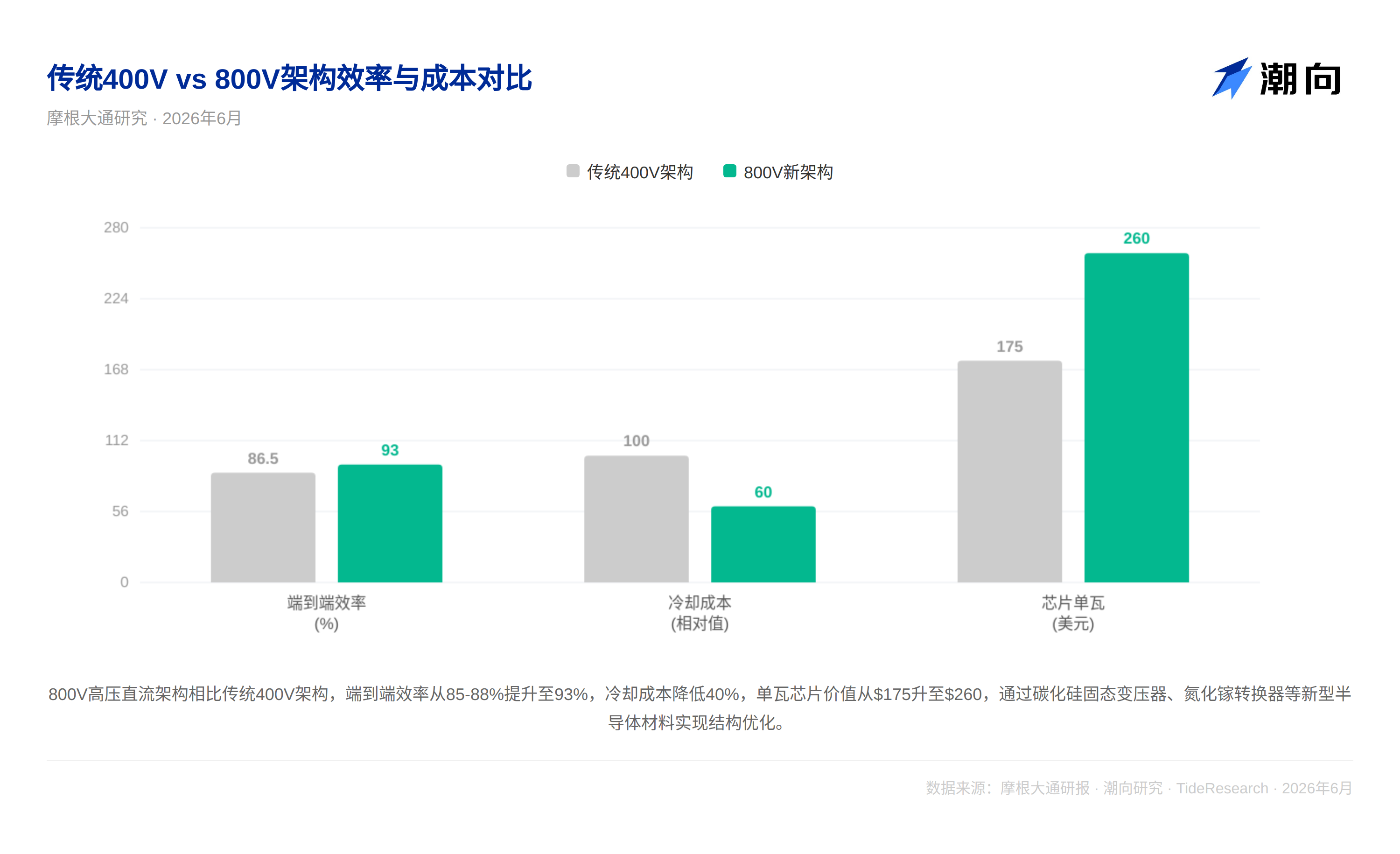
JPMorgan's first-principles analysis of the complete AI data center power delivery chain delivers a striking conclusion: the power semiconductor market will balloon from approximately $2.7 billion in 2025 to $19.2 billion by 2028, representing a three-year compound annual growth rate of 82%. The bigger catalyst is the 800V high-voltage DC (HVDC) architecture revolution, which replaces traditional electromechanical equipment with silicon carbide (SiC) solid-state transformers and gallium nitride (GaN) converters, boosting semiconductor content per watt from $175 to $260. A previously overlooked value chain is now being exposed.
Current Power Chain: Inefficient Five-Stage Conversion
Today's data center power distribution is a classic long-chain, low-efficiency model: grid 10-35kV AC is stepped down to 400-480V via transformer, passes through UPS, then PDU, then server PSU (AC to DC), and finally VRM to sub-volt GPU core voltages. Five stages, each losing 2-5%, yielding end-to-end efficiency of only 85-88%. For a 100kW rack, that means 15kW of waste heat requiring active cooling.
The $19.2B Market: Semiconductor Content per Watt from $175 to $260
Using internal AI server models, JPMorgan estimates that by 2028 global AI data centers will add ~81 GW of installed capacity (63 GW new build + 18 GW replacement), with AI chip power consumption accounting for approximately 54 GW. The power semiconductor market supporting this 81 GW is projected to see per-watt semiconductor content rise from $175 today to $260, pushing total addressable market to $19.2 billion. The inflection point is the adoption of 800V HVDC architecture.

800V HVDC: Copper Loss Falls to One-Quarter, Material Content Transforms
The physics is straightforward: power = voltage × current, and thermal loss is proportional to the square of current. By raising voltage from 400V to 800V, current halves and copper loss drops to one-quarter. But the real transformation is in semiconductor content density. Traditional architecture concentrates semiconductors in PSU and VRM, while 800V architecture introduces four new nodes: SiC solid-state transformer (replacing copper-wound transformer), SiC solid-state circuit breaker (microsecond fault interruption), DC-native battery backup unit (with bidirectional DC-DC converter and BMS chip), and rack-level 800V-to-low-voltage DC-DC conversion.
Deployment Timeline: NVIDIA Kyber Rack Drives Scale from H2 2027
The report outlines a clear timeline. 2026-2027 still dominated by conventional 400V architecture, but retrofits begin with side-car power shelves. From H2 2027 to 2028, NVIDIA’s Kyber rack (600kW per rack) will drive native 800V solutions toward volume deployment. Post-2028, solid-state transformers mature, merging side-car power shelf and transformer into a single SST device.

Material Share Evolution: SiC, GaN, and Silicon Compete
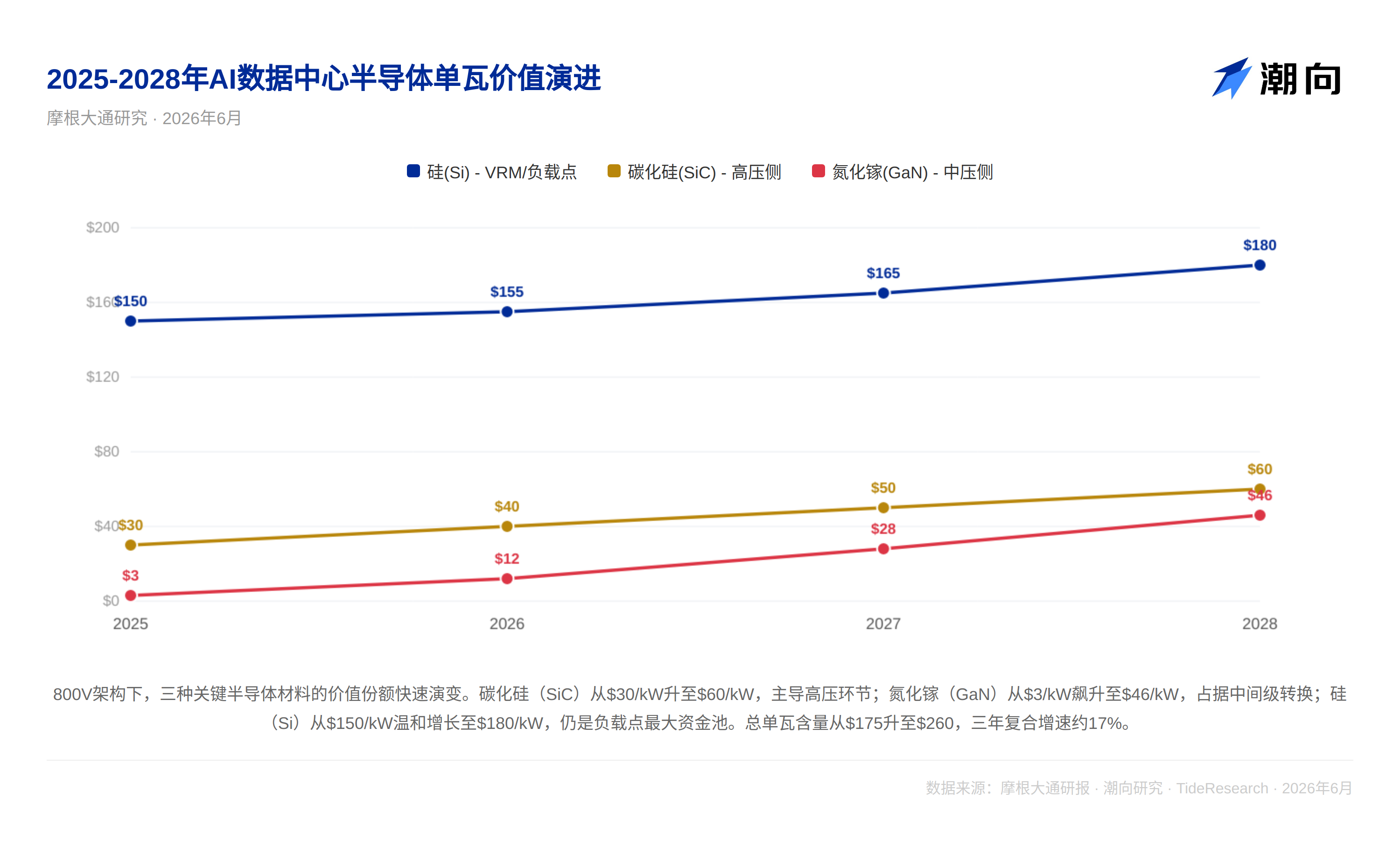
JPMorgan quantifies the changing semiconductor mix. SiC per-watt content rises from $30 to $60 long-term, dominating grid-to-rack high-voltage stages. GaN surges from $3 to $46, winning intermediate 800V-to-low-voltage conversion. Silicon grows moderately from $150 to $180, still anchoring the largest VRM/point-of-load pool thanks to cost-performance advantage.
Player Landscape and Risk Warnings
Key players are solidifying. Infineon (strongest full-chain coverage), MPS (VRM leader, core NVIDIA supplier), and Renesas hold largest shares in intermediate conversion and point-of-load. NVIDIA has selected multiple suppliers. The report covers 12 core companies: Infineon, MPS, Renesas, TI, STMicroelectronics, Navitas (GaN leader), ADI, Onsemi, Rohm, Innoscience, AOS, and Wolfspeed. Two risks are flagged: (1) U.S. grid upgrade cycles (median 3-5 years) conflict with data center construction cycles (2 years), challenging the 81 GW 2028 forecast; (2) NVIDIA’s pricing power along the value chain means its selection of power suppliers for the Kyber rack will directly reshape competitive dynamics. Additionally, JPMorgan has investment banking relationships with Infineon, STMicroelectronics, and other covered companies – readers should consider this context.