
JPMorgan: AI Data Center Power Semiconductor Market to Grow 3x in Three Years
JPMorgan applied first-principles reasoning to the complete power delivery chain of AI data centers and derived a striking figure: the power semiconductor market will expand from approximately $2.7 billion in 2025 to $19.2 billion in 2028, a compound annual growth rate of 82%. This value chain has been overshadowed by the GPU spotlight — everyone counts GPU shipments, but few count watts.
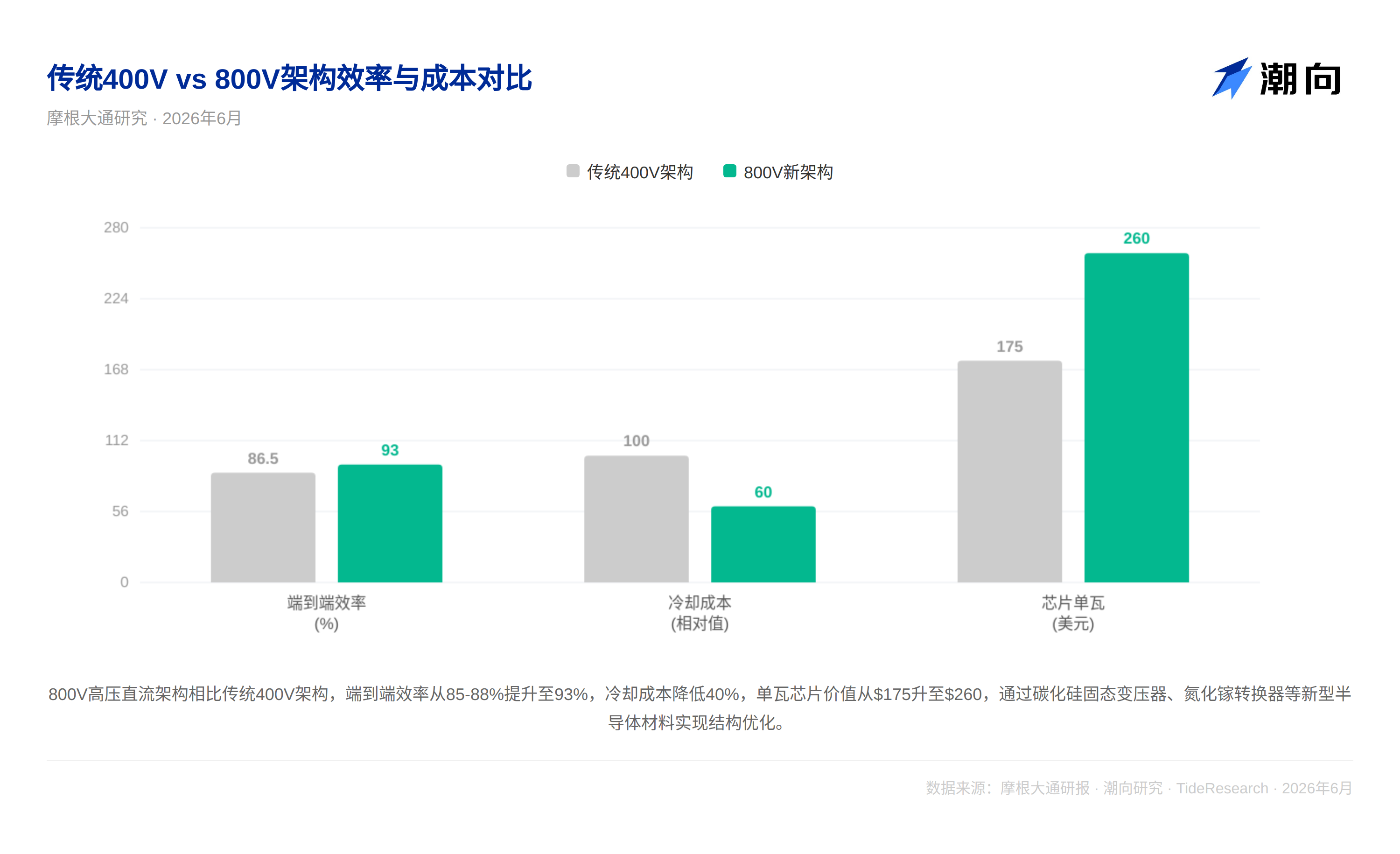
Current data center power distribution is a long, inefficient chain: grid 10-35kV AC is stepped down to 400-480V via transformers, passed through UPS and PDU, converted to DC by server power supplies, and finally regulated to sub-volt levels by VRMs for GPU cores. Each of the five stages loses 2-5%, yielding end-to-end efficiency of only 85-88%. A 100kW rack wastes 15kW as heat. And AI chip power consumption is soaring — JPMorgan's internal AI server model estimates that by 2028, global AI data centers will add ~81 GW of installed capacity (63 GW new builds, 18 GW replacements), with AI chips consuming ~54 GW. To support this 81 GW, the power semiconductor market will see per-watt semiconductor content rise from $175 to $260, pushing the total market to $19.2 billion.
800V HVDC Architecture: The Key to Silicon Content Leap
The report's core technical insight is the replacement of traditional AC architectures with 800V high-voltage DC (HVDC) designs. The physics is simple: power = voltage × current, and heat loss is proportional to the square of current. Raising voltage from 400V to 800V halves the current and reduces copper losses to one-quarter. But the real significance of the architecture shift lies in the qualitative change in semiconductor content. In traditional designs, most stages are electromechanical — semiconductors concentrate only at PSU and VRM. The 800V architecture introduces four new nodes: silicon carbide (SiC) solid-state transformers replacing copper-wound transformers; SiC solid-state circuit breakers for microsecond fault interruption; native DC battery backup units with bidirectional DC-DC converters and BMS chips; and rack-level 800V-to-low-voltage DC-DC conversion.

The report provides a clear timeline: 2026-2027 will still see predominantly traditional 400V architectures, but retrofits have already begun with sidecar power shelves and power racks emerging. From the second half of 2027 through 2028, Nvidia's Kyber rack (600kW per rack) will drive large-scale deployment of 800V native solutions. After 2028, solid-state transformers mature, consolidating sidecar power shelves and transformers into a single SST device. The per-watt semiconductor content jumping from $175 to $260 is precisely the incremental contribution from these four new device categories.

Semiconductor Materials and Competitive Landscape: SiC, GaN, and Silicon Divergence
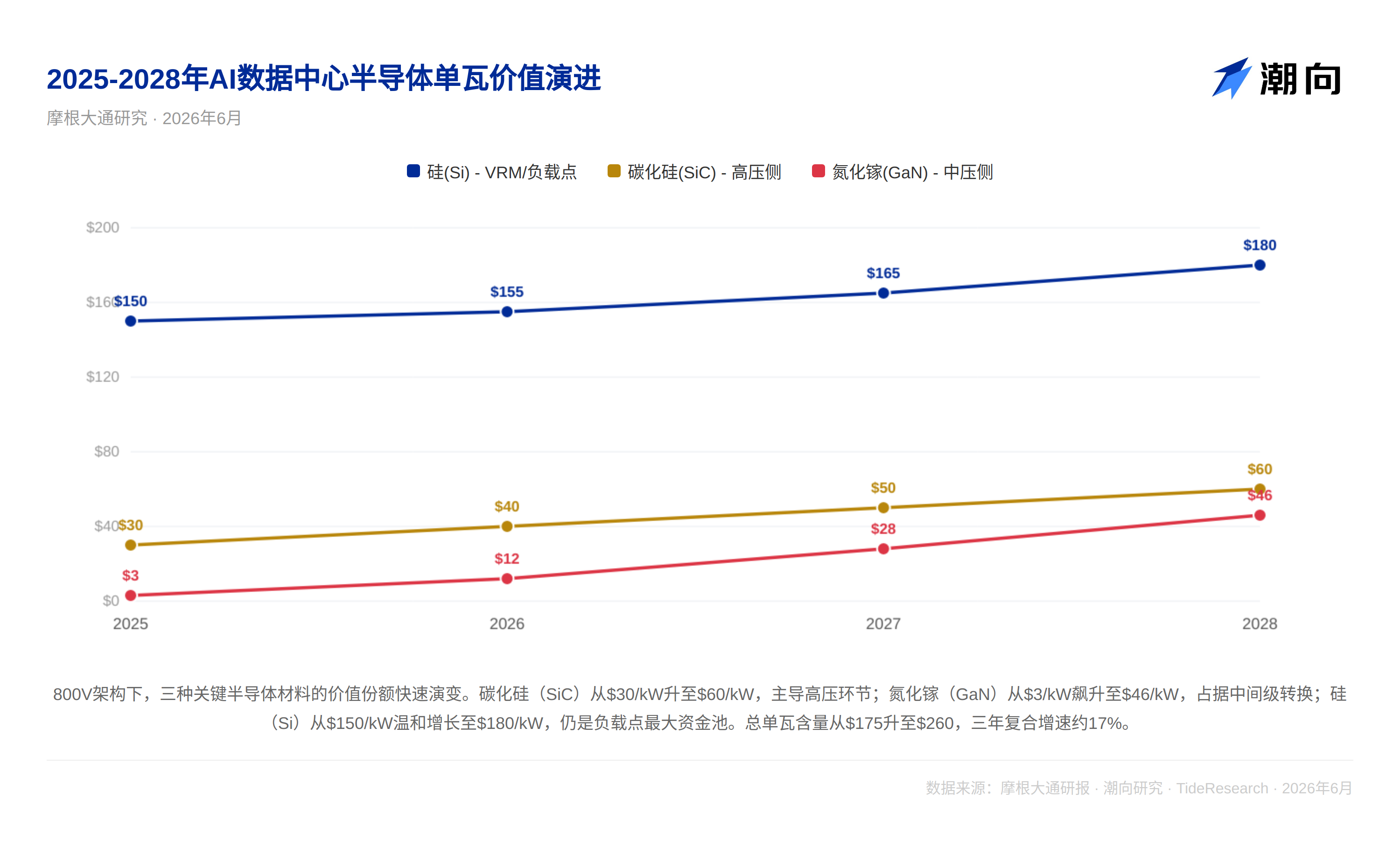
The report quantifies the share evolution of different semiconductor materials. Silicon carbide per-watt content will rise from $30 today to $60 in the long term, dominating the high-voltage segment from grid to rack. Gallium nitride (GaN) will surge from $3 to $46, winning the intermediate conversion stage from 800V to low voltage. Silicon will grow modestly from $150 to $180, still occupying the largest pool — VRM/point-of-load — and defending its position by cost performance.

The key player landscape is forming. Infineon is strongest across the full chain; MPS is the VRM leader and a core Nvidia supplier; Renesas holds the largest share at intermediate conversion and point-of-load. The report covers 12 core companies: Infineon, MPS, Renesas, TI, STMicroelectronics, Navitas (GaN leader), ADI, ON Semiconductor, Rohm, Innoscience, AOS, and Wolfspeed. Note that JPMorgan has investment banking relationships with Infineon and STMicroelectronics, so the company-specific recommendations should be considered with that context.

Execution Risks and Investor Considerations
The core value of JPMorgan's report lies in framework building rather than specific target prices. The $19.2 billion figure is modest relative to overall AI infrastructure spending, but the key point is: without sufficient power semiconductors, no amount of GPUs can run. Two assumptions not fully explored deserve attention.

First, the delivery cycle of grid expansion (US median 3-5 years) severely mismatches the two-year data center construction cycle. The 81 GW installation forecast for 2028 faces execution risk on the grid side — US grid upgrade capacity may not keep pace with AI infrastructure build-out. Second, Nvidia holds pricing power over the entire value chain; its choice of power suppliers for the Kyber rack will directly impact competitive dynamics. Investors should closely track changes in Nvidia's supplier list.