
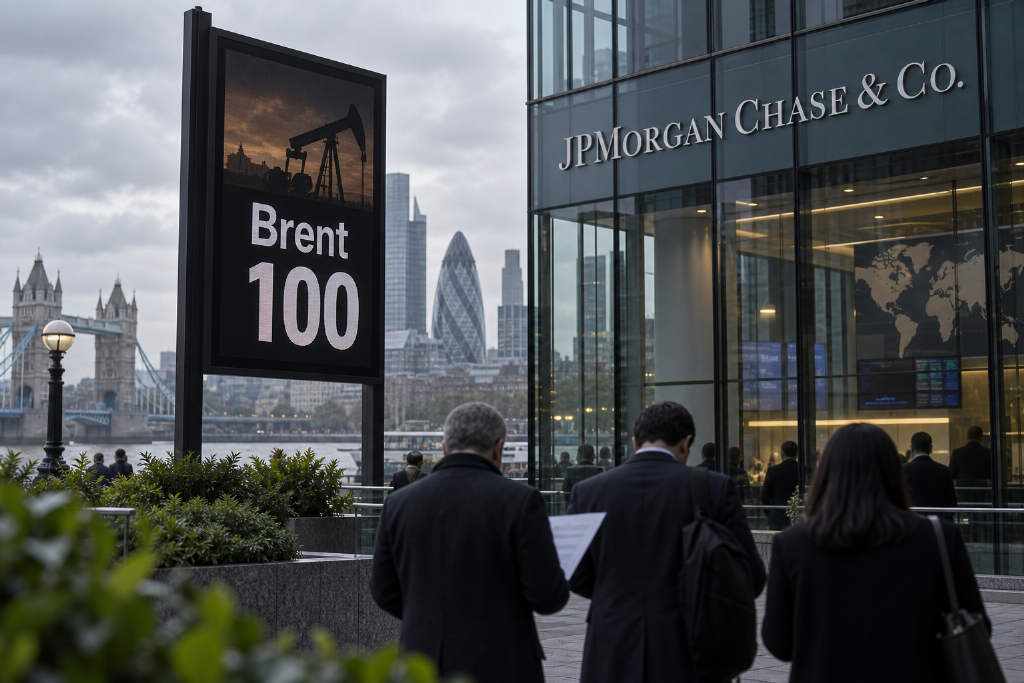
JPMorgan said the move in Brent crude above $100, with the benchmark at $107.6 on Sept. 10, combined with rising bond yields to push global equities lower, but the bank does not see the latest pullback as a trend reversal. In its equity strategy report dated Sept. 14, 2026, the bank said the sell-off has created room to add to stock positions and argued that third-quarter earnings, due to start coming through in October, should help calm markets.
The report, written by strategist Mislav Matejka, framed the central question as whether investors should join the sell-off. JPMorgan’s answer was no. The bank said the short-term direction of oil will shape risk appetite, but the volatility should not be extrapolated too far. Over the past two years, the “escalation to de-escalation” pattern has played out repeatedly, and turning bearish because of higher oil prices could leave investors exposed if follow-up headlines turn more constructive.
Oil shock seen as a chance to add risk
JPMorgan described Brent’s break above $100 last week as the final blow to equity market resilience. Before that, stocks had held up well on the back of improving economic activity and earnings upgrades. The bank said the current setup fits its “escalation to de-escalation” template, adding that over a three- to six-month horizon it does not pay to sell an equity decline driven by the oil move.
The report noted that seasonal factors are weak at the moment and that investors remain uneasy about inflation and higher bond yields. Those pressures could still leave markets softer over the next few weeks. Even so, JPMorgan said investors should avoid reading too much into the volatility, arguing that the seasonal drag should fade as the calendar turns and that the next earnings season will offer a fresh anchor for pricing.
On earnings, the bank said revision momentum is improving in a key area, with upgrades outnumbering downgrades and breadth continuing to widen. JPMorgan added that this kind of positive revision backdrop is rarely seen at the start of a prolonged market decline. It also pointed to better euro area manufacturing PMI readings in the second quarter and stronger U.S. ISM manufacturing data as support for third-quarter earnings.
Stock-bond correlation has not reached the turning zone
JPMorgan said equities have absorbed the rise in bond yields fairly well this year. MXWO is up 11% year to date, while bond yields have risen by 65 basis points over the same period. In the bank’s view, the latest rise in yields has been driven by upgrades to economic activity and corporate earnings, with real rates moving higher but long-term inflation expectations staying contained.
The report said 5y-5y inflation forwards have not reacted to the recent jump in oil prices, a break from the historical relationship. Term premium, meanwhile, is at a 10-year high, and most of the normalization has already happened. Wage growth is still slowing, and while the latest nonfarm payrolls report showed solid headline data, hourly pay growth was the slowest in five years. JPMorgan said that with nominal GDP growth averaging 5% to 6%, bond yields at or below that range should not be treated as a headwind.
The bank has long argued that stock-bond correlation risks become more serious when the 10-year U.S. Treasury yield approaches 5% to 5.5%. At around 4.83% now, yields are still below that area. As long as the drivers of higher yields do not change and the absolute level does not move too high, JPMorgan does not expect yields to become a major problem over the coming months. It also said credit growth remains strong in both the U.S. and Europe, which it sees as direct evidence that current yield levels have not choked off the economy.
Cyclicals and value remain preferred
On market leadership, JPMorgan said higher yields usually support cyclical stocks, especially when the growth outlook is not being challenged. Over the past several months, sector leadership has been far from defensive. Cyclicals have risen, and low-volatility factors have dropped back to their lows for the year, in line with firmer PMI readings and stronger earnings revisions. If markets were truly moving into a defensive phase, the bank said, investors should be seeing the opposite pattern.
The report added that European cyclicals have stayed closely linked to the PMI cycle relative to defensives, and both are strengthening together. Earnings momentum is also better for cyclicals than for defensive sectors. JPMorgan said value should also perform well, especially as earnings leadership for growth versus value may be peaking. The forward earnings advantage of growth over value is narrowing, which makes it harder for growth stocks to sustain their premium valuations.
Allocation call: overweight equities, emerging markets and the euro area
In asset allocation, JPMorgan kept an overweight on equities, a neutral position on bonds and an underweight on cash. Regionally, it remains overweight emerging markets and the euro area, underweight developed markets, and neutral on the U.S., Japan and the U.K.
The bank said emerging markets look cheap on valuation, could benefit from a restart in fund flows, and may get extra support from a weaker U.S. dollar and easing trade headwinds in China. For the euro area, it cited an improving credit impulse, auto sales data, and strong earnings revisions alongside firmer PMI readings.
At the sector level, JPMorgan is overweight materials, industrials and consumer discretionary, while underweight energy, consumer staples, healthcare and financials. It said materials should benefit from cyclical recovery and earnings revisions, industrials from upgrades in capital goods and transport, and consumer discretionary from better earnings trends in autos and durable goods.
Risks still center on oil and geopolitics
JPMorgan said a further surge in oil prices would put more pressure on equities, and any geopolitical escalation could increase volatility. The bank also said a rate hike by the Federal Reserve this week may be better than no hike because it would help build credibility. As long as any tightening is measured, earnings growth remains strong and inflation expectations stay anchored, the equity market should be able to absorb it.
Based on that view, JPMorgan said investors should use oil-driven weakness in equities to add exposure and argued that once third-quarter earnings begin to come through, the current bout of volatility should give way to a better trading backdrop.
The source article said the piece was a整理 and interpretation by Chaoxiang Research of a third-party broker report from JPMorgan dated Sept. 14, 2026, combined with public market information. It also said that any ratings, target prices, earnings forecasts and related judgments cited in the article were the views of the broker’s analysts, represented only the institution behind them, and did not constitute investment advice.
The article further noted that markets involve risk, decisions should be made independently, and the material should not be used as a basis for buying or selling any security.
