

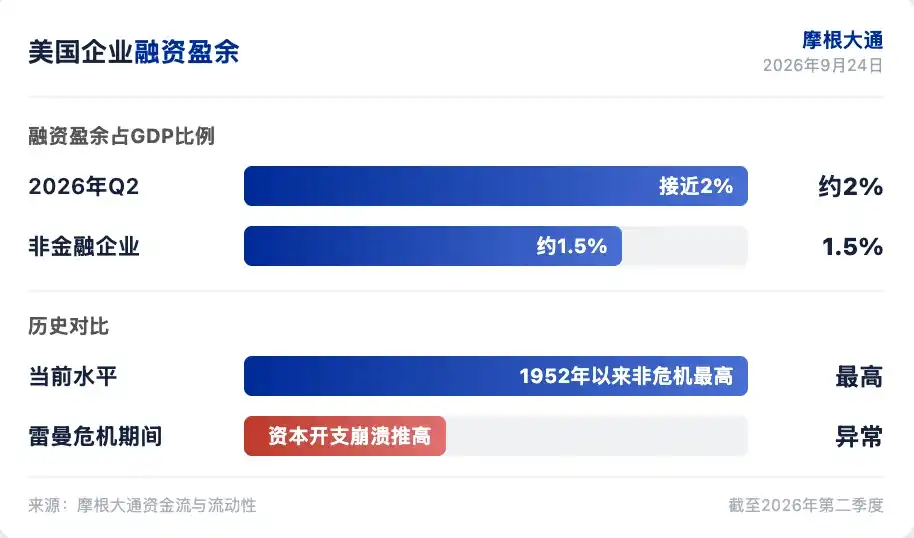
JPMorgan said the U.S. corporate sector’s financing surplus is close to historic highs. In its flows and liquidity report dated Sept. 24, 2026, the bank said the surplus reached nearly 2% of U.S. gross domestic product in the second quarter of 2026, one of the highest non-crisis readings since records began in 1952. For non-financial corporates, the surplus was about 1.5%, the highest non-crisis level since 1958.
The bank said cash-flow growth has been running ahead of capital expenditure, leaving the corporate sector with little need for additional financing. JPMorgan analyst Nikolaos Panigirtzoglou said that backdrop is helping sustain share buybacks and, in turn, support U.S. equities.
Financing surplus widens as cash flow outpaces capex
JPMorgan said the gap between U.S. corporate cash flow and capital spending widened sharply in the first half of 2026. On the bank’s measure, which adjusts for taxes, dividends, capital consumption and inventory valuation, cash flow rose much faster than capex. By the second quarter, the financing surplus was close to 2% of GDP, near the upper end of non-crisis or repatriation-period readings since 1952.
The report noted that the surplus was even higher during the Lehman crisis, but for a very different reason: capex had collapsed. This time, both capex and cash flow are rising, with cash flow increasing faster.
Within that total, non-financial corporates accounted for a surplus of about 1.5%, the highest non-crisis reading since 1958. Financial companies contributed a larger share of the recent expansion in the surplus. JPMorgan added that corporate surpluses across the G4 economies — the United States, the euro area, the United Kingdom and Japan — are also near historical highs, led by the U.S.
AI spending is strong, but broad capex remains restrained
JPMorgan said AI-related capital expenditure is strong, yet overall corporate cash-flow growth is still outpacing capex. One explanation, the bank said, is that AI spending is crowding out other forms of investment and limiting the growth rate of aggregate capex.
Spending tied to AI, especially in data centers, has expanded rapidly, but it remains highly concentrated. Investment outside the technology sector is relatively soft. The share of total U.S. capex in GDP has risen only modestly in recent years and remains well below the strong gains seen in the 1990s. Intellectual property capex has also stayed below 1990s levels, partly because of the 2022 removal of R&D bonus depreciation. JPMorgan said that category picked up again in the first half of 2026 after the One Big Beautiful Bill Act, or OBBBA, restored the provision.
On that basis, the bank said the broad data still do not show a repeat of the capex excess seen in the late 1990s. Corporate savings are still being directed mainly into share repurchases. JPMorgan expects global buybacks to total $1.7 trillion in 2026, with U.S. companies accounting for $1.3 trillion.
The report also said the technology sector’s share of buybacks has risen over the past decade. That mix may change. As AI infrastructure spending eats into earnings at hyperscalers and other technology companies, the contribution from financials is increasing, and the tech sector’s share of buybacks could decline over the next five to 10 years.
Momentum signals turn more negative in bonds, mixed elsewhere
In rates, the z-scores for 10-year U.S. Treasuries and German Bunds fell back to -1.7 and -1.5 after the recent selloff, pushing bond futures momentum signals deeper into bearish territory. U.K. gilt futures returned to -0.8. The spread signal for French government bonds versus Bunds dropped further to -2.5, which JPMorgan said may reflect additional unwinding of euro-area overweight positions seen in its European client survey.

For equity index futures, the S&P 500 signal rose from 0.6 to 1.0, still below the extreme levels above 1.5 seen at the start of the year. Euro Stoxx 50, Nikkei and MSCI Emerging Markets futures signals were in a 0.4 to 0.6 range.
In foreign exchange, the dollar’s momentum signal against G10 currencies rose to +0.5, while the signal against emerging-market currencies was neutral. The yen signal moved from -1.4 at the end of July to +0.5 on Sept. 8, then fell back to -1.0.
In commodities, the oil signal eased from +1.7 on Sept. 15 to +0.9. Refined products slipped from +2.2 to +1.9. Natural gas averaged +0.8, though the Dutch TTF signal peaked at +2.3 before retreating. Gold fell from 1.3 to neutral, silver stood at +0.3, and Bitcoin was at +1.0.
Bitcoin moves back above estimated production cost
JPMorgan said Bitcoin had traded below its production cost for 280 days before recently breaking back above that level. The bank estimated the average cost to produce one Bitcoin at about $85,000, with the spot price moving above that threshold before the latest pullback.
A sustained move above production cost would ease pressure on miners and lower the risk of forced selling, according to the report. JPMorgan said miners have been managing their fleets by relocating machines to regions with cheaper electricity, reselling older rigs, idling equipment, scrapping units or recycling inefficient hardware. Those cleanup measures can improve average efficiency and reduce selling pressure from weaker operators.
The bank also said Bitcoin network hashrate and mining difficulty are down about 19% and 15% from their peaks in October last year, reflecting a structural shift by miners toward AI. JPMorgan said AI customers are paying large premiums for existing power access and data-center infrastructure, drawing miners toward cash flows that are more predictable, more stable and higher on a per-megawatt basis. It added that the share of publicly listed miners has declined relative to private and sovereign miners.
Three market observations from JPMorgan
JPMorgan grouped its market view into three points. First, corporate financing surpluses are near historical highs, reducing financing needs and supporting buybacks, especially outside the technology sector. Second, AI capex is crowding out other capex, leaving overall investment growth moderate and still short of the excess seen in the late 1990s. Third, Bitcoin’s move above production cost reduces the risk of forced miner selling, even as the shift toward AI is contributing to a structural slowdown in hashrate growth.
The original article said it was a整理 and interpretation of a third-party broker report from JPMorgan dated Sept. 24, 2026, combined with public market information. It also said that any ratings, target prices, earnings forecasts and related judgments cited in the piece were the views of the broker’s analysts, represented only their institution’s position, and did not constitute investment advice.
The article ended with a risk reminder, saying market decisions should be made independently and that the piece should not be used as a basis for buying or selling any security.