
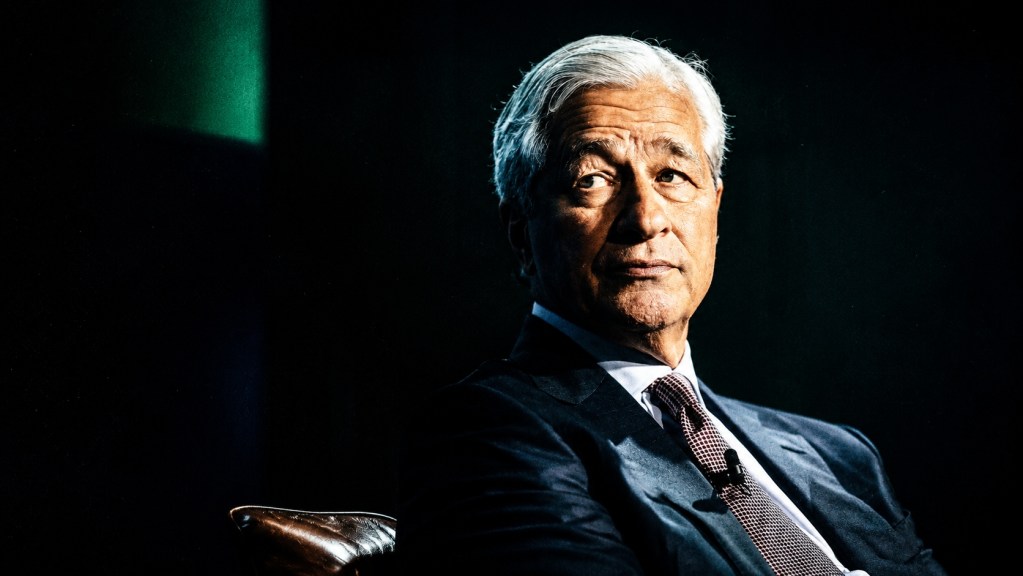
JPMorgan CEO Jamie Dimon said he would not buy U.S. stocks or long-term U.S. Treasuries at current prices, arguing that investors are not fully accounting for geopolitical threats and the risks tied to America’s fiscal position.
In an interview on The Master Investor Podcast released Monday, Dimon said current market pricing does not adequately reflect how complicated the global backdrop has become. He specifically cited the Russia-Ukraine war, conflict involving the U.S. and Iran in the Middle East, continuing tension between the U.S. and China, and the fact that governments are increasing military spending while fiscal deficits widen.
He said the potential impact of those risks could be larger than many investors assume. While he acknowledged that some of those threats may already be reflected in prices, he argued that markets are not necessarily prepared for the real shock if events escalate. “Some things may be priced in, but what actually happens is what is not priced in,” he said.
Dimon added that the global economy is more resilient than it used to be because it is less dependent on energy than in the past. Still, he said that does not remove the chance of a sudden tipping point. “You may need more straws to break the camel’s back before you hit that tipping point, but that doesn’t mean the risk isn’t there,” he said.
Fiscal deficit and rates
On U.S. fiscal policy, Dimon said he is pessimistic. He argued that the country’s growing budget deficit will eventually trigger a market reckoning, with so-called bond vigilantes demanding higher yields to compensate for the risk of holding U.S. government debt. In his view, that would push interest rates higher across the market.
“My view is that this is going to be a big problem,” he said.
Dimon said he would not buy long-dated Treasuries. Even if inflation falls cleanly back to the Federal Reserve’s 2% target, he said the 10-year Treasury yield “should probably be at 4% to 4.5%,” leaving little room for bond prices to rise.
He took a similarly cautious line on equities. Dimon said he would not rule out buying an individual stock that looked attractive, but he would not position in the broader market at current valuations. ABMedia noted that the S&P 500 has risen nearly 10% this year, making his view stand out against the market’s prevailing optimism.
AI returns may take longer than investors expect
Dimon was more constructive, though still careful, on the artificial intelligence boom. He compared the current AI wave with the late-1990s internet bubble and said AI could, in aggregate, end up producing meaningful returns in the same way the internet era eventually did.
At the same time, he said investors should not assume they can accurately predict either the timetable or the companies that will come out on top. He pointed to the internet era as an example: early leaders such as Yahoo and Netscape faded, while Google and Facebook emerged later and became the major winners.
“Will it happen the way you think, in the timetable you think? Absolutely not,” Dimon said.
That leaves a central question hanging over the AI trade: whether the heavy capital spending now pouring into the sector will translate into corporate profits on the schedule investors expect.
Warning arrives as sentiment stays strong
Dimon’s remarks landed at a time when market sentiment remains firm. According to the report, the S&P 500 is up nearly 10% this year, consumer spending is still solid, inflation has continued to cool, and AI remains a core theme driving capital flows.
At the same time, JPMorgan and other major banks reported strong second-quarter earnings last week. Trading and investment banking helped lift results well above market expectations, reinforcing a broader view that the U.S. economy has been more resilient than many expected.
As the head of the world’s largest bank by market value, Dimon has long been seen as one of Wall Street’s most persistent warning voices. His latest message was straightforward: even in an upbeat market, investors should keep an eye on the risks that have not been fully priced in.