

JPMorgan said in a July 21 research note that South Korea’s KOSPI has fallen about 28% from its June 22 peak, while positions in leveraged exchange-traded funds and hedge funds have been cut sharply. Even so, the bank kept its overweight view on Korea and left its 12-month KOSPI target at 12,500.
The note framed the latest slide in Korean equities as a deleveraging event and a reset in concentrated positions rather than a sudden break in fundamentals. By JPMorgan’s estimates, Korea-linked leveraged ETF assets dropped from about $50 billion at the end of June to $26 billion currently, with roughly 75% of the unwind already completed. Equity hedge funds have also deleveraged by more than half. Foreign investors have pulled out more than $110 billion this year, and around 90% of that outflow came from memory names Samsung Electronics and SK Hynix.
That does not mean conditions have normalized. JPMorgan said volatility in Korean equities is still high, with the VKOSPI-to-VIX ratio close to 5x versus a level of around 1x in normal periods. Tight swap capacity, tighter regulation on single-stock leveraged products, and uncertainty over whether AI demand can keep supporting the memory and industrial chain are still shaping the final stage of the adjustment.
A deep drawdown, but JPMorgan says the selling looks more like forced positioning than a collapse in fundamentals
The decline has been severe. The KOSPI closed at a record 9,114.55 on June 22, then fell more than 20% from that high by early July. Using a level around 6,516 near July 21, the index was down roughly 28.5% from the peak.
JPMorgan’s decision to keep a 12,500 target rests on the view that the drop was driven by crowded trades being pushed out of the market, not by a sharp deterioration in the underlying story. Korean equities had rallied quickly on AI, the upcycle in memory, and expectations for corporate governance reform. Some investors amplified exposure through leveraged ETFs, swaps, and long-short funds. Once volatility rose, liquidations and redemptions intensified the move lower.
A four-week pullback of nearly -26% in the price momentum factor pointed to the same pattern: stocks that had risen the most and attracted the heaviest positioning were under the greatest pressure.
Volatility, however, is still far from normal. With VKOSPI running at close to five times the VIX, JPMorgan said local market volatility remains far above US levels. Positioning pressure is easing, but short-term price swings can still be amplified.
Leveraged ETF assets fell from about $50 billion to $26 billion
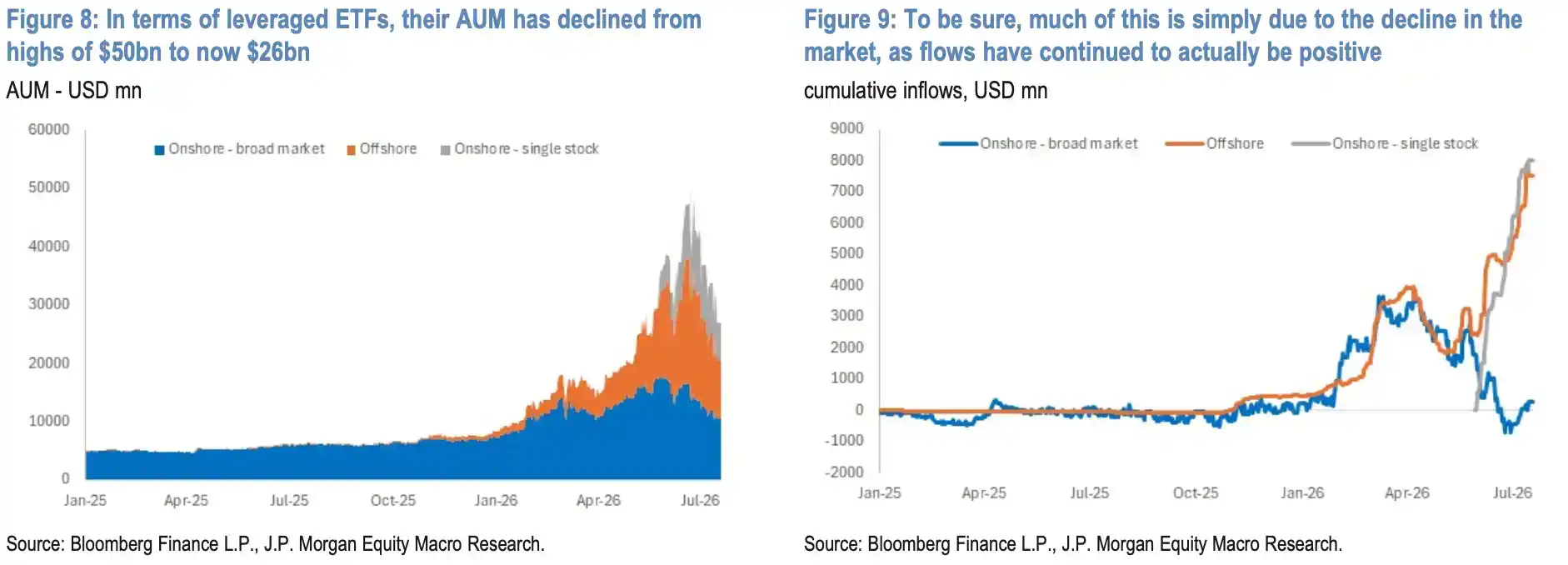
The most visible cleanup happened in leveraged ETFs. JPMorgan estimated that leveraged ETF assets tied to Korean underlyings fell from about $50 billion at the end of June to $26 billion now. That implies about 75% of the unwind has already happened and leaves the market closer to what the bank sees as a more acceptable level of around $18 billion.
The bank said the drop in assets should not be read simply as heavy investor redemptions. Cumulative flows over the same period remained positive. The decline in assets was driven mainly by falling markets, meaning net subscriptions did not disappear but the value of leveraged exposure contracted as prices fell.
That matters for market mechanics. If leveraged product assets had stayed elevated, each new decline could have triggered more forced selling. With assets nearly halved, the same price move should have a smaller effect on subsequent liquidation pressure.
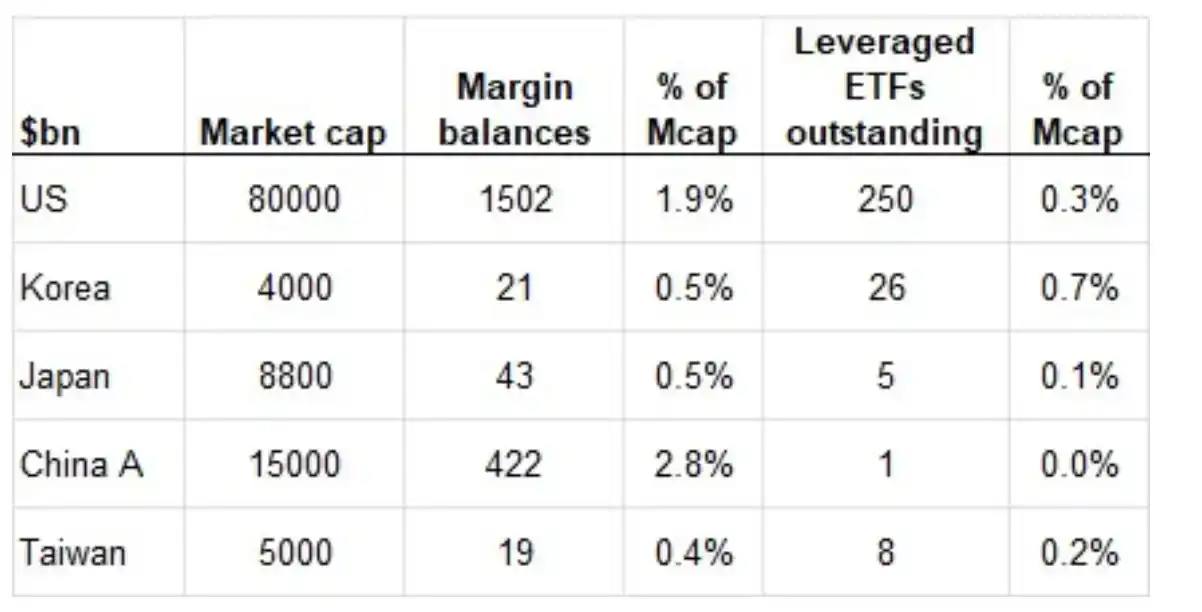
On a cross-market comparison, Korea’s retail margin financing does not look extreme on its own. JPMorgan’s figures showed margin balances at about $21 billion, or 0.5% of total market capitalization, while leveraged ETFs stood at about $26 billion, or 0.7%. In the US, margin balances are about 1.9% of market cap and leveraged ETFs about 0.3%. In China’s A-share market, margin balances are about 2.8% and leveraged ETFs close to 0%.
That comparison suggests Korea’s issue is not unusually high margin balances. It is the larger role played by leveraged ETFs in the market. Retail investors remain an important source of buying in Korean equities, and since June, several leveraged products have still ranked near the top in overseas stock purchases. Sentiment has not fully cooled; falling prices and regulatory expectations have simply pushed leverage lower first.
Hedge funds have also cut leverage by more than half, though conditions are not back to normal
A second sign of the cleanup came from hedge funds. JPMorgan’s prime book showed equity hedge funds had deleveraged by more than 50%, with the long-short ratio dropping from above 5.5x at the peak to below 4x.
That suggests funds that added aggressively during Korea’s rally over the past year have already cut a meaningful amount of exposure. A roughly 28% drop in the index shows prices have reset sharply. A lower long-short ratio shows the fuel for forced selling is also being reduced. If that ratio falls further, the risk of chain-reaction selling from crowded positions should be lower than it was at the end of June.
Still, below 4x does not mean normal. Deleveraging remains incomplete, swap capacity is still tight, and volatility is still unusually high. In a concentrated market like Korea, any narrowing in financing channels can magnify drawdowns in the most popular names, especially those tied to the AI and memory trade.
JPMorgan also cautioned that a 75% unwind should not be treated as a confirmed bottom. The market may have moved away from its most crowded state, but as long as volatility stays high and financing stays tight, the remaining positions can still intensify down moves on specific trading days.
More than $110 billion in foreign outflows, concentrated in two memory stocks
The structure of foreign flows matters more than the headline total. In JPMorgan’s July 21 note, foreign investors were shown to have sold more than $110 billion of Korean equities this year, with about 90% of that outflow concentrated in Samsung Electronics and SK Hynix.
The report added that similar public figures in late June were around $95 billion, and that the later number may have been updated after further market declines and foreign selling.
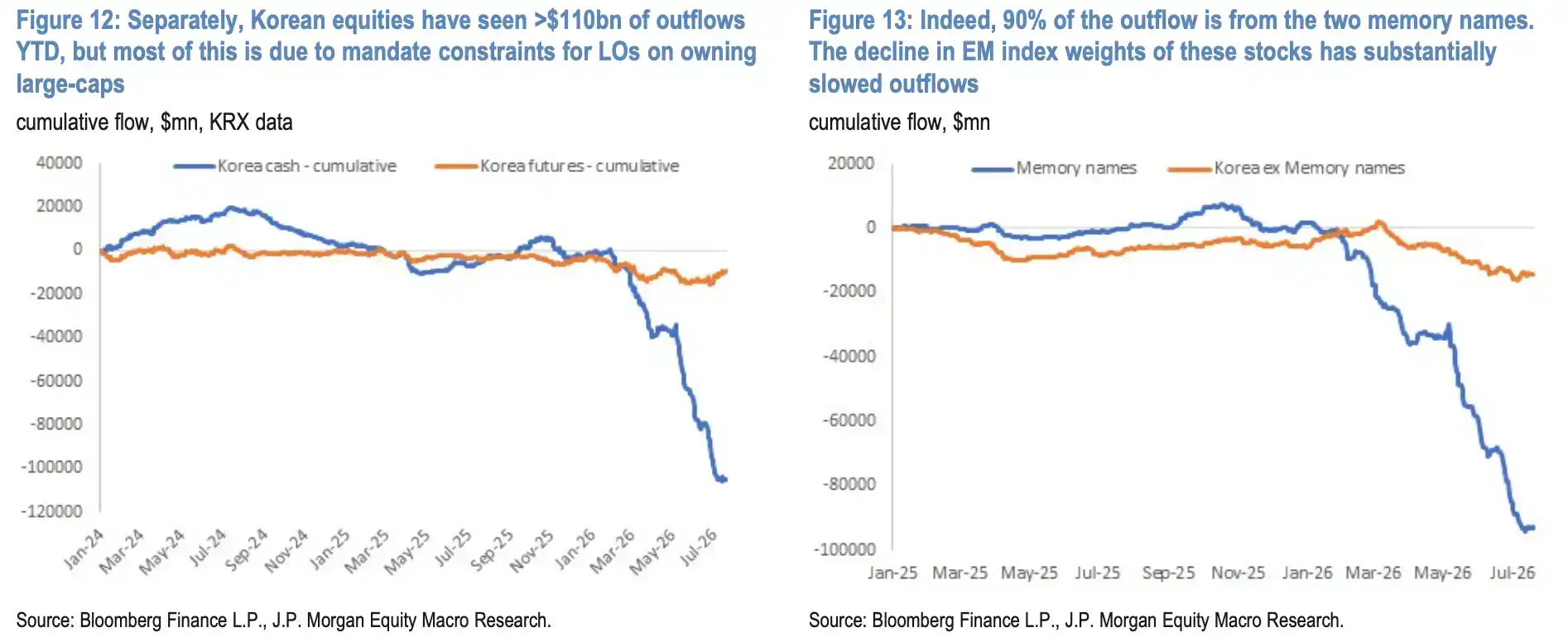
This kind of concentrated outflow is different from a broad exit from Korea. The two memory names saw their weights in the MSCI Emerging Markets Index fall from 9.5% and 8.3% at the end of June to 7.5% and 5.7%. With those weights lower, funds constrained by mandates, benchmark weights, or concentration limits may face less forced selling pressure going forward.
That is one reason JPMorgan kept its overweight stance. If foreign investors were cutting Korean assets across the board, the issue would look closer to a broader confidence problem. If the selling is centered on two overweight memory stocks, the market may behave differently once index weights and position limits become less binding.
The risk remains in the same place. Korea’s market support is still closely linked to AI capital spending, data-center construction, and demand for high-end memory. If investors start questioning the durability of AI compute spending, or if a new technology path implies less need for premium memory, Samsung Electronics and SK Hynix could again become the main channel through which foreign flows and index volatility are amplified.
Korea tightens rules for single-stock leveraged products
Korean regulators have already moved to cool high-leverage trading. On July 16, the Financial Services Commission said it would suspend new listings of single-stock leveraged, inverse, and covered call products.
The minimum deposit requirement will rise from KRW 10 million to KRW 30 million, with implementation expected on Aug. 5. From Aug. 19, only cash will count toward initial margin. Starting in November, the minimum trading unit for Korea-listed single-stock leveraged products is set to increase from one share to 20 shares.
These steps do not cover all leveraged ETFs. They are aimed specifically at single-stock leveraged products. The immediate effect is not to lift the index, but to limit how quickly leverage can build again. Even if retail sentiment stays firm, the room for investors to scale up exposure through small trades and non-cash collateral will narrow.
That helps explain why JPMorgan can stay constructive on Korea while still stressing regulation. If the clampdown proves temporary, leverage could reappear through other products or venues. If the new rules stick, the market’s built-in mechanism for amplifying volatility should weaken.
2026 EPS revisions are still rising, and AI remains the core variable
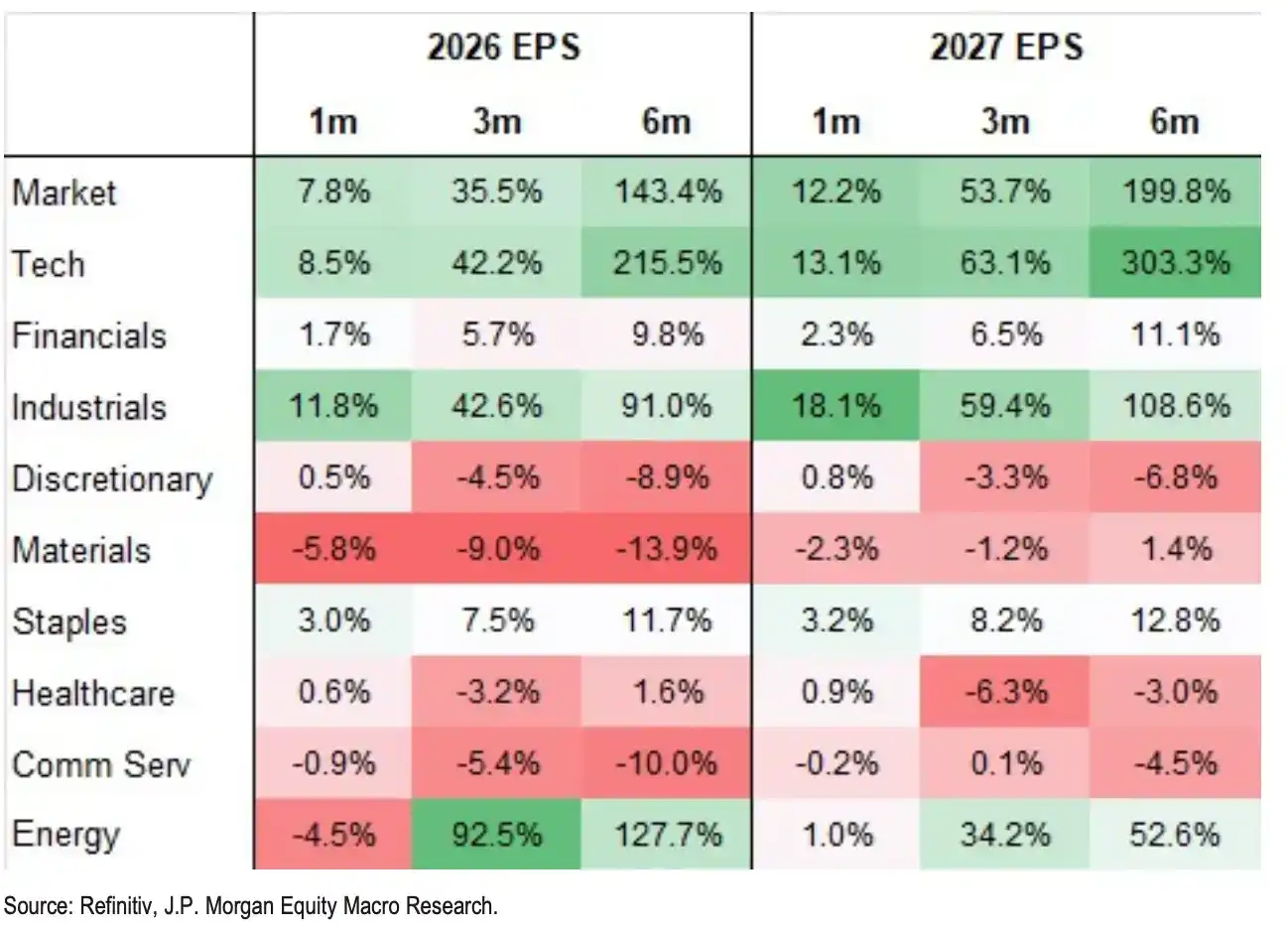
Another pillar of JPMorgan’s view is still-improving earnings expectations. The note said 2026 EPS forecasts for the Korean market have been revised up by 143.4% over the past six months, with technology up 215.5% and industrials up 91.0%.
Even after the sharp equity pullback, analyst revisions remain strong, especially in AI-linked technology and industrial names. JPMorgan tied that to large-scale compute spending, data-center buildouts, security and resilience spending, and longer-term expectations for Korean corporate governance reform. For the Korean market, memory, servers, industrial equipment, and the related supply chain remain the clearest areas of exposure.
The risk sits in the same theme. The fundamental support for Korea’s rally is heavily tied to the AI cycle. If AI capital spending slows, or if new technologies reduce demand for high-end memory and related hardware, the basis for those earnings upgrades could be re-examined. Weakness in materials and consumer sectors also shows that the improvement is not broad across every part of the market.
JPMorgan’s 12,500 target depends on a combination of conditions: continued progress in clearing leverage, no breakdown in the AI demand story, and a moderation in concentrated foreign selling. For now, the bank’s note argues that the most crowded positions in Korea have loosened materially. It does not say volatility is back to normal, that foreign money has turned into a sustained inflow, or that AI-linked earnings upgrades are fully locked in.