
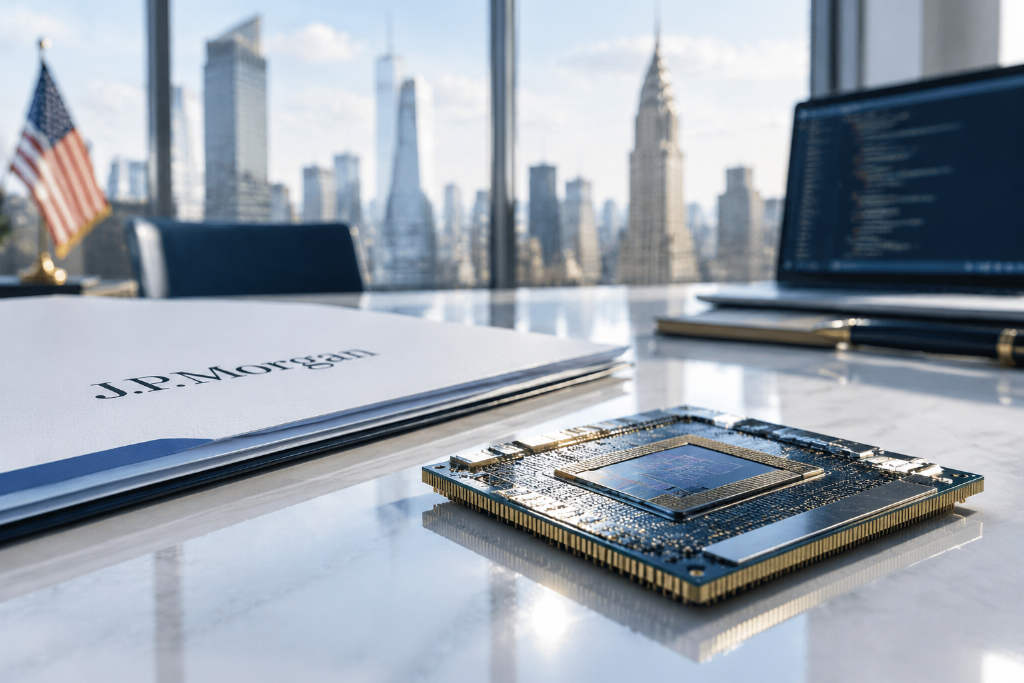
JPMorgan said the valuation reset in several areas of the technology sector is already substantial, with positioning now cleaner, earnings momentum still in place, and the capex upcycle likely to stay intact. In its Sept. 28, 2026 equity strategy report, the bank said the tech and AI ecosystem had been flat for three months from June through last week, but valuation cuts across most segments had become deep enough to support re-engagement with the sector.

The article was written by Rita and presented as a summary and interpretation by Chaoxiang Research of JPMorgan's Sept. 28, 2026 report, combined with public market information.
JPMorgan sees a widening split between semiconductors and software
JPMorgan analyst Mislav Matejka said the bank had argued over the summer that tech and AI were unlikely to dominate markets in the second half of 2026 in the same way they had before, and would not return to being the only trade that mattered. That view remains unchanged. At the same time, he said the AI complex still offers plenty of opportunities.
The report points to a clear divergence in both price action and earnings between semiconductors and software. Software peaked against semiconductors in June and then reversed, while forward earnings for semiconductors kept moving about 30% higher. Software, by contrast, has seen almost no earnings upgrades. JPMorgan said software valuations have fallen to historical lows, but questions around earnings power remain. In that setup, the risk-reward of shorting software is not attractive, and the group could continue to lag other parts of the AI ecosystem. The bank therefore recommends re-entering the relative trade of semiconductors outperforming software.
The report also said comments from Anthropic CEO Dario calling for a need to 「slow down the AI frontier」 triggered a 12% one-day outperformance of software versus semiconductors, the largest daily move since 2025. JPMorgan said it is skeptical that AI development will slow sharply, arguing that the race remains existential and winner-takes-most.
Magnificent 7 valuations have fallen to decade lows
JPMorgan said the Magnificent 7 now trade at their lowest valuation level in a decade, nearly one standard deviation cheaper than the broader market. The bank had already said in March that valuation derating in the group might have gone too far. It now argues that changes in business models, higher leverage, and weaker free cash flow do justify lower multiples, but that a large part of that compression has already happened.
For hyperscalers, JPMorgan expects future share performance to be supported by earnings growth, even if part of that support is offset by additional valuation compression. Not all of it will be. The hyperscaler index referenced in the report includes Amazon, Alphabet, Microsoft, Meta, and Oracle, and is down relative to the market by about 8% this year. JPMorgan's view is that the derating is largely over, leaving earnings growth as the main support for what comes next.
AI capex cycle still looks intact
JPMorgan said the AI capex upcycle remains intact. The report projects a 28% compound annual growth rate in hyperscaler capital expenditures through 2030. Company commentary still points to accelerating demand. The economics of AI continue to justify buying compute, and model progress is still speeding up.
The bank added that over the next two years, companies should still have enough room to raise capex through growth in operating cash flow, debt issuance, and equity financing.
At the industry level, JPMorgan said semiconductor sales growth remains strong and sector fundamentals remain healthy. Supply-demand balance is unlikely to break before 2028, and pricing is expected to keep rising through 2027. Equipment names stand out as major beneficiaries of higher capital spending, with ASML described as a key European equipment stock. JPMorgan said ASML screens as cheap on a PEG basis. Investors are pricing in earnings downgrades, but the bank's analysts see that as a buying opportunity.
Agentic AI may change the CPU-GPU mix
On infrastructure, JPMorgan said traditional large language model deployments typically run with a CPU-to-GPU ratio of about 1:4 to 1:8. In agentic AI, that mix shifts toward 1:1 and could even tilt further toward CPUs, because agents create more orchestration, data movement, tool use, and state-management workloads.
The report said the launch of MetaMuse lifted not only its own share price but also multiple semiconductor stocks, especially CPU-linked names. JPMorgan also highlighted its U.S. CPU ecosystem basket as a way to gain exposure to leading U.S.-listed companies involved in CPU design, manufacturing, and support.
At the same time, agentic AI could create risks for stocks that depend on consumer inertia, search friction, switching costs, or traffic control. JPMorgan said related baskets in Europe and the U.S. underperformed sharply after that announcement.
Three portfolio calls stand out
JPMorgan's allocation view on the technology sector centers on three areas. First, the valuation reset in tech is already substantial, and cleaner positioning supports re-engagement. Second, the semiconductors-over-software trade looks attractive again because semiconductor earnings momentum remains intact. Third, hyperscaler valuations have dropped to decade lows, and future performance should be supported by earnings growth.
Chaoxiang Research said the ratings, price targets, earnings forecasts, and related judgments cited in the article all reflect the views of JPMorgan analysts and their institution, not the stance of Chaoxiang Research, and do not constitute investment advice.
The article also says markets carry risk, investment decisions should be made independently, and the text should not be used as a basis for buying or selling any security.
