
JPMorgan’s JLTXX posts rapid on-chain growth on Ethereum
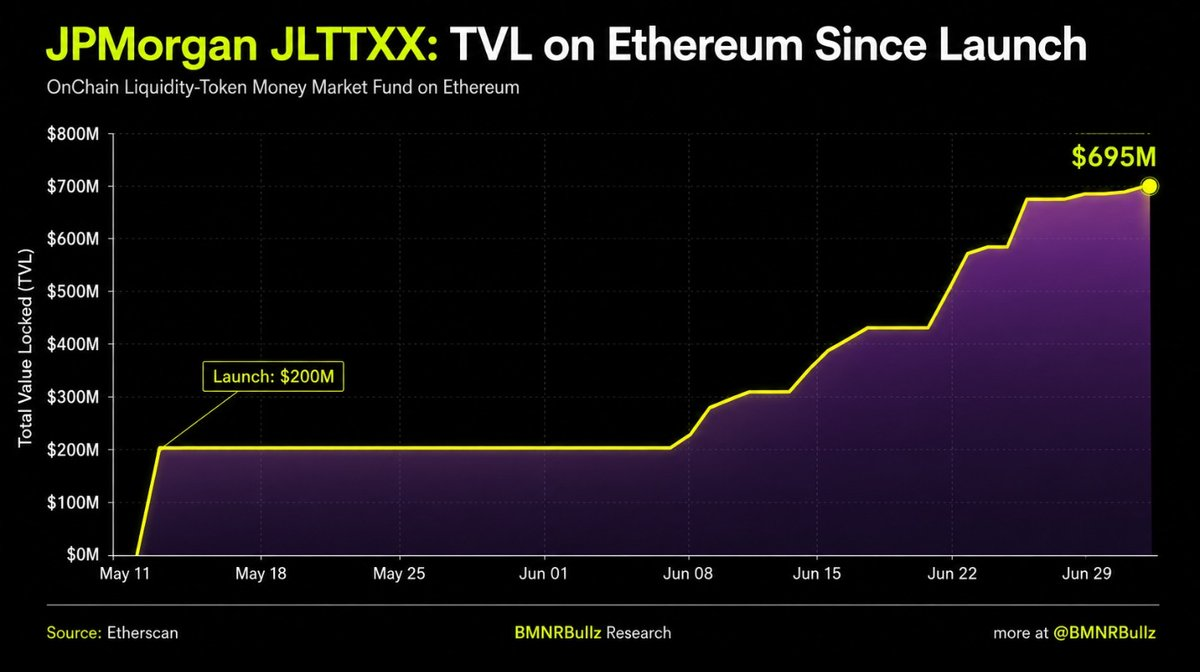
JPMorgan’s OnChain Liquidity Token Money Market Fund, or JLTXX, expanded its on-chain assets by roughly 250% over the past month, according to data cited by The Defiant from Token Terminal. The fund launched on May 13 and runs exclusively on the Ethereum mainnet. Data summarized by ethereuminsti indicates that total value locked was about $200 million on launch day and climbed to $695 million seven weeks later, implying growth of around 248%, broadly in line with the Token Terminal estimate.
The underlying portfolio is conservative. JLTXX invests in short-dated U.S. Treasuries and overnight repurchase agreements fully collateralized by Treasuries or cash, making it structurally similar to traditional low-risk money market products. What stands out is not the asset mix, but the infrastructure choice. JPMorgan already operates its own private settlement network, Kinexys, yet JLTXX, like the bank’s earlier tokenized fund MONY launched in December 2025, was deployed on public Ethereum instead of the bank’s proprietary rails.
That decision carries broader signaling value for crypto markets. A global bank with its own blockchain infrastructure is still choosing Ethereum as the ledger for regulated tokenized products. For ETH market participants, the message is less about speculative upside and more about Ethereum’s role as a base layer for compliant financial issuance and settlement. This kind of demand does not necessarily translate into immediate price appreciation, but it can accumulate into durable network usage over time.
Stablecoin reserve demand is becoming a major growth driver
Part of JLTXX’s acceleration appears to be linked to stablecoin reserve allocation. According to a Dune-focused analytics account cited in the source article, JLTXX has been added to the reserve asset pool for the USDG stablecoin, alongside BlackRock’s BUIDL and Superstate’s STBXX. That development points to a growing segment of demand: stablecoin issuers need on-chain Treasury exposure that fits the reserve requirements under the U.S. GENIUS Act, the stablecoin legislation passed in 2025.
Tokenized Treasury money market funds fit that need particularly well. They provide regulated exposure to high-quality short-duration government assets while remaining operable within blockchain-based infrastructure. JPMorgan also designed JLTXX to accept subscriptions in both cash and stablecoins, putting the product directly at the intersection of traditional finance and crypto-native capital flows.
Competition in the sector is intensifying. BlackRock has already filed with the SEC for two tokenized money-market-related products. One of those filings would tokenize a share class of an existing $6.1 billion Treasury liquidity fund onto Ethereum. Meanwhile, BlackRock’s BUIDL remains the world’s largest tokenized fund, with assets under management exceeding $2.8 billion by early 2026 and distribution across eight blockchains. Read together, those moves suggest a consistent institutional preference: as tokenized funds and stablecoin reserves scale, Ethereum is increasingly being selected as the settlement and issuance layer.
BitMine adds $73 million in ETH and approaches 5% of circulating supply
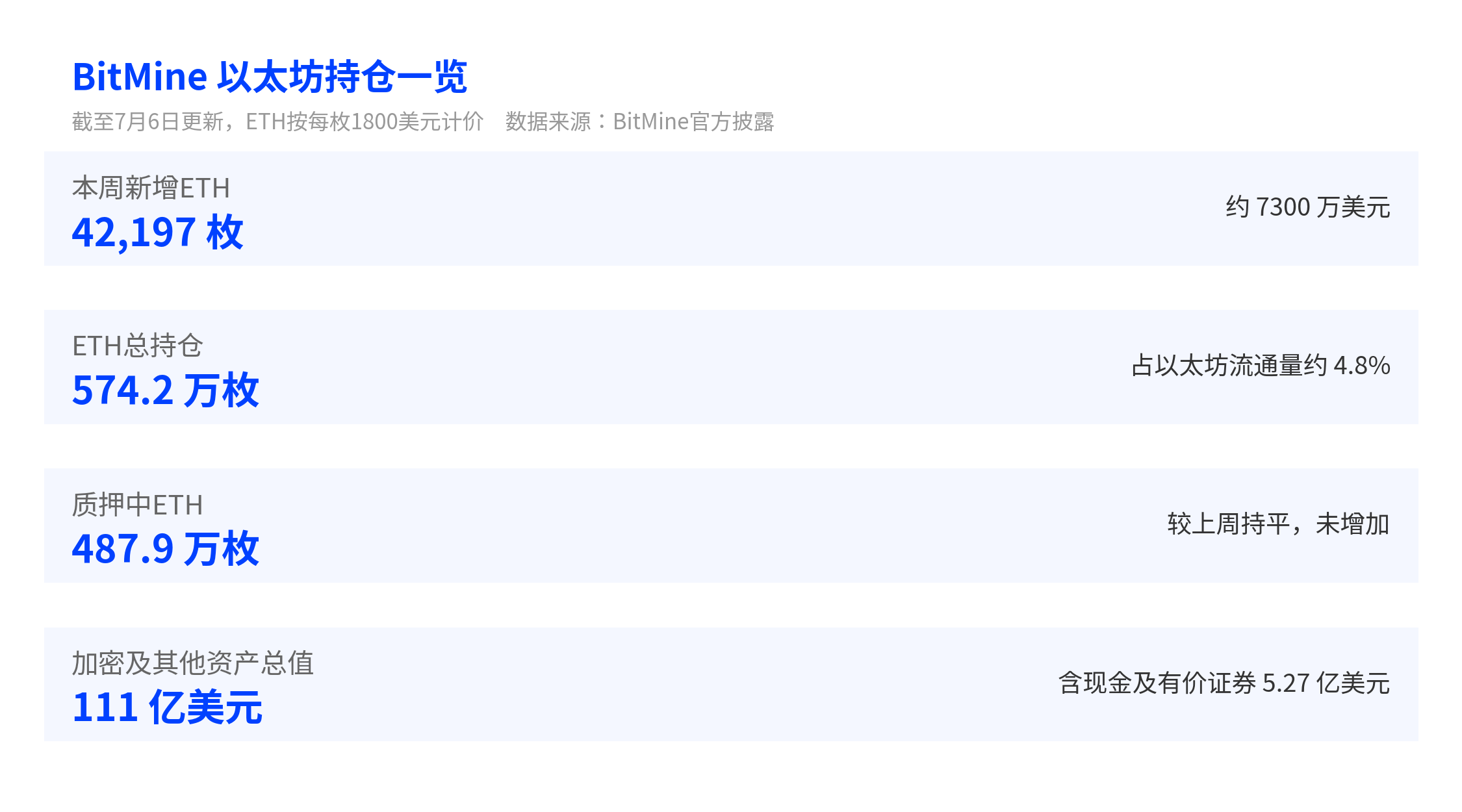
Institutional positioning around Ethereum is not limited to tokenized fund issuance. Treasury-style balance sheet accumulation is also continuing. On Monday, BitMine Immersion Technologies (NYSE: BMNR) disclosed that it bought 42,197 ETH over the past week, worth about $73 million at the time of purchase. That raised the company’s total ETH holdings to 5,742,237 ETH, equal to roughly 4.8% of Ethereum’s circulating supply. BitMine is chaired by Fundstrat co-founder Tom Lee.
According to the company’s reported figures, BitMine lists $11.1 billion in crypto and other assets. Its ETH position is valued internally at $1,800 per coin. The company also holds 206 BTC, a $180 million equity stake in Beast Industries, a $71 million stake in Eightco Holdings, and $527 million in cash and marketable securities. One detail stands out: staked ETH remained unchanged at 4,879,157 ETH versus the prior week, meaning the newly purchased coins were not immediately added to staking.
BitMine has publicly stated a goal of controlling 5% of Ethereum’s total supply, and at its current pace it is nearing that threshold. Still, the strategy carries obvious mark-to-market sensitivity. The company’s ETH valuation benchmark is $1,800, while spot ETH was around $1,747 as of July 6, already below that internal reference level. In June, an insider had also warned about a potential $30 million cash shortfall, though Tom Lee publicly rejected claims of a financing crisis.
Institutional adoption is strengthening while ETH price action remains weak
When JPMorgan’s tokenized fund growth is viewed alongside BitMine’s continued ETH accumulation, the market picture looks unusual. Institutions are moving toward Ethereum from two directions at once: one side is using it as infrastructure for tokenized Treasury products and stablecoin reserves, while the other is building direct ETH exposure through treasury accumulation. Yet none of this has so far reversed the weakness in the secondary market.
According to the data cited in the source article, ETH has fallen by more than 50% from its roughly $4,900 all-time high in August 2025. The first three quarters of 2026 have each closed lower, marking the first three-quarter losing streak on record for Ethereum. Spot Ether ETFs also recorded net outflows in June. On-chain participation has softened as well. Glassnode data shows the 14-day average of active addresses dropped from about 795,000 in early February to roughly 420,000 in June, a decline of around 46%.
That divergence suggests the market is pricing two different stories at the same time. Institutional buyers appear to be positioning for Ethereum’s longer-term role as a compliant financial substrate, especially for tokenized real-world assets and stablecoin reserve architecture. Secondary markets, by contrast, are still reacting to shorter-term forces such as liquidity conditions, risk sentiment, and ETF flow dynamics. Those narratives can remain disconnected for extended periods.
For investors, the takeaway is nuanced. Institutional accumulation and tokenized fund adoption are real and measurable shifts in Ethereum’s fundamentals. But they do not automatically create a short-term price floor. Large-holder buying has not always been a clean bottom signal in past cycles, and concentration itself can introduce new risk. As a result, the current trend may support a long-duration Ethereum thesis, while offering far less certainty about near-term market timing.