

JPMorgan does not see higher interest rates as the automatic end of the U.S. equity rally.
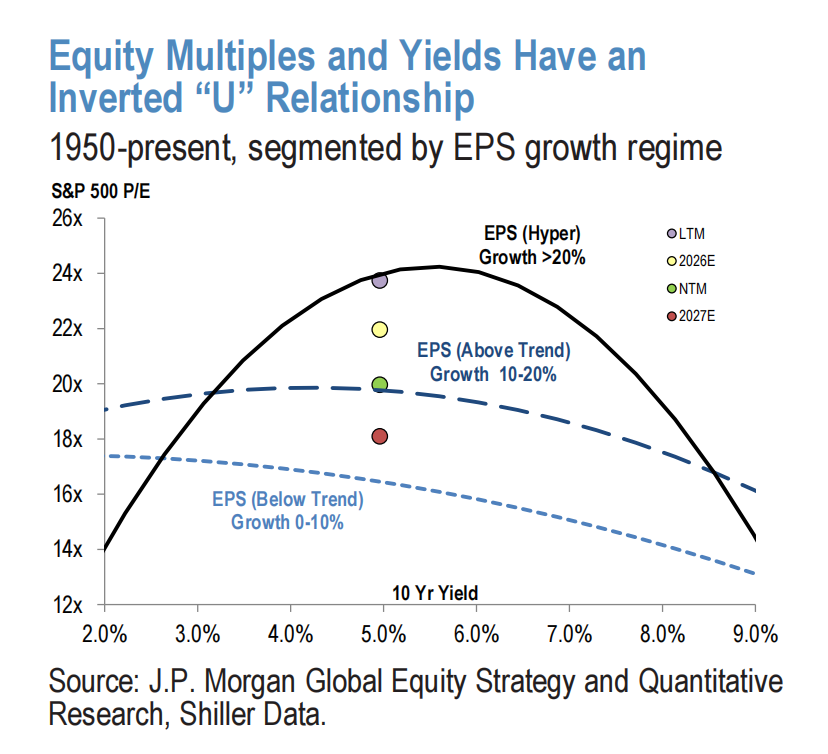
A Sept. 14 report cited by Wallstreetcn says the latest rise in yields is still some distance from the point where valuations come under clear pressure. The bank’s central argument is that earnings growth, not yields alone, determines how high equity multiples can go.
The backdrop looks harsh at first glance. The 30-year U.S. Treasury yield has climbed to about 5.40%, the highest level in nearly 20 years. Long-duration Treasuries have fallen about 10% over the past year, and the S&P 500 forward price-to-earnings multiple has compressed by about 3 turns. Even so, U.S. equities are still up about 16%.
The real valuation pressure point sits around a 5% to 6% 10-year yield
JPMorgan sorted valuation data since 1950 by earnings-growth buckets and found that the relationship between the 10-year Treasury yield and S&P 500 valuation multiples is “reverse U-shaped,” not linear.
That means valuations can actually find support during the early phase of a moderate rise in yields. Only after yields move past a certain threshold does the rate move start to compress multiples in a visible way. Based on current earnings conditions, JPMorgan puts that threshold at roughly 5% to 6% for the 10-year Treasury yield.
The report breaks the framework into growth regimes. In a super-growth environment, where earnings growth runs above 20%, valuation multiples can be supported at about 24x, corresponding to a 10-year yield near 6%. In a higher-than-trend growth regime, where earnings growth is 10% to 20%, multiples are around 20x, with a corresponding yield near 5%. The lower the earnings growth, the lower the yield level the market can absorb.
At present, the S&P 500 trades at about 22x 2026 EPS, which corresponds to adjusted 2026 earnings growth of roughly 28%. For 2027, the market is at about 18x, implying earnings growth of around 21% after excluding one-off investment gains and losses. On that basis, JPMorgan says valuations in 2027 still have room to re-rate if earnings growth can stay above 15%.
The bank uses a two-stage dividend discount model as another valuation check. That model implies an equity risk premium of about 7.2%, at the 69th historical percentile, while the long-term PEG ratio is around 2x. In practical terms, the report says current valuations still have fundamental backing if companies can deliver annual earnings growth of 13% to 15%.
AI leaders trade at a premium tied to profit visibility and balance sheets
JPMorgan also compares valuation levels across equity groups. The 30 AI leaders are trading at about 30x forward earnings, versus about 19x for the other 470 S&P 500 constituents and about 14.3x for MSCI ACWI peers.
According to the report, that premium is mainly driven by stronger earnings visibility, lower leverage, and steadier shareholder returns.
Productivity is another buffer in the bank’s framework. If productivity stays in a 1.5% to 2.5% range, current yields can still support valuations of around 20x. If AI pushes productivity above 2.5%, the support for valuations becomes stronger.
How rates reach earnings: debt structure first, cash flow next
JPMorgan says the impact of higher interest expense on corporate earnings should be gradual rather than immediate, because corporate debt is still largely fixed-rate and long-dated.
In the near term, two forces can partly offset higher financing costs. One is improving earnings in the financial sector. The other is that companies still hold about $2.4 trillion in cash, which can generate higher interest income in a higher-rate setting.
Most corporate borrowing costs also remain below their 2023 peaks. The 30-year fixed mortgage rate is about 6.8%, below 8.1% in 2023. Investment-grade yields are around 6%, below 6.5%. High-yield debt is around 7.7%, below 9.6%.
The report says the more important issue is structural divergence. A “higher for longer” rate backdrop is crowding out consumer-linked activity, residential and commercial real estate, capital-intensive sectors that do not directly benefit from AI buildout, and highly leveraged companies.
JPMorgan describes this process as an “invisible hand,” with limited capital flowing toward the highest bidders and the strongest credits, namely governments and large multinationals. In that reading, higher rates do not necessarily mean a broad hit to overall corporate earnings, but they do widen the gap inside the market.
Yield-curve shape may decide sector leadership
Sector performance, the report says, will also depend on how the yield curve changes.
Under a bearish steepening scenario, where the gap between long-term and short-term yields widens, cyclical sectors such as energy and financials are more likely to benefit. Under bearish flattening, technology tends to hold the relative edge. Bond proxies and long-duration non-tech sectors, including utilities, real estate, communication services, and consumer staples, are the most sensitive to higher rates.
On style, JPMorgan’s base case remains a shallow hiking cycle. In that scenario, last year’s expectations for “insurance” cuts reverse, but conditions do not turn into aggressive tightening. Growth and quality-growth stocks can still outperform there. If inflation accelerates again and the market starts to price a broader hiking cycle, meaning another four to five rate hikes, leadership could rotate toward low-volatility names.
By market capitalization, large caps appear better positioned. Small caps are more dependent on short-term floating-rate bank financing, so monetary policy passes through faster and hits them harder.
Wall Street strategists are not treating renewed Fed hikes as the end of the bull market
More broadly, Wall Street strategists are not framing another round of Federal Reserve hikes as a signal that the bull market is over. Strategists at Goldman Sachs, Morgan Stanley, and JPMorgan all argue that as long as economic growth and corporate earnings remain resilient, any pullback triggered by moderate hikes is more likely to be short-term volatility.
Goldman Sachs chief U.S. equity strategist Ben Snider said the market has already priced in expectations for more than three rate hikes over the next year, while corporate earnings and balance sheets remain strong. Bloomberg’s historical data also show that what usually threatens a bull market is a full hiking cycle rather than a single increase.
JPMorgan adds that the current move higher in rates is being driven mainly by fundamentals, not by concern over Federal Reserve independence or U.S. fiscal credibility. Long-end swap spreads have stayed relatively stable, and long-term breakeven inflation has risen only slightly.