
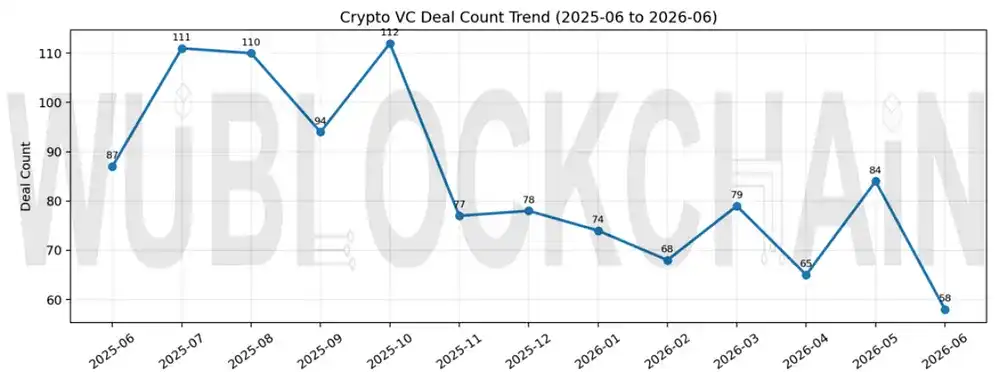
Crypto venture activity cooled sharply in June 2026. According to RootData, the sector disclosed 58 VC funding deals in June, down 31.0% from 84 in May and down 33.3% from 87 in June 2025. On both a month-over-month and year-over-year basis, deal count fell to the lowest level seen in the past year, underscoring a broad slowdown in primary-market activity across the industry.
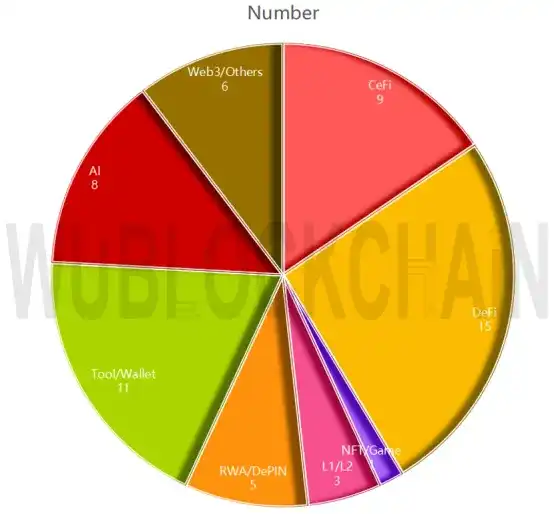
That said, the June data also points to a meaningful shift in market structure rather than a uniform retreat of capital. As total deal flow contracted, funding increasingly concentrated in a smaller number of larger, higher-conviction transactions. DeFi, RWA-linked infrastructure, payments, and institutional data services captured a larger share of investor attention, suggesting that venture firms are rotating toward projects with clearer product-market fit, financial utility, or integration potential with traditional markets.
Deal count dropped, but DeFi gained share of the monthly mix
By sector, June’s funding distribution was as follows: CeFi accounted for 15.5% of deals, DeFi represented 25.9%, NFT/gaming came in at 1.7%, L1/L2 made up 5.2%, RWA/DePIN reached 8.6%, tools/wallets took 19.0%, and AI represented 13.8%. Compared with May, DeFi’s share rose from around 20% to nearly 26%, making it one of the clearest shifts in June’s fundraising profile.
The move suggests that, in a weaker overall funding environment, investors are becoming more selective rather than indiscriminately risk-off. Capital appears to be favoring protocols and infrastructure layers with direct financial use cases, especially those tied to credit, tokenization, market structure, and enterprise-grade blockchain services. RWA remained a particularly important narrative, not only as a standalone category but also as a cross-cutting theme behind some of the month’s largest raises.
Total disclosed funding was cut by more than half
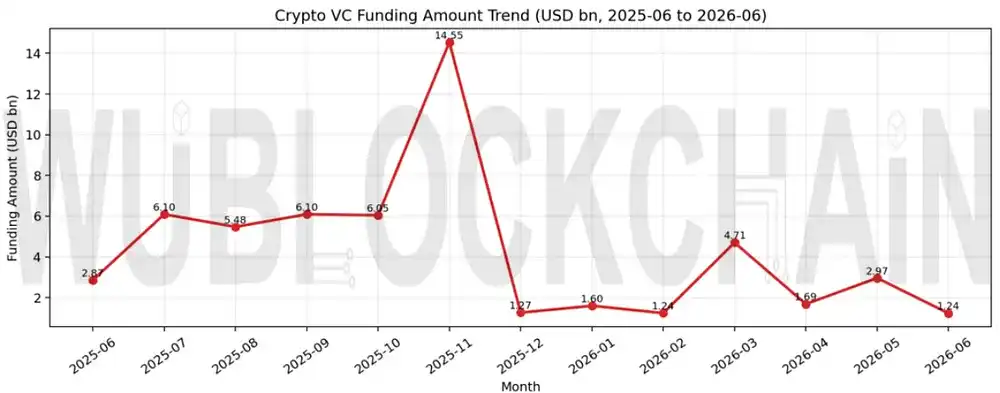
Total crypto VC funding in June came to about $1.237 billion, down 58.3% from $2.966 billion in May and down 56.9% from $2.868 billion in June 2025. RootData noted that projects with undisclosed amounts are counted in deal volume but excluded from the total funding tally. In addition, not all rounds are publicly disclosed in the same month they close, meaning the data may be revised over time as more announcements surface.
Even with that caveat, the monthly decline was substantial. More importantly, the disclosed capital that did come to market was concentrated in a relatively small set of large rounds and one major acquisition. The top end of the table was led by Digital Asset, SBI Holdings’ acquisition of Bitbank, Morpho, fomo, SignalPlus, and Allium, indicating that venture and strategic investors are currently prioritizing scale, institutional reach, and infrastructure relevance over broader early-stage experimentation.
Digital Asset led the month with a major Canton Network raise
Digital Asset, the developer behind the privacy-focused blockchain Canton Network, raised $355 million in a round led by a16z crypto. Participants included Abu Dhabi Investment Authority, Apollo Funds, BNP Paribas, Citadel Securities, CME Ventures, Coinbase Ventures, HSBC, S&P Global, SBI Group, and SoFi, among others. Canton Network is designed to provide large financial institutions with a shared ledger for the issuance and trading of RWA such as bonds, loans, and funds while preserving privacy and maintaining compliance requirements.
The size and composition of the investor list stood out. The round brought together crypto-native firms alongside major financial institutions and strategic backers, reinforcing the idea that tokenized real-world assets remain one of the few narratives capable of attracting capital at scale in the current market. Rather than focusing on retail adoption alone, the Canton thesis centers on institutional workflows, regulated asset movement, and privacy-preserving coordination between participants.
SBI’s Bitbank acquisition became one of Japan’s largest crypto M&A deals
In another headline transaction, Japanese financial group SBI Holdings acquired domestic crypto exchange Bitbank for $289 million. The deal is one of the largest mergers and acquisitions transactions in Japan’s crypto sector. Based on the disclosed rationale, the acquisition is expected to help SBI consolidate trading liquidity, expand its user base, and strengthen its competitive position against other domestic exchanges.
The transaction also stands out because it highlights a parallel route for capital deployment during weaker venture cycles: strategic acquisition. While startup fundraising slowed, incumbent financial groups with existing balance sheet strength continued to pursue assets that can broaden distribution, deepen liquidity, or improve market share. In that sense, June’s data reflects not just less capital, but more targeted capital.
Morpho brought DeFi back to the center of the funding map
Among DeFi projects, decentralized lending protocol Morpho completed a $175 million token sale led by Paradigm, a16z crypto, and Ribbit Capital, with participation from Apollo Funds, VanEck, Circle Ventures, Ledger Cathay, Wintermute Ventures, and others. Founded in 2021 and headquartered in Paris, Morpho focuses on building modular, open on-chain credit infrastructure.
The company said the new funding will be used to deepen integrations with traditional financial platforms and accelerate the global expansion of RWA through decentralized finance. That mandate aligns closely with the broader monthly trend: investors are showing renewed interest in protocols that can serve as credit rails, collateral frameworks, or tokenization layers rather than purely speculative applications.
Mid-sized rounds clustered around trading, data, payments, and compute
Several other notable June raises reinforced the infrastructure theme. Crypto trading platform fomo closed a $75 million Series B led by Index Ventures, with participation from Union Square Ventures, Benchmark, and multiple non-crypto angel investors, at a valuation of $550 million. Founded in 2025 by former dYdX employees, the platform focuses on simplifying blockchain interaction through a social trading experience and is expanding into tokenized stocks and derivatives.
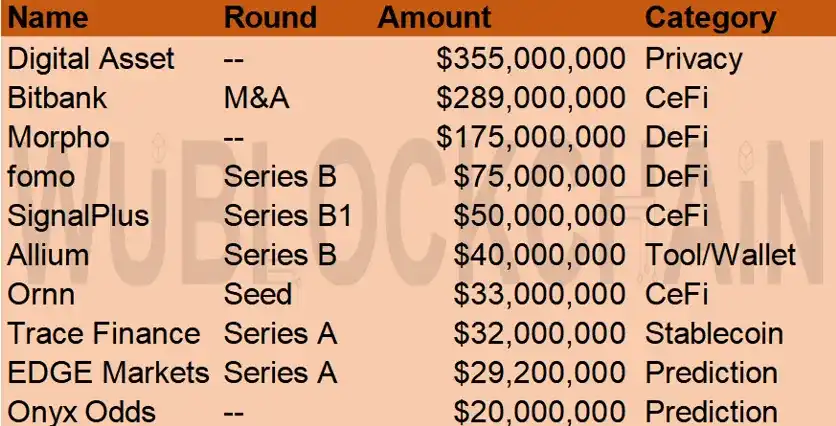
Options and derivatives trading infrastructure provider SignalPlus announced a $50 million Series B1 round at a post-money valuation of $500 million. The round was led by HashKey Capital, with BlockBooster and AppWorks participating, while Goldman Sachs served as exclusive financial adviser. Blockchain data analytics firm Allium raised $40 million in a Series B led by Amplify Partners, with Kleiner Perkins and Theory Ventures also participating. The company said the funding will support growing institutional demand for structured and standardized on-chain data.
Ornn, meanwhile, raised $33 million in seed financing led by a16z Crypto, joined by Galaxy Ventures, Nordstar, and SV Angel. The company’s thesis is to transform GPU compute capacity—typically sold by cloud providers through privately negotiated long-term contracts—into a publicly priced asset that can be traded, financed, and hedged. The idea places Ornn at the intersection of crypto market infrastructure and AI-related resource markets.
Stablecoin payment infrastructure firm Trace Finance raised $32 million in a Series A led by CoinFund to expand in Latin America and the Asia-Pacific region. Other investors included Coinbase Ventures, Haun Ventures, Jump Capital, Paxos, Chainlink Labs, and HOF Capital. The round highlights continued investor appetite for payments infrastructure that can connect stablecoin settlement with real commercial corridors.
Prediction market infrastructure also attracted capital
Prediction-market-focused infrastructure company EDGE Markets announced a $29.2 million Series A in early June, led by CoinFund with participation from Indicator Ventures, Mantis VC, Stepstone Group, and Bullpen Capital. The financing will support the launch of EDGE Pro and the payment network EDGE Connect.
Onyx Odds, a prediction market application, also raised $20 million in a Series A led by Payward, the parent company of crypto exchange Kraken, at a valuation of $220 million. The capital will be used to expand its sports prediction and related trading products. While smaller than the month’s top transactions, these rounds show that specialized market infrastructure still retains investor support when there is a clear product direction and monetizable user behavior.
Overall, June’s numbers depict a market that is smaller in volume but more concentrated in conviction. Funding levels fell to a one-year low, yet DeFi increased its share of total deals, and RWA remained the dominant strategic narrative across several of the biggest rounds. For now, venture capital in crypto appears to be flowing less toward breadth and more toward institutional rails, tokenization, market structure, and infrastructure with direct links to real financial demand.