
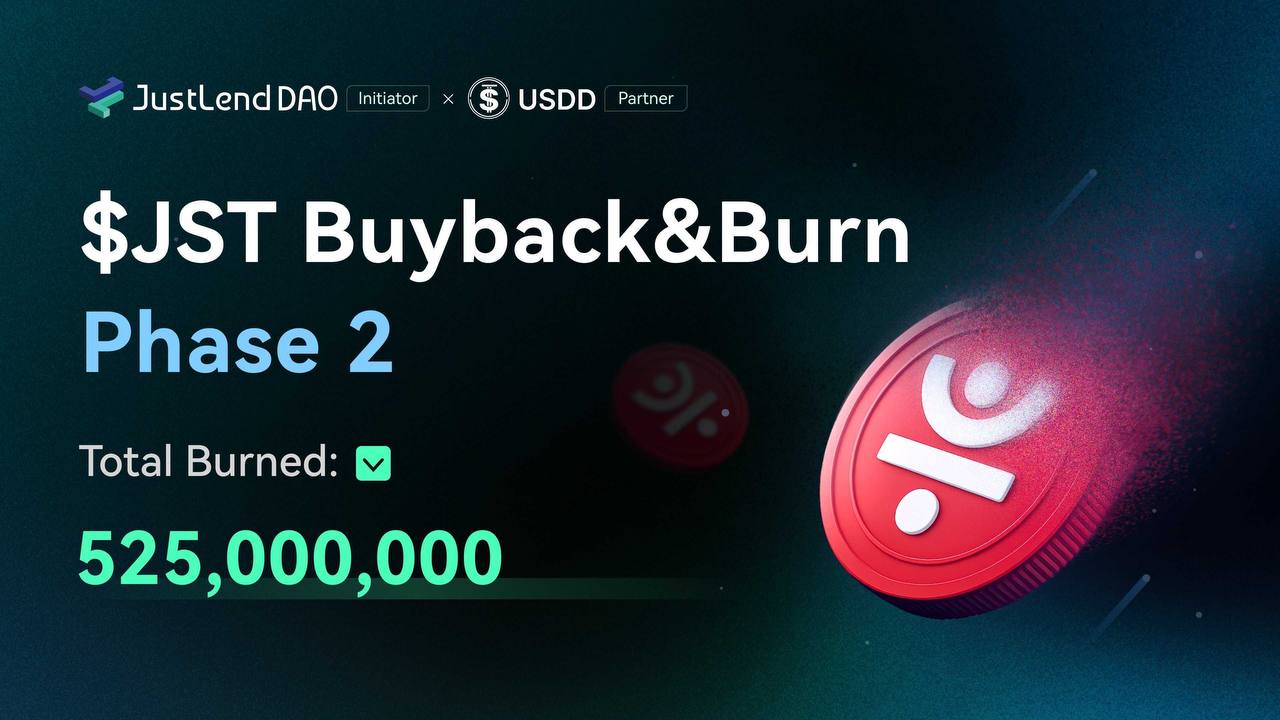
JustLend DAO executed its second large-scale JST token burn on January 15, 2026, permanently removing 525 million JST (5.3% of total supply). The cumulative burn now stands at 1.089 billion JST, or 10.96% of the total supply. Valued at over $21 million at current prices, the move accelerates the token's deflationary trajectory within just three months since the first burn.
Dual Funding Sources: Quarterly Net Income and Reserve Earnings
The buyback was funded by two sources: $10.19 million from JustLend DAO's Q4 2025 net earnings and $10.34 million from accumulated reserve earnings. The reserve portion came from initial burn proceeds deposited into the SBM USDT market, effectively allowing the protocol to generate income on its own capital. This highlights JustLend DAO's robust profitability and sustainable cash flow.
In Q4 2025, JustLend DAO's total value locked (TVL) surpassed $7.08 billion, ranking among the top three lending protocols. The sTRX (Staked TRX) service drove growth, with over 9.3 billion TRX staked by Jan 15. Energy rental fees were cut from 15% to 8% in September 2025, boosting transaction volume and protocol income.
The GasFree smart wallet eliminated the need for users to hold TRX for gas fees, allowing direct deduction from transferred tokens like USDT. A 90% fee subsidy campaign pushed GasFree-driven transaction volumes past $46 billion as of Jan 15, saving users over $36.25 million in network fees. This feature brought massive incremental users and liquidity into the ecosystem.
Meanwhile, USDD's multi-chain expansion contributed additional buyback funds. USDD TVL hit $1 billion on Jan 14, doubling in under two months. Deployments on Ethereum, BNB Chain, and others broadened use cases, creating a value loop linking stablecoin growth, lending activity, and JST deflation.
From Governance Token to Yield-Bearing Asset
JST has evolved beyond a utility token for gas fees or governance voting. Its value is now directly tied to the cash flows of JustLend DAO and USDD. On Jan 8, JST market cap surpassed $400 million, with 24-hour trading volume rising 21.92% to $31.49 million and a 10.82% price gain over the prior month. The synchronized expansion in market cap and trading volume reflects market confidence in the protocol's fundamentals and buyback mechanism.
As the total supply irreversibly shrinks, each remaining JST token carries greater governance weight. Long-term holders benefit from both economic value appreciation and increased voting power on key decisions—parameter adjustments, new product launches, treasury allocations, etc. This design aligns core community incentives with the protocol's long-term success.