Tokenized assets become Kamino’s only net-growth segment
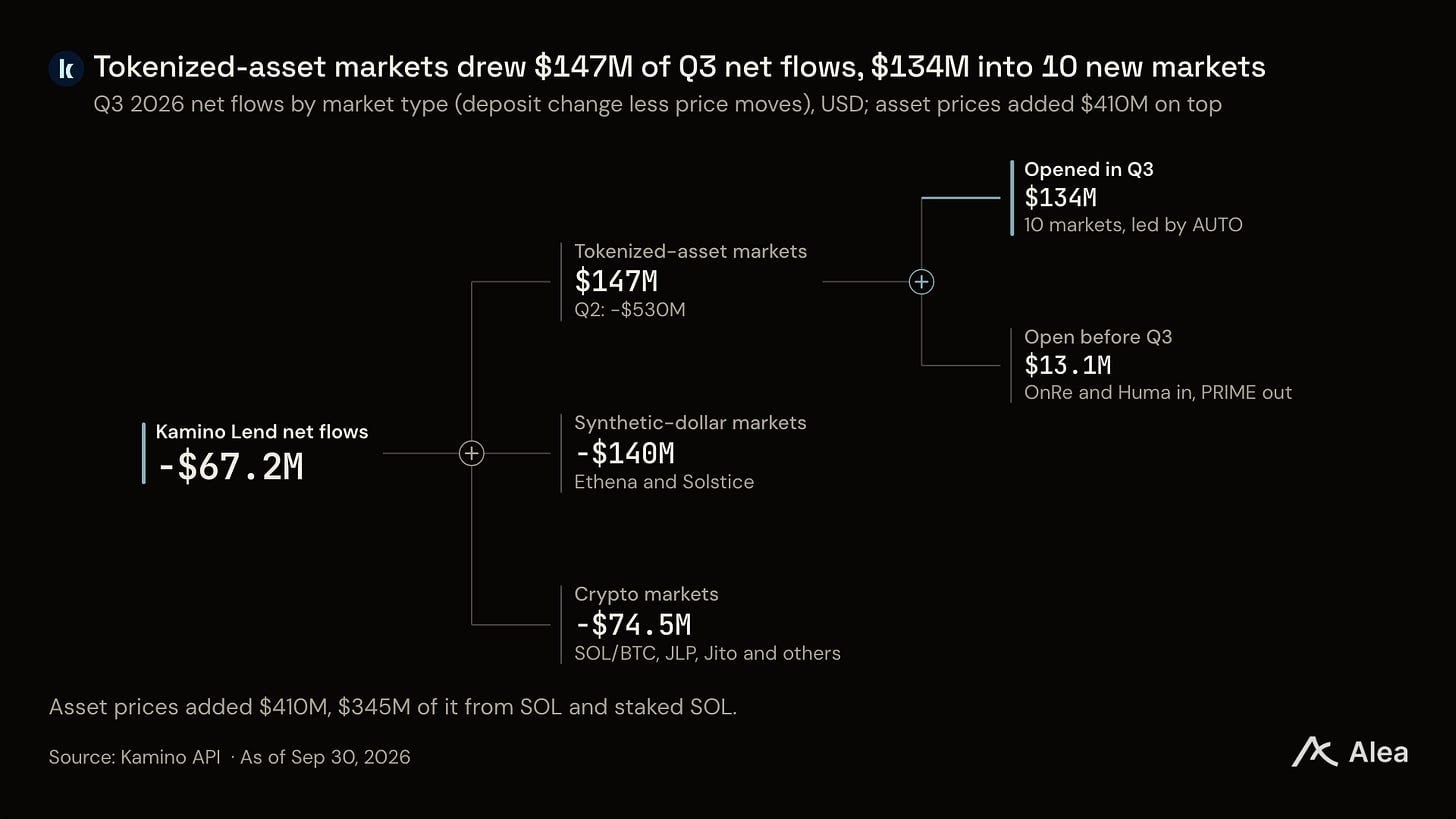
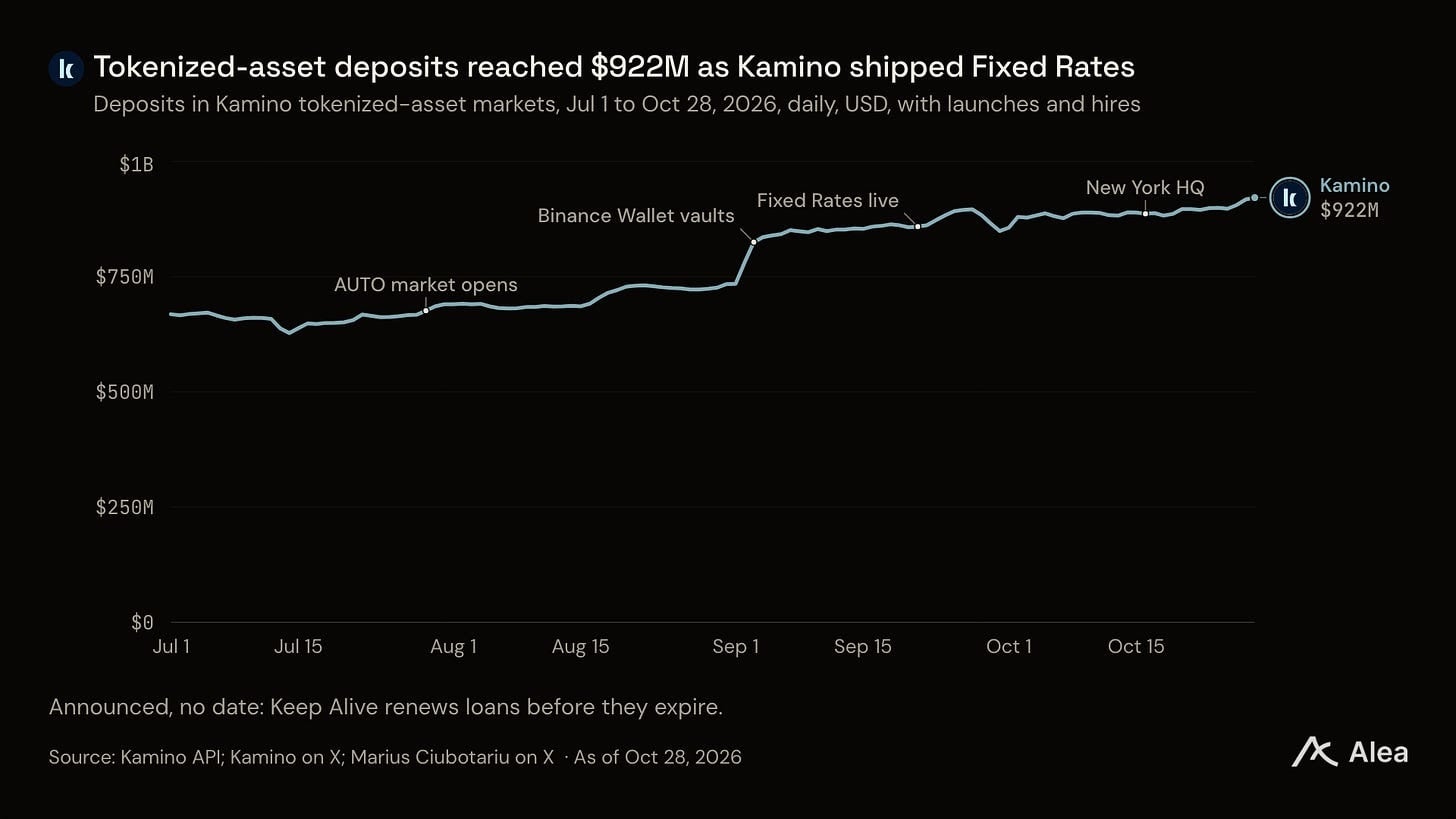
Kamino’s tokenized-asset markets recorded $147 million in net inflows in the third quarter of 2026, according to a report by Alea Research. The segment was the only market category on the protocol to post net growth during the quarter.
Crypto-native assets and synthetic-dollar markets together lost $215 million over the same period. Kamino had reported $530 million in net outflows in the second quarter. Of the tokenized-asset inflows in Q3, $134 million went into 10 markets launched during the quarter. Asset-price appreciation added another $410 million to the segment’s size, but was not counted as net capital inflows.
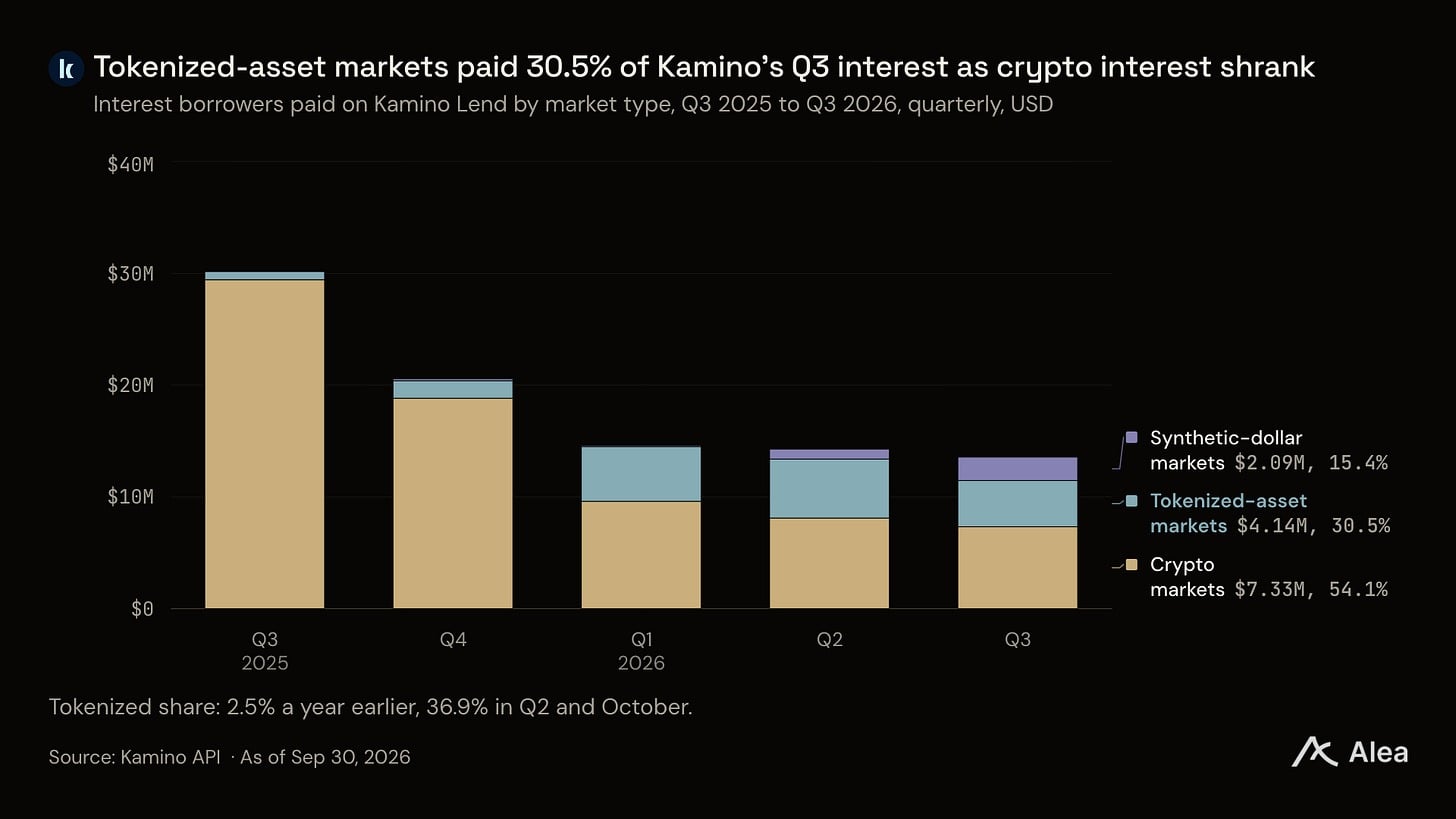
Tokenized-asset borrowers receive repayment cash flows from auto loans, home equity, reinsurance premiums and trade finance. Those sources are not tied to the price of SOL. SOL’s average price fell from $192 to $90 in the third quarter, and demand for SOL-collateralized borrowing declined with it. A year earlier, crypto-native assets had generated $29.4 million of Kamino’s $30.2 million in quarterly interest revenue.
Interest revenue share rises to 30.5%
Tokenized-asset markets generated 30.5% of Kamino’s lending interest revenue in Q3, up from 2.5% a year earlier. The share was below the 36.9% recorded in Q2, when a contraction in the Figure PRIME market weighed on the mix. By October, the share had returned to the Q2 level.
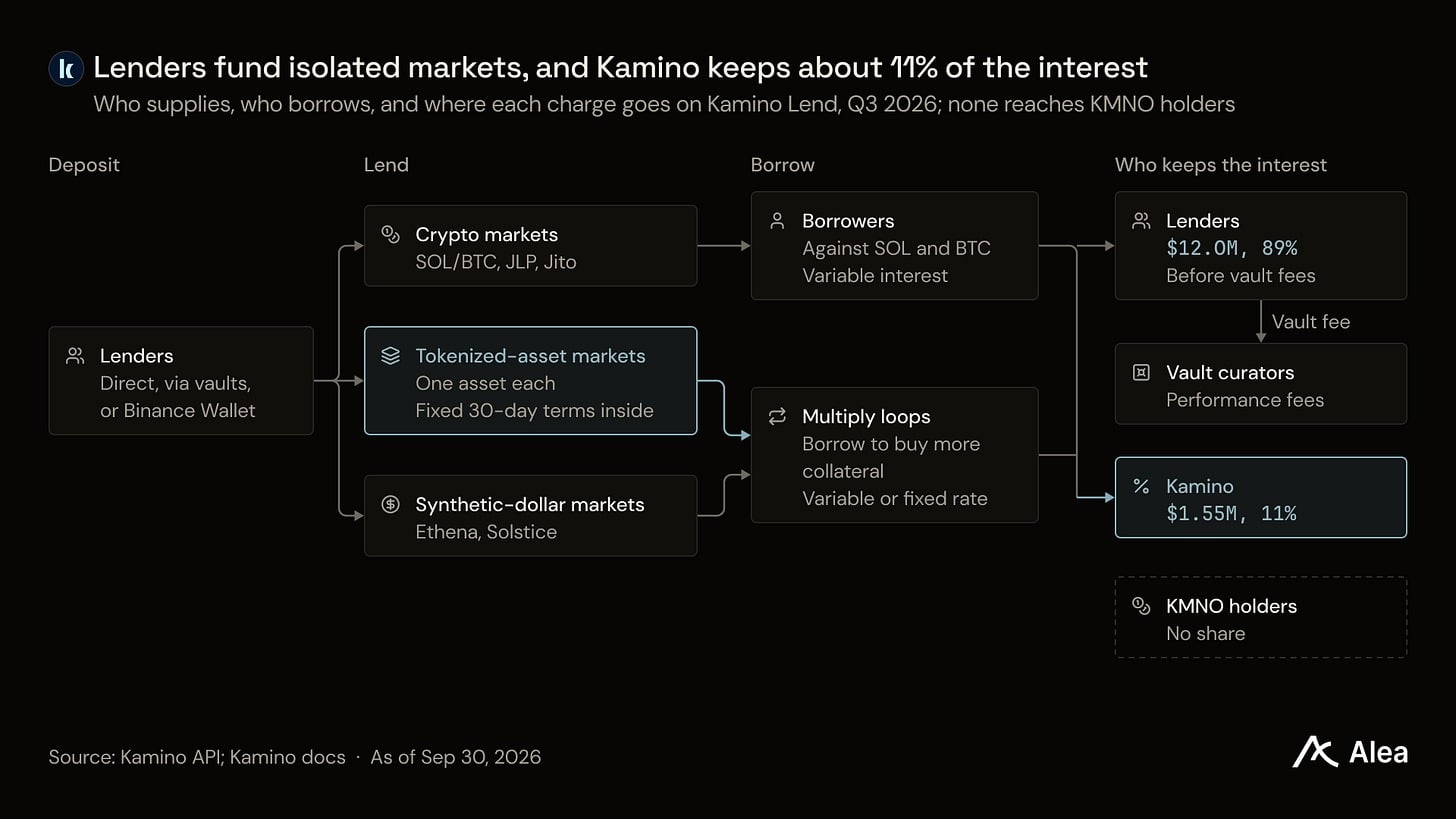
Kamino retained $1.55 million in protocol interest revenue in Q3, compared with $1.61 million in Q2. Total interest across the protocol fell 5%, leaving Kamino’s retained amount broadly unchanged. The protocol keeps about 11% of borrowing interest; the figure excludes liquidation fees.
The retained interest is not currently distributed to KMNO holders. Under Kamino’s incentive-season system, staked KMNO increases users’ KMNO token rewards rather than providing a share of protocol revenue. Michael Weisz, Kamino’s chief executive, recently said that more plans for KMNO value capture would be announced soon.
Ten new markets account for most of the inflows
Kamino launched 10 tokenized markets in Q3, covering Figure’s AUTO auto loans, trade finance from Obligate, tokenized gold and pound-denominated assets. Among the dollar-collateralized markets that operated throughout the quarter, deposits moved toward those offering wider carry spreads.
Deposits in the OnRe market rose by $92.5 million, while Huma’s PST market added $62.5 million. Figure’s PRIME market continued the outflow trend that began in Q2 and contracted by $125.5 million during the quarter. On Morpho, by contrast, PRIME deposits had exceeded $470 million by Oct. 28.
Three dollar markets launched before September showed a similar pattern. AUTO had attracted $64.9 million in deposits by Sept. 30, with a net carry spread of 2.23 percentage points. OnRe retained its Q3 incremental funds even after its 10-times points incentive on Kamino’s looping pool ended on Sept. 21.
Kamino operates roughly 50 risk-isolated markets. Most support a single collateral asset and receive vault funding from strategy curators including Sentora, Steakhouse and Galaxy. Galaxy formally joined the curator group on Sept. 17. Binance Wallet, Kraken and Solflare also directed user traffic to Kamino.
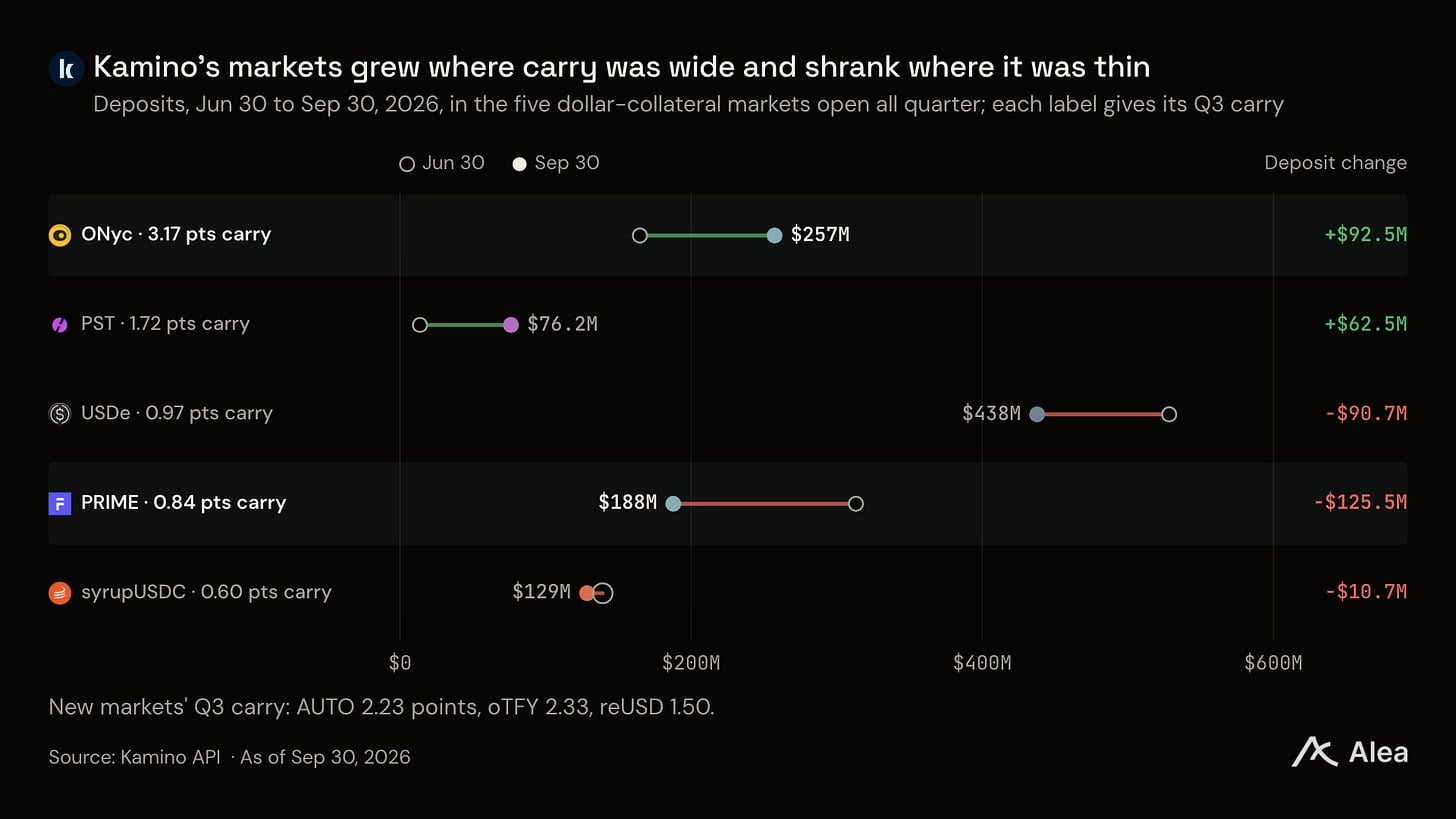
The breadth of Kamino’s tokenized collateral is a central part of its lending structure. Each newly supported asset receives its own market, risk parameters and one-click Multiply looping mechanism. As of Oct. 8, Kamino controlled 95.6% of the AUTO collateral share across the market.
Fixed-rate loans reach $73.7 million
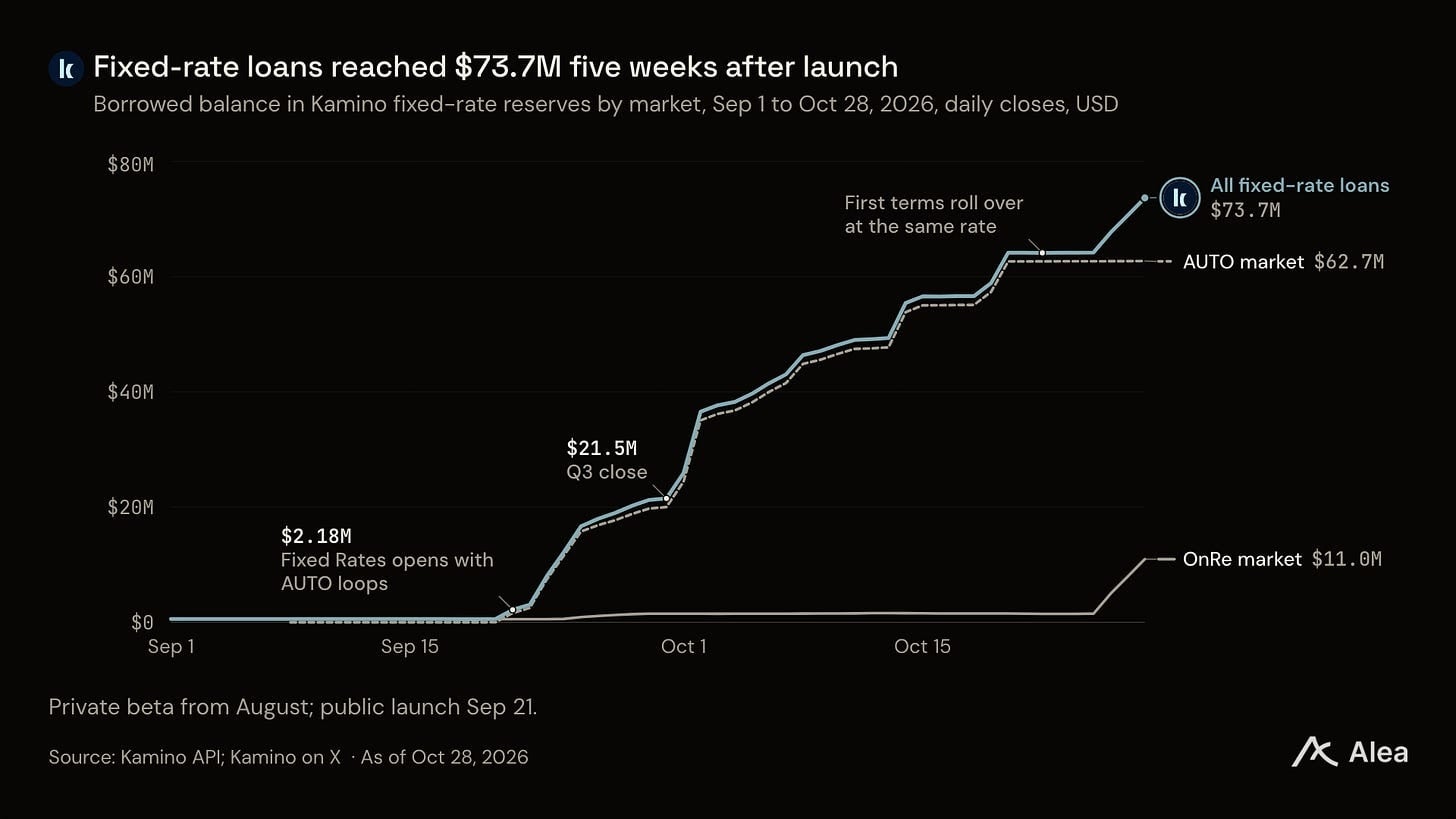
Kamino launched Fixed Rates on Sept. 21, allowing borrowers to lock borrowing costs for terms of up to 30 days. Outstanding fixed-rate loans reached $21.5 million by Sept. 30 and climbed to $73.7 million by Oct. 28. The first $12 million of maturing loans renewed at the original rates for another 30-day cycle.
The product passed $21.5 million only nine days after launch. By Oct. 28, it represented 8.5% of Kamino’s total outstanding loans. During the week of Oct. 22, the first $12 million of fixed-rate loans continued at the original rates through the renewal mechanism, with the next maturity date expected around Nov. 21.
The OnRe market, launched on Sept. 25, offered an 8% fixed USDC rate. That rate remained stable through the end of September, while the market’s floating USDC rate moved between 7.6% and 9.6%. If lenders do not request redemption at maturity, a loan can automatically roll into another 30-day period at the same rate.
Ethena’s market faced a different dynamic. Floating-rate borrowers had no cap on borrowing costs, and the average borrowing rate rose to 4.57% in October, nearly twice the July level. It approached the roughly 4.75% base reward yield on USDe. Loans in the market fell by $166 million during October.
All four AUTO fixed-rate quotes across Kamino were funded by the same vault. The vault lends Figure’s yield-bearing dollar asset wYLDS, with rates starting at 5.3% and rising for each successive quote.
Wallet and institutional channels add capital
Binance Wallet users deposited more than $100 million into Kamino vaults over nine days. Kamino also became a core venue for Galaxy’s GOFR lending program. Its institutional commodity-yield vault passed $50 million on Sept. 29.
In October, Kamino announced that two executives had joined the company and that it had established a headquarters in New York. Weisz also said the company planned to lend against private-fund LP interests at rates of 5% to 6%. Binance Wallet separately supplied $150,000 in rewards to the Kamino RWA USDC vault, with the campaign scheduled to run through Dec. 1.
Kamino announced Keep Alive on Sept. 22. The feature allows borrowers to extend fixed-rate loans before maturity. The OnRe market added USDG fixed rates on Oct. 21, and the Backpack market for tokenized U.S. equities began operating on Oct. 28.
Kamino’s roadmap, set in December 2025, listed six core products. Five have now been delivered: fixed rates, off-chain collateral, the BuildKit developer toolkit, private credit operated by Institutional Yield, and the Borrow Orders borrowing-intent system. The RWA DEX remains outstanding.
Kamino faces a closer contest with Jupiter Lend
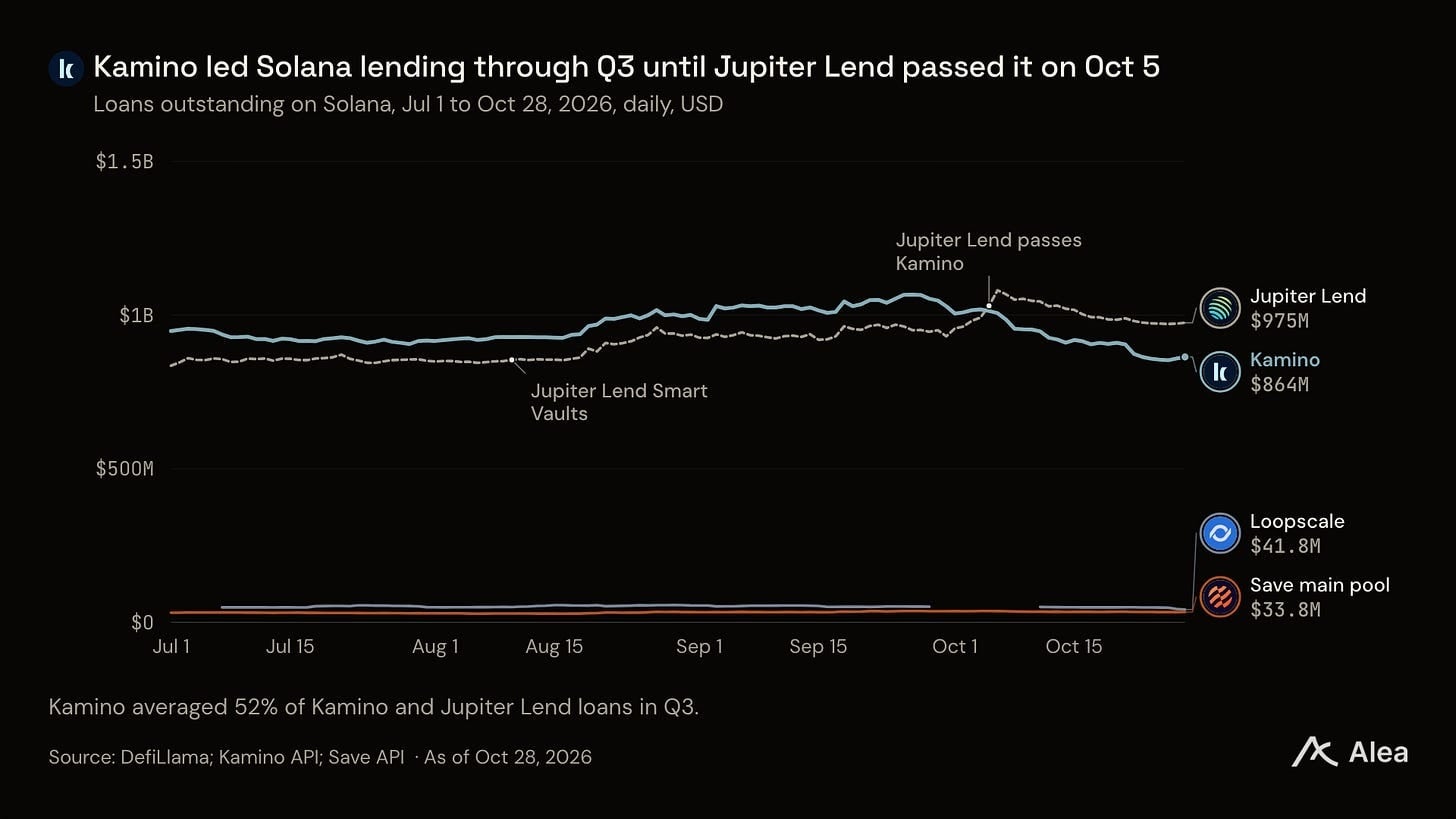
Kamino held an average 52% share of loans across Solana’s two leading lending protocols in Q3, down from 58% in Q2. Including Save’s main pool and Loopscale, its average share was 50% for the quarter and had fallen to 45% by Oct. 28.
Jupiter Lend and Loopscale are adding similar tokenized collateral. Jupiter Lend launched reUSD in August and added an sUSDai looping pool in September. Loopscale supports lending against ONyc. Jupiter also added a fixed-rate USD* looping pool to its peer-to-peer Offerbook order book. Kamino built its fixed-rate mechanism directly into existing lending markets.
Jupiter Lend released version 2 on Aug. 10 and surpassed Kamino in total borrowing on Oct. 5. Its Smart Vaults convert borrowing positions into DEX liquidity and earn trading fees. Jupiter’s Q3 loan balance rose 17% from the prior quarter, while Kamino’s fell 6%.
Kamino still led on net deposits after loans were deducted. Average daily net deposits reached $1.17 billion at Kamino during Q3, compared with $1.02 billion at Jupiter Lend.
Excluding Ethena, Kamino’s total loans increased by $9 million in October. The AUTO market added $44 million, while the Ethena market lost $166 million as leveraged arbitrage loops were unwound.
AUTO looping has a modeled break-even yield of 4.3%
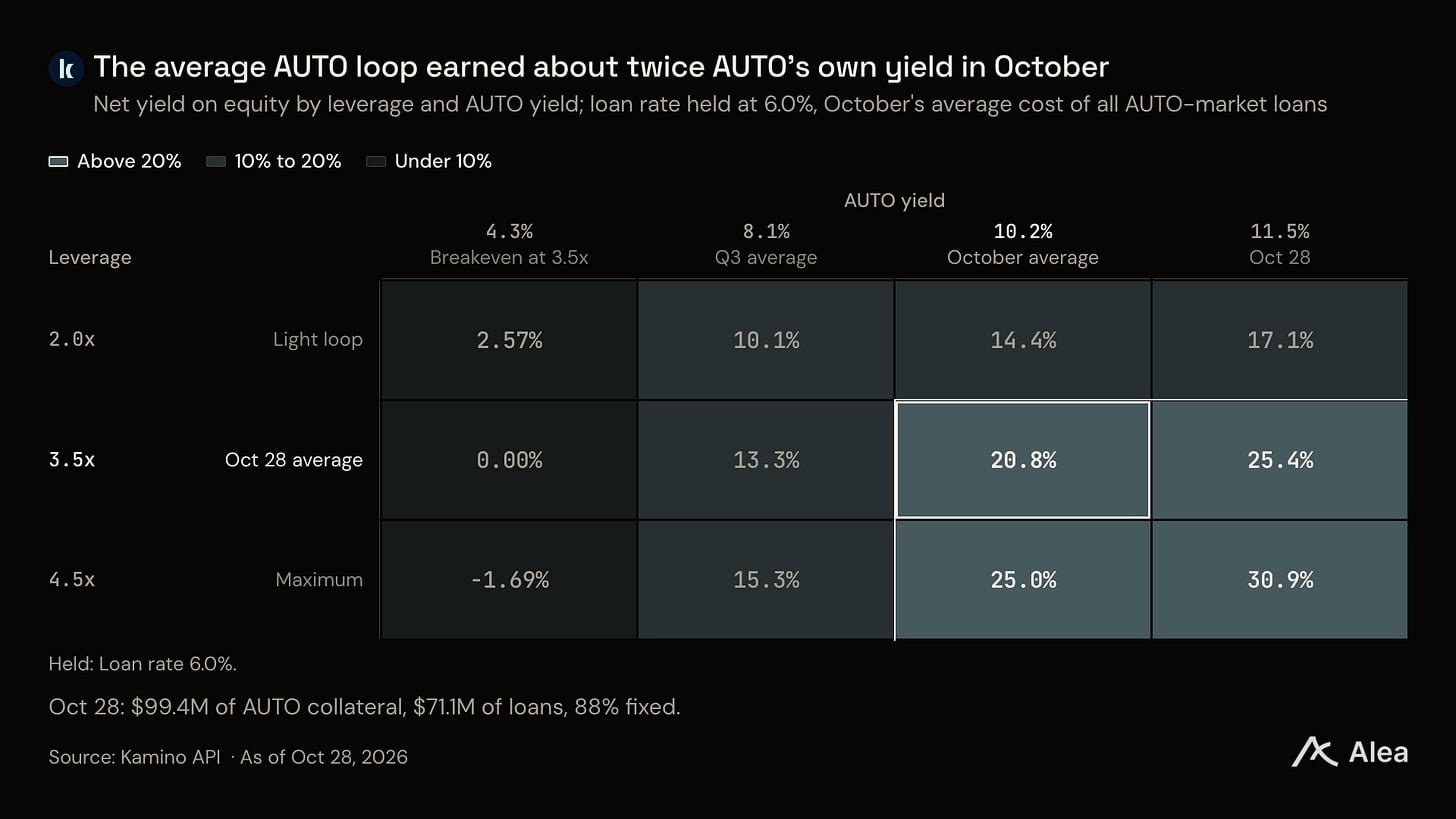
Multiply looping can remain profitable when the yield on collateral exceeds borrowing costs and carry stays positive. As of Oct. 28, AUTO looping positions used an average of 3.5 times leverage. At a fixed borrowing cost of 6%, the modeled break-even yield was 4.3%.
AUTO’s average yield in October was 10.2%. At 3.5 times leverage, the modeled net return was 20.8%, about twice the return from holding AUTO without leverage. The calculation excludes fees and price volatility.
Fixed rates lock the liability-side borrowing cost but do not lock the yield of the underlying asset. AUTO’s average underlying yield was 10.2% in October and 11.5% on Oct. 28. If that yield falls below 6%, leveraged looping would produce a lower net return than holding the asset directly.
Using a 6% average rate and a 10% Kamino share of interest, fixed-rate loan balances of $150 million, $250 million and $400 million would generate estimated annual incremental revenue of $900,000, $1.5 million and $2.4 million for Kamino. The protocol’s annualized total revenue for Q3 was $6.2 million.
Management and token performance
Michael Weisz, the former founder of Yieldstreet, became Kamino’s CEO on Sept. 15. KMNO rose 133% in Q3, while SOL gained 60% and JUP rose 56% over the same period.
The report was prepared by Alea Research and was not paid for or commissioned by Kamino. Alea Research team members, including researchers directly involved in the analysis, may hold positions in the tokens discussed. The material is for research and educational purposes only and is not financial or investment advice. Alea Research describes itself as a research platform rather than a registered investment or financial adviser. Readers are advised to conduct their own due diligence and allocate only what they can afford to lose.
Referenced materials include Kamino’s roadmap dated Dec. 12, 2025, the Kamino Fixed Rates product documentation, Kamino’s September 2026 monthly risk insights report and Kamino’s official Fixed Rates launch announcement.