
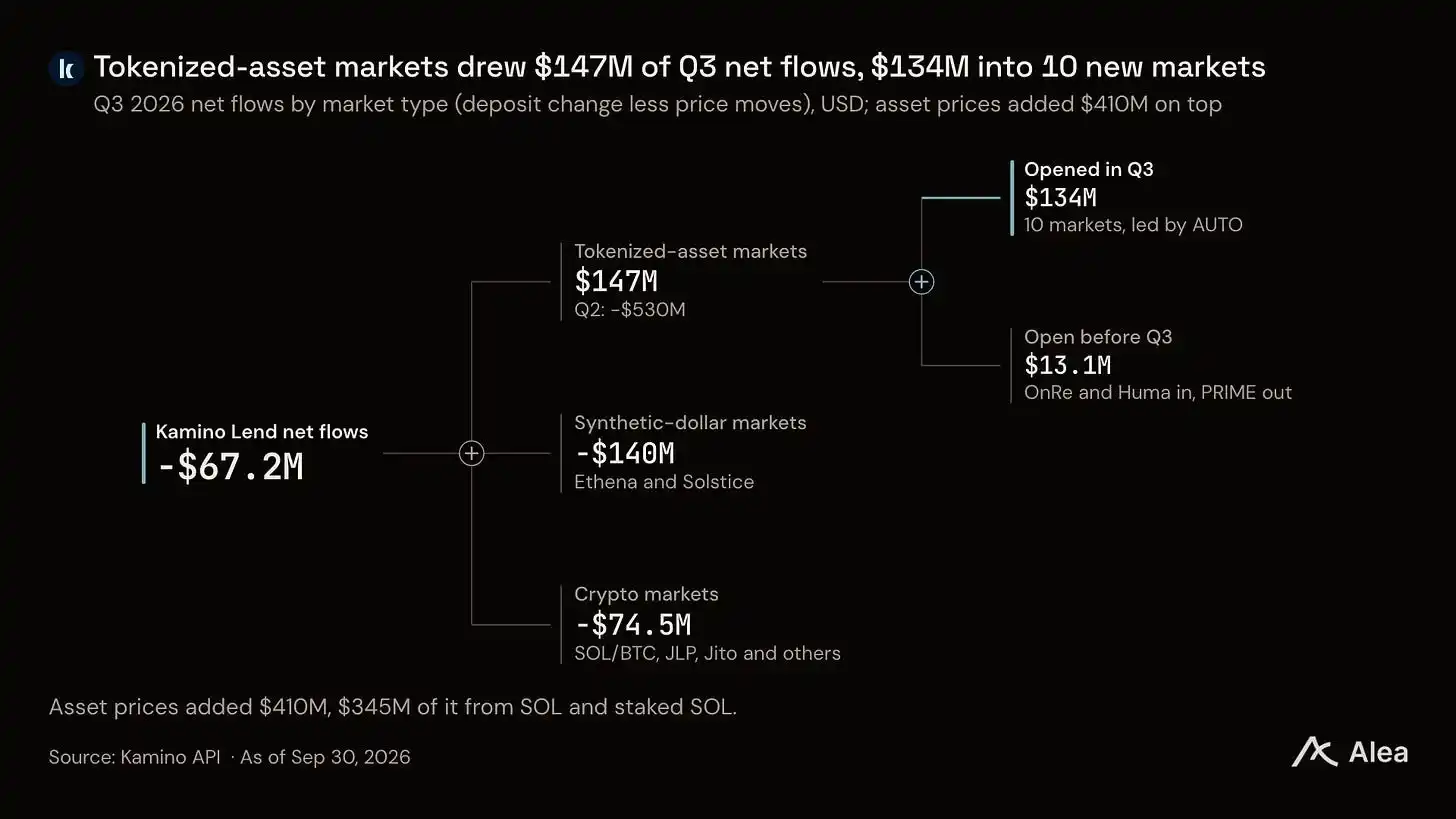
Kamino’s tokenized asset markets attracted $147 million in net inflows during the third quarter of 2026, making the segment the only market category on the protocol to record net growth during the quarter, according to research from Alea Research. Kamino’s crypto-native asset and synthetic-dollar markets lost a combined $215 million over the same period.
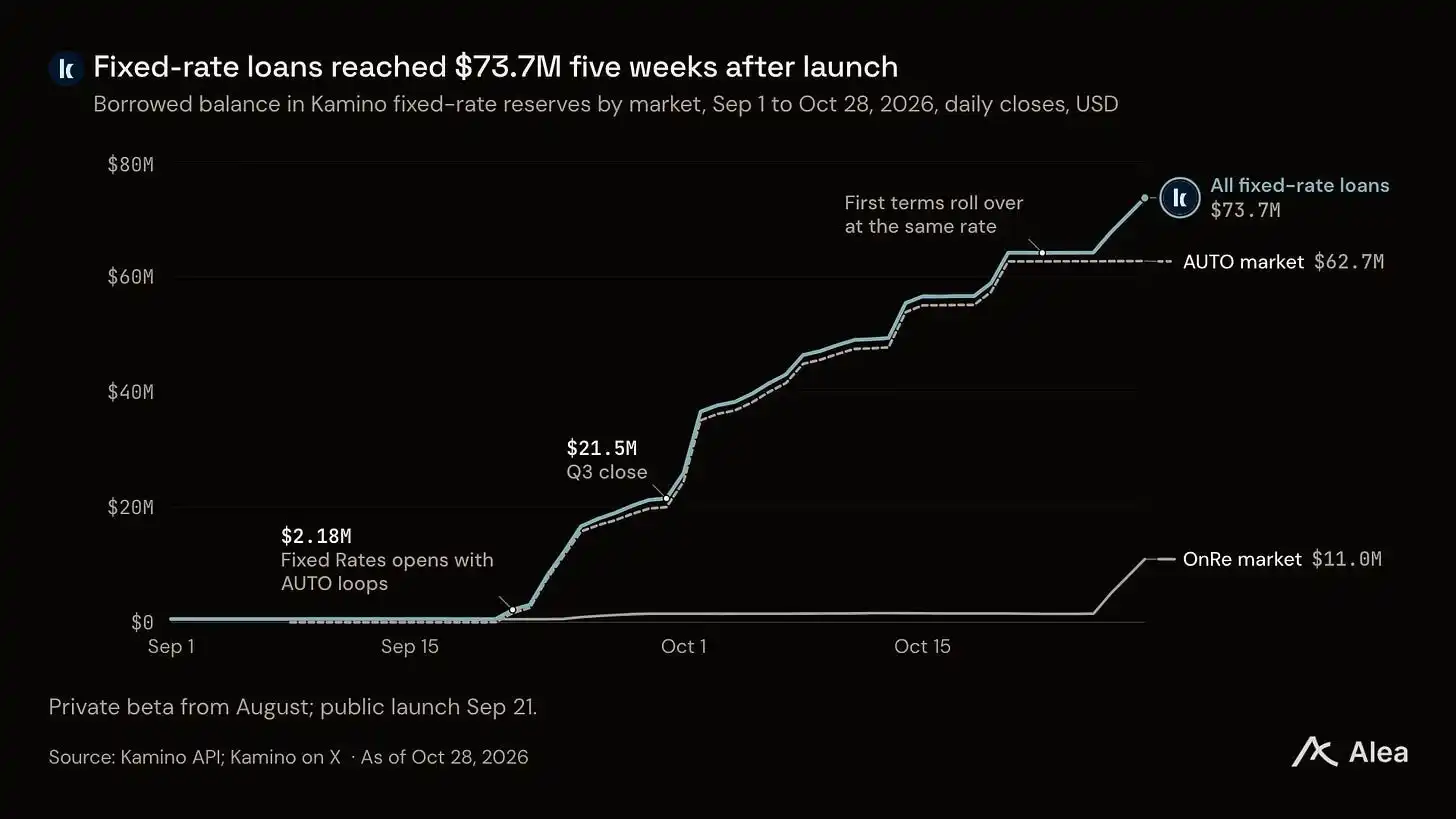
The protocol launched its 30-day fixed-rate credit product on September 21. Within a little more than a month, fixed-rate loans grew to $73.7 million. The product lets borrowers lock in borrowing costs for terms of up to 30 days.
Tokenized markets reverse Kamino’s broader outflows
Kamino had recorded $530 million in net outflows in the second quarter. In Q3, its tokenized asset market reversed that trend with $147 million in net inflows. Markets opened during the quarter accounted for $134 million of the total. Asset-price appreciation contributed another $410 million in scale, according to the report.
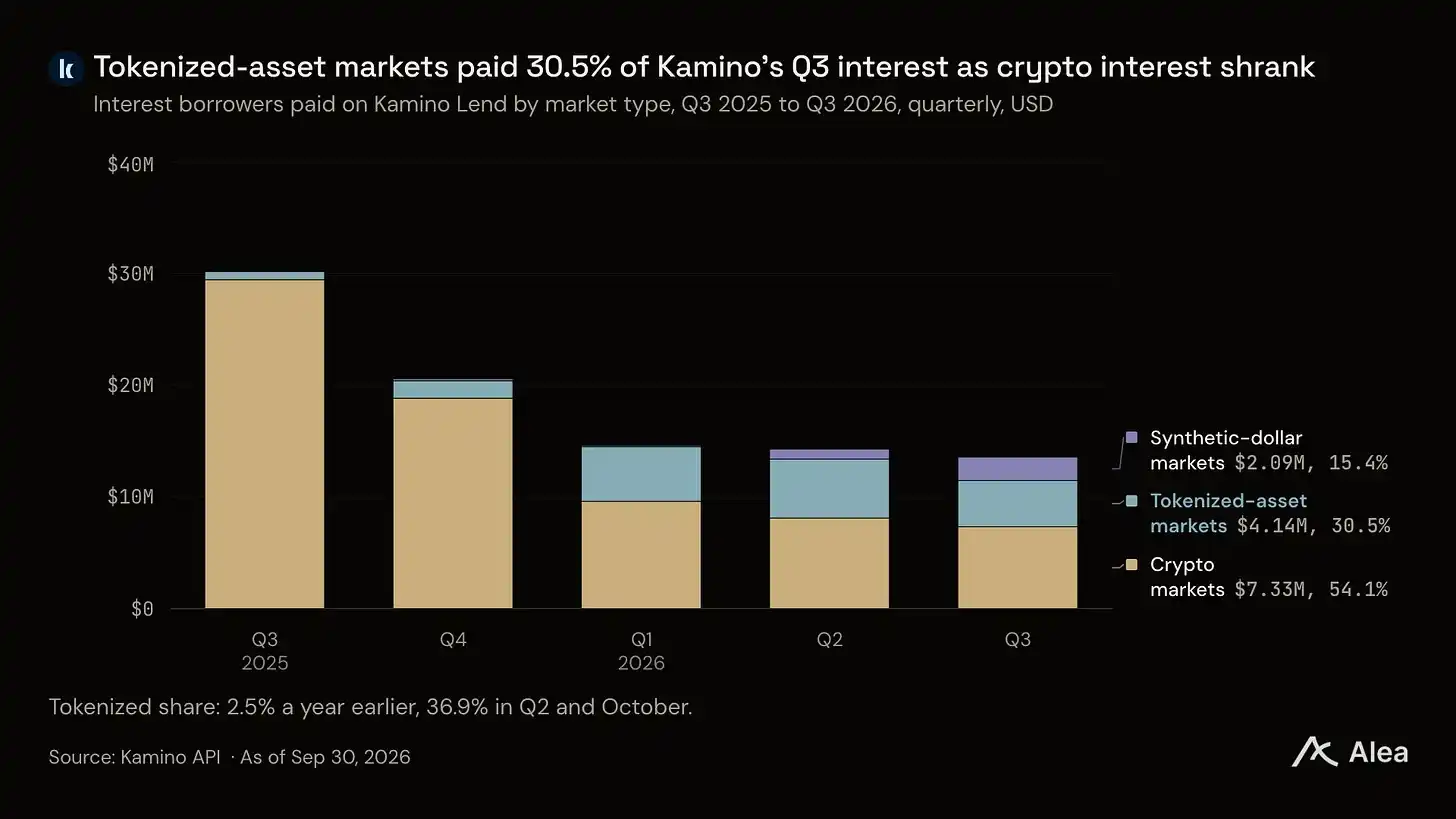
Tokenized assets generated 30.5% of Kamino’s borrowing-interest revenue in Q3, up sharply from 2.5% a year earlier. The share was below the 36.9% reported in Q2, when contraction in the Figure PRIME market weighed on the figure, but it had returned to the Q2 level by October.
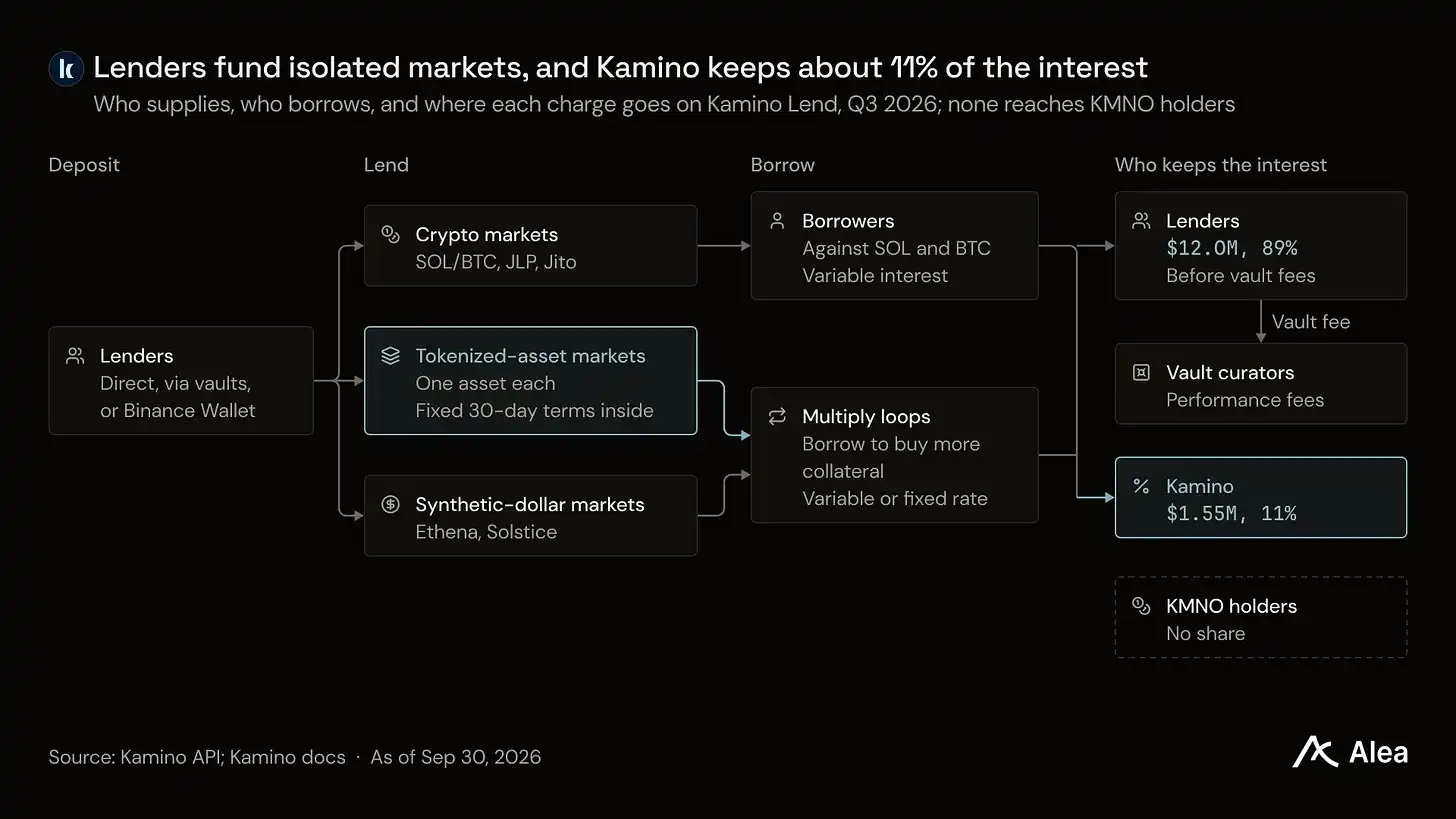
Kamino retained $1.55 million in protocol interest revenue during Q3, compared with $1.61 million in Q2. The network’s total interest contracted by 5%, leaving Kamino’s retained amount broadly unchanged. The protocol retains about 11% of borrowing interest; the calculation excludes liquidation fees.
A year earlier, crypto-native assets had generated $29.4 million of Kamino’s $30.2 million in quarterly interest revenue. In Q3 2026, the average SOL price fell from $192 to $90, and demand for SOL-collateralized borrowing declined. Tokenized-asset borrowers, by contrast, receive repayment cash flows from auto loans, home equity, reinsurance premiums and trade finance. Those cash flows are not linked to SOL’s price movement.
Isolated markets and a broad collateral base
Kamino operates about 50 isolated-risk markets, a structure similar to Morpho on Ethereum. Most pools support a single collateral asset. Treasury capital is supplied by strategy curators including Sentora, Steakhouse and Galaxy.
Galaxy formally joined as a strategy curator on September 17. Front-end applications including Binance Wallet, Kraken and Solflare have also directed user flow to Kamino.
Kamino’s range of tokenized collateral is a central feature of its lending business. Each newly supported asset receives its own market, risk parameters and one-click leveraged looping through the Multiply feature. As of October 8, Kamino held 95.6% of all AUTO collateral across the network.
Kamino currently does not distribute this interest revenue to KMNO holders. Under its incentive-season structure, staking KMNO increases a user’s KMNO token rewards rather than providing a share of protocol income. Michael Weisz recently said that more plans for KMNO value capture would be announced soon.
Multiply strategies can remain profitable when the yield on collateral exceeds the cost of borrowing, leaving positive carry.
Deposits chase the widest carry
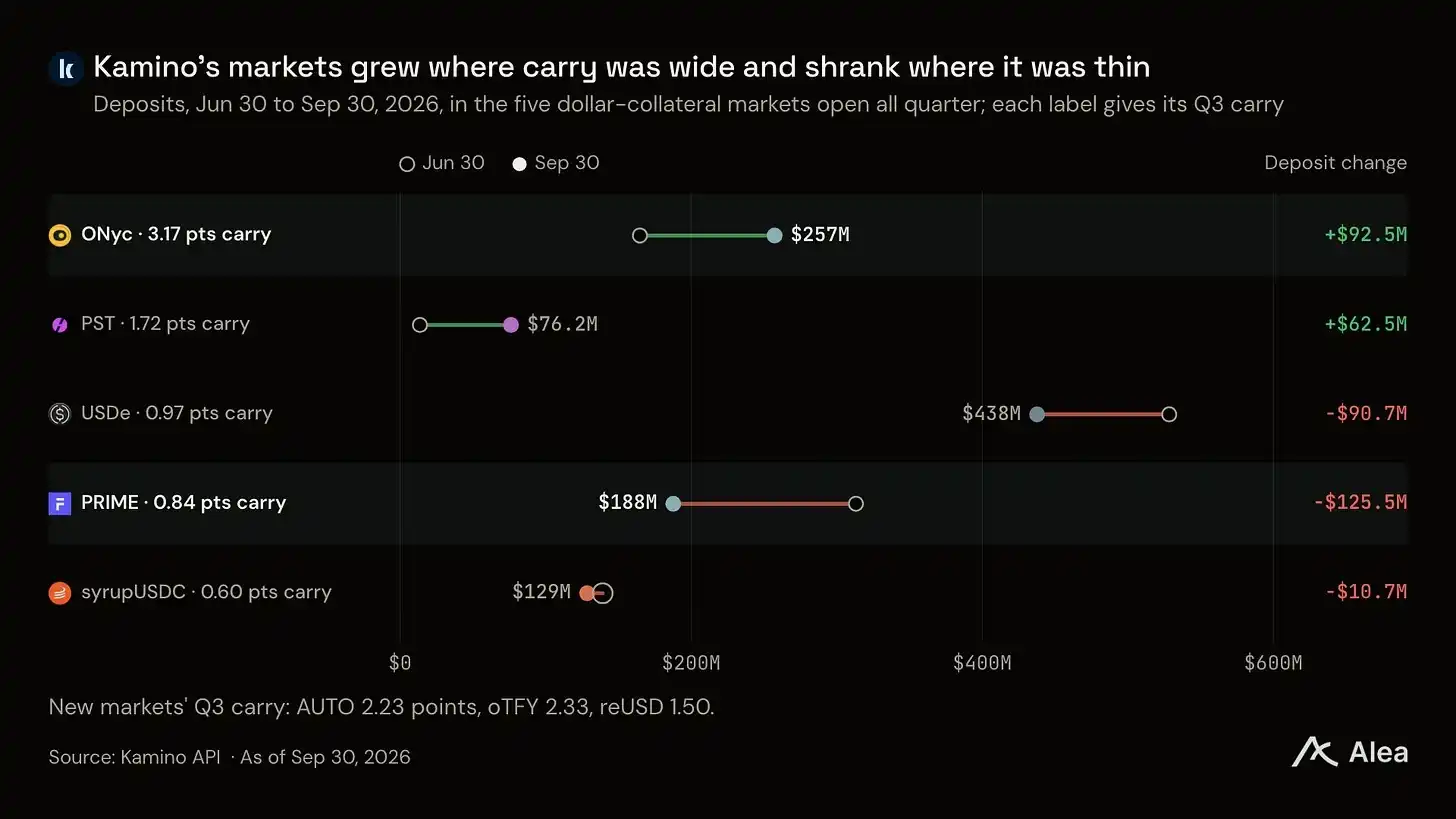
Kamino opened 10 tokenized markets in Q3. They cover Figure’s AUTO auto-loan product, trade finance from Obligate, tokenized gold and tokenized sterling assets. Among dollar-collateralized markets that operated throughout the quarter, new deposits concentrated in the markets with the widest carry.
Deposits in the OnRe market grew by $92.5 million. Huma’s PST market added $62.5 million. Figure’s PRIME market continued the outflow trend that began in Q2, shrinking by $125.5 million during the quarter. On Morpho, PRIME deposits had exceeded $470 million by October 28.
Three dollar markets opened before September showed the same pattern. AUTO had attracted $64.9 million in deposits by September 30 and offered a 2.23-percentage-point net spread. OnRe continued to hold its Q3 incremental deposits after its 10-times-points incentive on Kamino’s looping pool ended on September 21.
Distribution channels also brought in significant capital. Binance Wallet users deposited more than $100 million into Kamino vaults in nine days. Kamino became a core venue in Galaxy’s GOFR lending program, and its institutional commodities-yield vault passed $50 million on September 29.
Kamino competes with Jupiter Lend
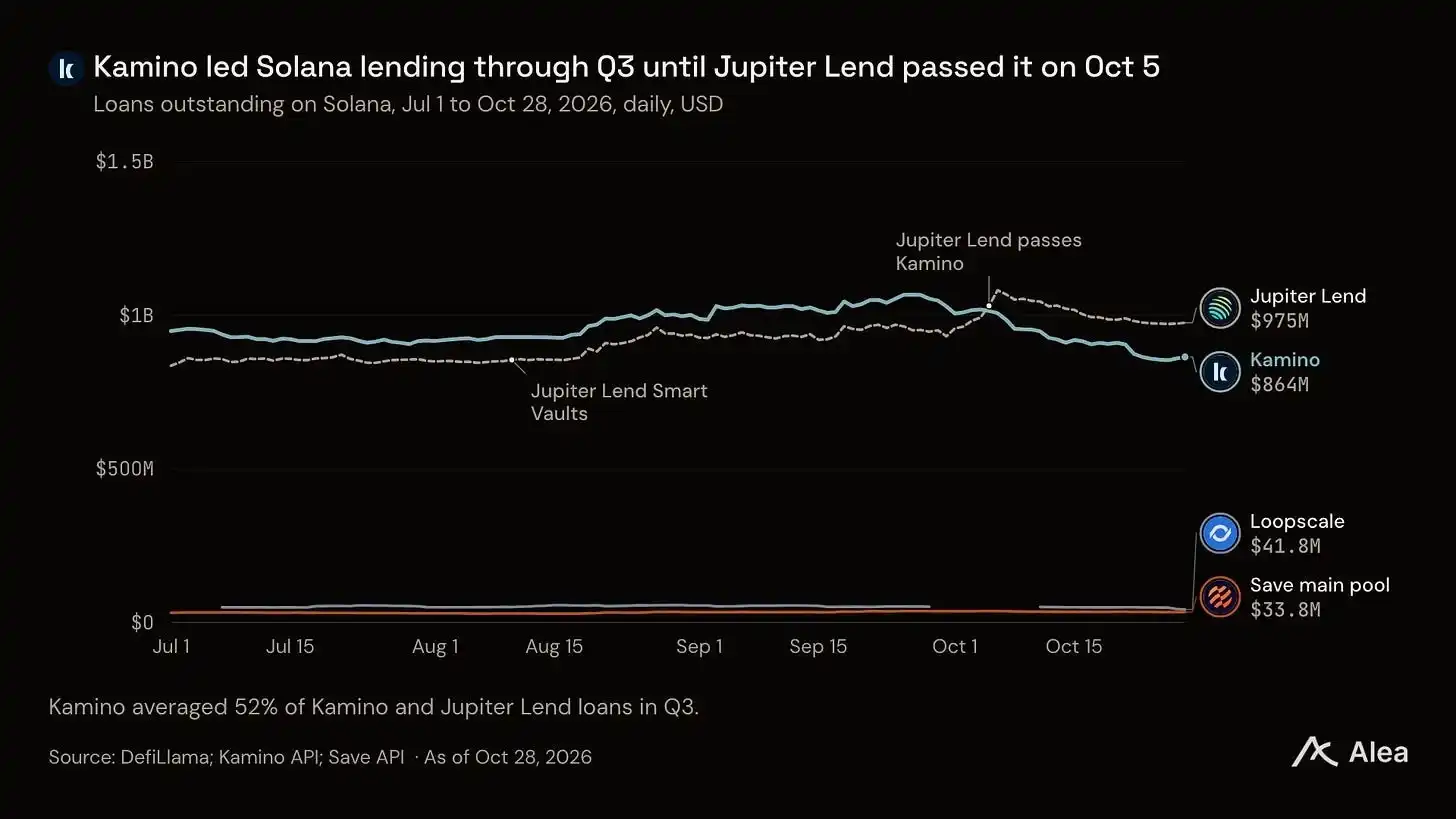
Kamino accounted for an average 52% of lending across Solana’s two leading lending protocols in Q3, down from 58% in Q2. Including Save’s main pool and Loopscale, Kamino’s average share was 50% for the quarter and fell to 45% by October 28.
Competitors are adding similar collateral assets. Jupiter Lend launched reUSD in August and added an sUSDai looping pool in September. Loopscale supports lending against ONyc. Jupiter also added a fixed-rate USD* looping pool to its peer-to-peer lending order book, Offerbook. Kamino instead built fixed-rate functionality directly into its existing lending markets.
From July 1 through October 28, Kamino’s average Q3 outstanding loan balance was $970 million, compared with $892 million for Jupiter Lend. Save’s figure counts only its main pool.
Jupiter Lend launched version 2 on August 10 and surpassed Kamino in total borrowing on October 5. Its Smart Vaults can convert borrowing positions into DEX liquidity to earn trading fees. Jupiter Lend’s Q3 loan balance rose 17% quarter over quarter, while Kamino’s fell 6%.
Kamino still led on net deposits, or liquidity retained after loans are deducted. Its Q3 average daily net deposits were $1.17 billion, compared with $1.02 billion for Jupiter Lend.
Fixed-rate loans reach $73.7 million
Kamino’s fixed-rate mechanism allows borrowers to lock in the cost of borrowing for a defined term. At maturity, a loan automatically rolls into another 30-day period at the same rate unless a lender requests redemption.
Outstanding fixed-rate loans reached $21.5 million by September 30 and $73.7 million by October 28. The amount represented 8.5% of Kamino’s total loans. During the week of October 22, the first $12 million of fixed-rate loans rolled into the next 30-day period at the original rate. The next maturity was expected around November 21.
The OnRe market, launched on September 25, offered an 8% fixed USDC rate. That rate remained stable through the end of September, while OnRe’s floating USDC rate moved between 7.6% and 9.6% during the same period.
Borrowers in the Ethena market did not have a cap on floating-rate costs. The average borrowing rate there climbed to 4.57% in October, nearly twice its July level and close to USDe’s base reward yield of about 4.75%. Loans in the Ethena market fell by $166 million in October as arbitrage loops were unwound.
One treasury currently funds all four of Kamino’s AUTO fixed-rate quotes. It lends Figure’s yield-bearing dollar asset, wYLDS. Rates start at 5.3% and rise with each successive quote. The four AUTO fixed-rate tranches total $62.7 million. OnRe rates range from 7% to 8%.
Product expansion and the roadmap
Binance Wallet added $150,000 in incentives to Kamino’s RWA USDC vault. The campaign is scheduled to run through December 1. In October, Kamino announced that two executives had joined the company and that it had established a New York headquarters. Weisz also disclosed plans to offer lending against private-fund LP interests at rates of 5% to 6%.
Kamino announced the Keep Alive feature on September 22. It lets users proactively extend fixed-rate loans before maturity. The OnRe market added fixed-rate USDG on October 21. The Backpack market for tokenized U.S. equities began operating on October 28.
Kamino’s December 2025 roadmap identified six core products. Five have been delivered: fixed rates, off-chain collateral, the BuildKit developer suite, private credit operated by Institutional Yield, and Borrow Orders, a system for expressing borrowing intent. The RWA DEX remains outstanding.
AUTO looping economics
As of October 28, AUTO looping positions carried an average leverage multiple of 3.5 times. At a fixed borrowing cost of 6%, the break-even asset yield was 4.3%.
Using AUTO’s 10.2% average yield in October, a 3.5-times leveraged loop produced a calculated net return of 20.8%, about twice the return from holding AUTO without leverage. Fixed rates lock the cost on the liability side but do not lock the underlying asset yield. AUTO’s yield averaged 10.2% in October and 11.5% on October 28. If that yield falls below 6%, the leveraged loop produces a lower net return than holding the asset directly.
At a 6% average rate and a 10% Kamino revenue share, fixed-rate loan balances of $150 million, $250 million and $400 million would generate approximately $900,000, $1.5 million and $2.4 million in additional annual revenue for Kamino. The protocol’s Q3 total revenue, annualized, was $6.2 million.
Management change and token performance
Michael Weisz, the former founder of Yieldstreet, became Kamino’s CEO on September 15. KMNO gained 133% in Q3, while SOL rose 60% and JUP gained 56%.
Excluding Ethena, Kamino’s total loans increased by $9 million in October. The AUTO market added $44 million, while the Ethena market contracted by $166 million as arbitrage loops were closed.
Disclosure
The Kamino report was published by Alea Research and was not paid for or commissioned. Members of the Alea Research team, including researchers directly involved in the analysis, may hold positions in tokens discussed in the report.
The report is intended for research and educational purposes only and does not constitute financial or investment advice. Readers are instructed to conduct their own due diligence and allocate only within their ability to absorb losses. Alea Research is a research platform and is not a registered investment or financial adviser.
The report lists Kamino’s roadmap dated December 12, 2025, Kamino’s fixed-rate product documentation, Kamino Lend’s September 2026 monthly risk insights report and Kamino’s official fixed-rate launch announcement as related links.



