
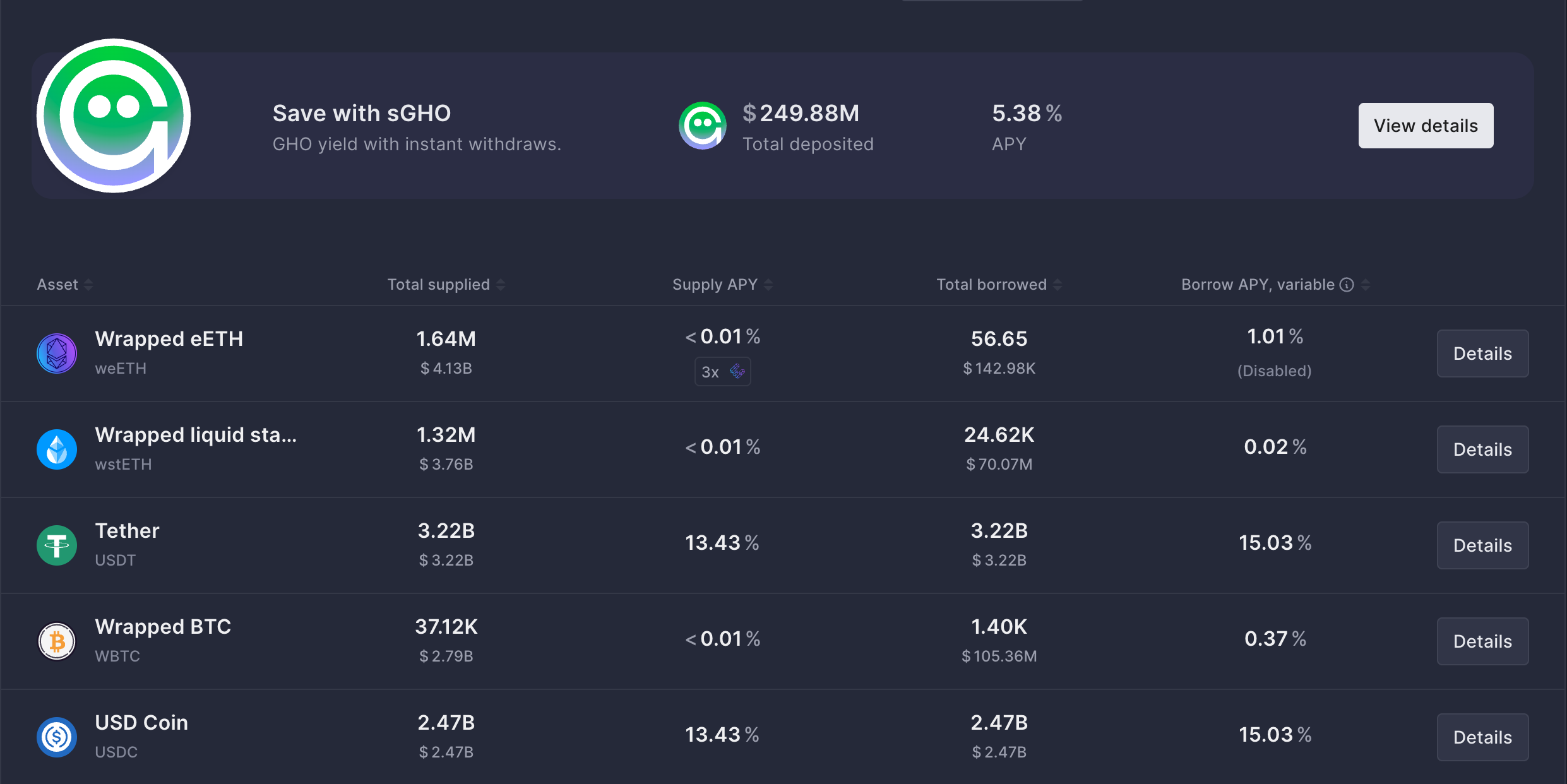
Aave’s USDT market saw a sharp rate spike after the Kelp DAO exploit spilled into DeFi lending. Data cited in the source shows USDT borrow APY rising to 15.03% and deposit APY climbing to 13.43%, with USDC showing a similar pattern. The reported trigger was an attack that minted more than 116,500 rsETH and posted those tokens as collateral on Aave V3 before borrowing large amounts of ETH.
The fallout was immediate. The report says users rushed to pull funds, with more than $5.4 billion in assets leaving as market participants moved to cut exposure. Borrow demand did not fall at the same pace, so the lending pool tightened quickly and stablecoin funding costs jumped across the protocol.
Utilization jumped past Aave’s optimal range
Aave uses a Jump Rate Model, where rates are driven by utilization, calculated as total borrowed divided by total supplied. In the report, the optimal utilization for the USDT pool is placed at about 92%. Below that level, borrowing costs rise more gradually. Once the threshold is crossed, the curve steepens fast.
That is what happened here. Depositors withdrew USDT because of concerns over bad debt tied to rsETH exposure, while borrowers did not unwind at the same speed and some positions borrowed more as a hedge. Supply fell, borrowed balances stayed nearly flat, and utilization was pushed to roughly 99%. That move drove borrowing costs into the steep section of the curve and pulled deposit yields higher as well.
Fake collateral created real bad debt
The source says the Kelp DAO incident involved about $290 million in stolen value. The attacker deposited more than 110,000 rsETH into Aave and borrowed WETH against it, leaving Aave facing close to $200 million in bad debt. The core issue was not a normal market drawdown. The rsETH used as collateral no longer had real assets backing it at the base layer.
That has put Aave’s risk controls under pressure. The report argues that LTV, oracle design, and supply caps did not stop a non-price attack built on fraudulent minting. Even if Aave’s own contracts were not compromised, the protocol still accepted invalid collateral and lent out real assets against it.
Pressure spreads across DeFi and restaking markets
The article says the event could reshape how the market prices LRTs such as rsETH, ezETH, and weETH. These liquid restaking tokens had been widely used in DeFi as yield-bearing ETH collateral. After this exploit, the risk premium attached to that category is likely to face fresh scrutiny, and listing standards for similar assets on lending platforms may turn stricter.
The rate shock is also hitting trading and carry strategies. The source highlights several channels: delta-neutral trades funded by borrowed USDT become less workable, leveraged looping positions face forced deleveraging pressure, and RWA strategies that relied on borrowing USDT from Aave to buy US Treasuries lose their carry once funding costs surge.
Protocols move to cut LayerZero OFT links
The aftershocks also reached LayerZero’s OFT standard. According to the report, several protocols chose to disconnect from LayerZero OFT as a precaution and said they had no direct rsETH exposure. Those measures were described as temporary.
The list included Ethena, Lombard, Euler Labs, TRON DAO, ApeCoin/ApeChain, ether.fi, mETH Protocol, Solv Protocol, MOCA Foundation, and River, more than 10 protocols in total. The broader message from the incident is that in composable DeFi systems, a failure in token issuance or cross-chain infrastructure can move quickly into lending pools, collateral quality, and benchmark stablecoin rates.