



Kevin Muir, author of The Macro Tourist, said in an interview with Maggie Lake that the biggest risk in markets right now may be hiding beneath the surface. The S&P 500 looks relatively calm, he said, but the underlying action in individual stocks and sectors has been far more violent.

"There are a million little flashing red lights all over the market, and people keep finding excuses to ignore them," Muir said. "To me, this is an extremely worrying market. I am very shocked that everyone is so complacent in the face of all this."
The funding story behind AI spending has kept changing
Muir said one of the clearest warning signs is the way the market has justified AI infrastructure spending at each stage.
At first, the argument was that the spending did not matter because it was backed by large free cash flow. That later shifted to the idea that companies could still borrow cheaply in bond markets. Now that low-cost borrowing is no longer available, the market has moved again, telling itself that equity issuance can fund the buildout.
He described that progression in blunt terms: "At one point, the dominant market view was that the bubble did not matter because all of this was being paid for by huge free cash flow. Then it deteriorated into, 'It does not matter because they can issue debt at extremely cheap levels.' And now that the cheap borrowing window has closed, people are comforting themselves by saying, 'It still does not matter because they can raise money by issuing stock.'"
For Muir, that kind of retreat in the funding narrative is a dangerous late-stage signal.

Indexes are steady, but the internals are not
Muir said a recent research note of his focused on the scale of the internal rotation in U.S. equities.
He cited June 22, 2026, when Goldman Sachs' AI Winners vs. Losers basket was up 94.2% for the year. Over the same period, the Nasdaq had gained 21% and the S&P 500 had risen 10%. Since then, however, the Goldman basket has fallen 55% from its high, while the Nasdaq is down only 4% and the S&P 500 is roughly flat. At the same time, the Magnificent 7 has kept moving higher.
"So the environment we are in has gone through a huge internal sector rotation," Muir said. "Under the surface there has been enormous turbulence, while broad indexes have barely moved over the past six months."
He compared the market to a swan that looks graceful on the water while kicking furiously below it. In his telling, the strong negative correlation between stocks has suppressed realized volatility at the index level. A lot of damage has taken place, but the headline indexes have not reflected it.
Why he puts more weight on market structure
Muir mentioned several possible explanations for the collapse in correlation.

One theory is that AI is a transformational technology and that major technological shifts often produce highly bifurcated markets. He said he gives that explanation only "a little bit" of credit. He places more emphasis on changes in how money is being traded.
He singled out multi-manager hedge fund platforms, or pod shops. According to Muir, many participants now trade in a way that looks very different from past decades. Traders are no longer simply long; each long position is paired with a corresponding short.
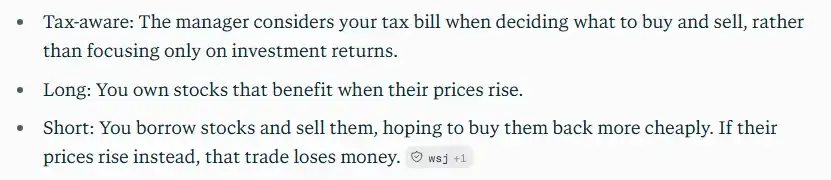
He also pointed to TALS, or tax-aware long-short strategies. He said that when a long position falls, managers may sell it to lock in a capital loss for tax purposes and immediately replace it with another highly correlated stock. When a short rises, they may buy it back and replace it with a new short candidate.
That process, he said, can help explain why some stocks keep grinding lower. In his view, those names may be carrying very high short interest that is never truly covered, partly because TALS-style rebalancing keeps the pressure in place. The core issue, he said, is that this behavior is creating serious microstructure distortions across the market.
Canada: long materials, energy and the real economy
Muir said he wrote more than a year ago about the case for Canada. His argument then was that whether Mark Carney or Pierre Poilievre ended up in power, the country's political and economic pendulum was swinging to the right and would bring a more serious push toward reform and practical policy action.
"And that is exactly what has happened," he said. "Mark Carney is not some detached radical environmentalist. The previous leader was a former school teacher, while Carney is a heavyweight who truly understands finance and capital."
Muir said Canada has performed very well over the past year and that many investors have not realized Canadian equities have outperformed the S&P 500. He acknowledged that geopolitical conflict has helped energy stocks, but said the deeper story is that Canada is making the changes needed to reactivate its economy and is becoming more business-friendly.
He was less positive on Canadian banks, saying valuations there have become detached from fundamentals.
"So short or sell domestic Canadian banks, go long basic materials, go long the real economy, and keep buying energy on dips," Muir said. "If you want to build the perfect pairs trade in Canada, the appeal of that strategy is probably as high as it has ever been."
Brazil: he sees the post-election drop as a buying chance
The interview also framed the week as a critical one for financial markets, with a heavy slate of earnings and a Federal Reserve meeting ahead. Two developments had already moved markets at the start of the week: Anthropic formally filed for an IPO, which was welcomed by tech stocks, while Luiz Inacio Lula da Silva's victory in Brazil's election triggered a sharp reaction that Brazilian equities did not welcome.

Muir said Lula's win did catch the market off guard, but he also argued that the balance of power in Congress has shifted meaningfully to the right. A fully free-market leader would be preferable, he said, but the broader macro direction is still moving that way.
He was explicit about how he viewed the selloff: "I see today's panic drop as an excellent buy-the-dip opportunity. In fact, I was already buying aggressively at the open today."
For Muir, Brazil's appeal is tied not only to an election-driven dislocation but also to its reserves of key commodities and its leverage to cyclical energy exposure.
Why Canada and Brazil fit the same portfolio view
Muir said investors often confuse a good company with a good investment, and that the two are not the same. In his view, the issue is not whether AI-linked companies are impressive businesses. The issue is whether valuations, funding methods and market structure have pushed risk too far.
He also said he does not believe governments will step in to rescue AI stocks if the trade breaks down. "When did we start naively believing that governments can control markets however they want? The power of the market is much bigger than anyone, even a president," he said. "I absolutely do not think that if there is a crash ahead, the government will come in and bail out AI stocks."
Muir said he is firmly bullish on energy, especially crude oil. "I strongly believe the energy sector is going to see unexpectedly strong buying over the coming period, especially in oil," he said. "As the global geopolitical backdrop becomes more unstable, sovereign nations will need to hold much larger strategic inventories."
That is why he groups Canada and Brazil together. "That is the core logic for owning Brazil and Canada in a portfolio, because these two countries have and keep producing the key materials the world will need to stockpile when uncertainty rises," he said.
He also flagged a pension funding ratio indicator that he finds unsettling, saying it measures how well funded pension plans are and that the market is now at the highest funding level since 2007.
Interview context and disclaimer
The piece was compiled from Maggie Lake's interview with Kevin Muir and translated by TechFlow. It also noted that The Market House is an independent publication supported by readers, thanked viewers who joined the live broadcast, and said the program would return on Wednesday with Dale to review the Federal Reserve's latest rate decision.
The article ended with a disclaimer stating that the material is for informational purposes only and does not constitute investment advice. Readers were urged to consult a qualified financial adviser to assess risk tolerance, investment objectives and overall financial planning.