


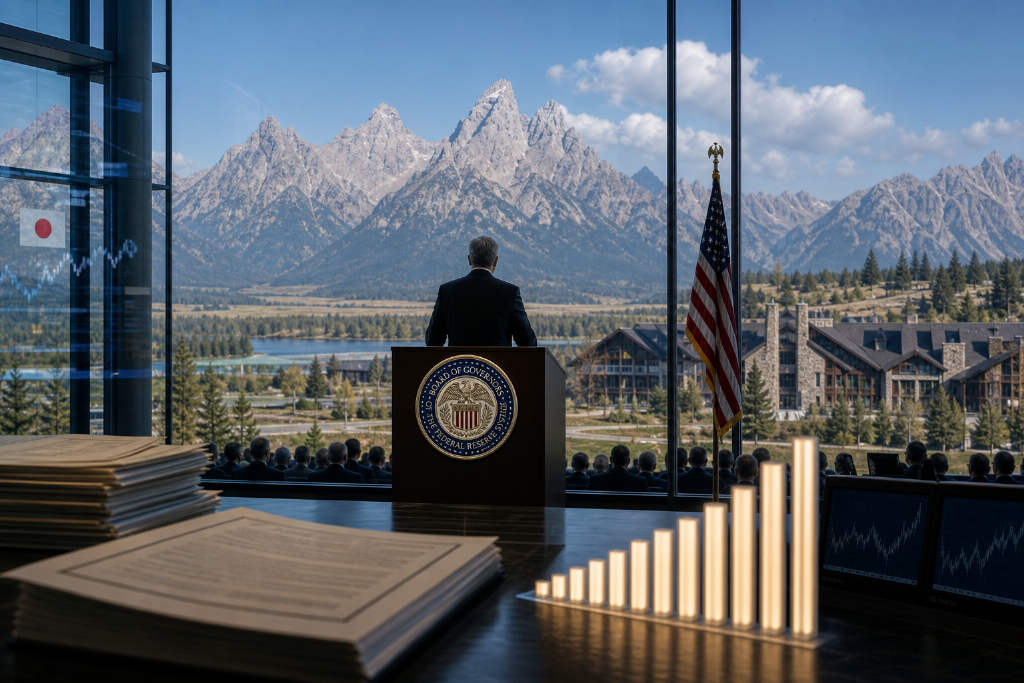
Federal Reserve Chair Kevin Warsh is set to deliver a keynote address at the Jackson Hole central banking symposium on Aug. 28 at 10 a.m. Eastern Time, according to schedules released by the Fed and the Federal Reserve Bank of Kansas City. It will be his first appearance at Jackson Hole since taking office as chair, giving markets an early look at how he may frame monetary policy.
Investors are not only looking for hints on the next move in rates. They are also watching to see whether Warsh will continue to scale back forward guidance, the practice of using public communication to shape expectations for the future path of interest rates. In the view presented by Michael J. Kramer, Warsh is unlikely to reverse course and may keep reducing the Fed’s step-by-step signaling, leaving economic data and market pricing to carry more weight.
Attention shifts from Nvidia earnings to Jackson Hole
The article says markets spent the first half of the week focused largely on Nvidia earnings, but that attention is expected to move to the Jackson Hole gathering after Wednesday. Hosted each year by the Kansas City Fed, the symposium is widely followed as a venue where central bankers discuss the economy and monetary policy, and where investors look for signals from the Federal Reserve.
In Kramer’s argument, the main issue is not simply what Warsh says about rates. It is whether he keeps pulling back from forward guidance. If that approach continues, long-term yields may stop being just a passive reflection of the expected path of short-term rates and begin acting as an independent driver of financial conditions.
Rising term premium could push the 10-year Treasury higher
One of Kramer’s central points is that the Treasury term premium has already started to rise. Term premium is the extra return investors demand to hold a long-dated bond instead of rolling over short-dated debt, compensating for uncertainty around future interest rates, inflation, and policy.
The article uses the New York Fed’s ACM term premium model. ACM refers to the framework developed by Tobias Adrian, Richard Crump, and Emanuel Moench to split long-term Treasury yields into expected short-rate components and term premium. The piece also notes that term premium cannot be observed directly and that different models can produce different estimates.
Based on the data cited by Kramer, the ACM term premium on the 10-year Treasury is about 82 basis points, still below the roughly 150-basis-point average seen in the decades before quantitative easing. From there, he sketches a scenario rather than a firm forecast: if term premium rises back to that historical average and the neutral rate remains a little above 4%, the 10-year Treasury yield could climb above 5%.
The article stresses that the calculation depends on two assumptions. Term premium would need to keep rising, and the long-run neutral rate would need to stay elevated. If either changes, the result could look very different. Kramer’s real focus is not the 5% level itself, but the way long-end yields are priced if the Fed stops trying to suppress policy uncertainty.
Less forward guidance could reprice bond volatility
Kramer also focuses on volatility in the bond market. Even though long-dated Treasury yields have moved up recently, the MOVE Index, which tracks implied volatility in Treasury options, remains relatively low. He reads that as a sign that markets still believe they can broadly anticipate the Fed’s next steps.
If that sense of certainty fades, each policy meeting could become an open event again. Investors would be less able to rule out a hike, a cut, or another pause in advance, and bond prices could become more sensitive to economic data and official remarks. In that setting, Treasury volatility could be repriced structurally even if the Fed does not change the policy rate.
According to the article, that alone could tighten financial conditions. Higher 10-year yields would feed through to mortgage rates and long-term corporate borrowing costs, while also weighing on valuations for long-duration assets such as equities. Higher rate volatility could also widen credit spreads and raise the cost of issuing debt for companies.
The piece adds an important qualifier: the federal funds rate remains the Fed’s core policy tool, and this should not be read as a claim that the short end no longer matters. Kramer’s point is narrower. Outside the policy rate itself, long-term yields and bond volatility can also affect the real economy, and in some cases the transmission may be more direct.
A framework where the long end does part of the tightening
Under the framework Kramer describes, the Fed may allow the yield curve to keep steepening, with the long end doing more of the restrictive work than it has in the past.
That would mean less forward guidance and less effort to remove uncertainty around every policy meeting. In an environment where supply pressures, inflation risks, and fiscal concerns remain in place, investors could demand more term premium. That, in turn, could lift long-dated yields and bond volatility, allowing markets to deliver part of the tightening on their own.
If that process weakens demand and helps inflation continue to move lower, the Fed could later cut short-term policy rates. The yield curve in that case could show relatively high long-end rates alongside gradually lower short-end rates.
Put differently, Kramer is not describing the traditional sequence of hikes followed by cuts. He is describing a path in which the long end tightens financial conditions first, creating room for cuts at the short end later.
The article also lays out the risks. Long-end yields are not fully under the Fed’s control. If term premium rises too far, mortgages, corporate financing, and government interest costs could all come under pressure at the same time. If markets interpret reduced communication as a sign of an unclear policy framework, higher volatility could damage the Fed’s credibility instead of helping it engineer an orderly tightening.
For that reason, the article says it is still too early to tell whether higher long-term yields would be a channel Warsh wants to use or simply extra compensation demanded by the market for inflation, fiscal, and policy uncertainty.
Japan adds another source of pressure on global long-end rates
Kramer also points to Japan as another force that could push global yields higher. Under the Bank of Japan’s latest policy settings, the target for the uncollateralized overnight call rate is about 1%. At the same time, Japan’s 10-year breakeven inflation rate has moved close to 2%.
The article defines breakeven inflation as the gap between nominal government bond yields and inflation-linked bond yields of the same maturity. It is often used as a market-based estimate of future inflation, though it also contains liquidity and risk premia.
In Kramer’s reading, firmer Japanese inflation expectations suggest markets are preparing for further normalization by the Bank of Japan. Based on the TONAR futures pricing cited in the article, implied rates are about 1.19% for September, 1.41% for December, and 1.6% for March of the following year. The piece notes that those figures reflect market pricing at the time of publication and can change with incoming data and policy expectations. They are not a preset path for BOJ rate hikes.
If Japanese rates keep rising, global demand for low-yielding overseas bonds could weaken at the margin, putting more upward pressure on long-dated yields worldwide. In that environment, long-end Treasuries may not fall easily even if Warsh does not deliver an explicit hawkish signal.
What markets need to hear on Friday
The article ends with a narrower test for Friday’s speech: how Warsh describes the recent rise in long-term yields. Does he see it as markets doing part of the Fed’s tightening for it, or as a source of financial risk tied to a higher term premium? Will he keep reducing forward guidance, and will he explain how the Fed wants markets to understand its reaction function?
Only clearer answers to those questions, the article says, will help determine whether the idea of letting the long end hike on the Fed’s behalf is a policy framework Warsh may use or a market narrative built around his silence.