Bubblemaps has pushed back against one of the louder claims circulating around the trader known as Kimchi.
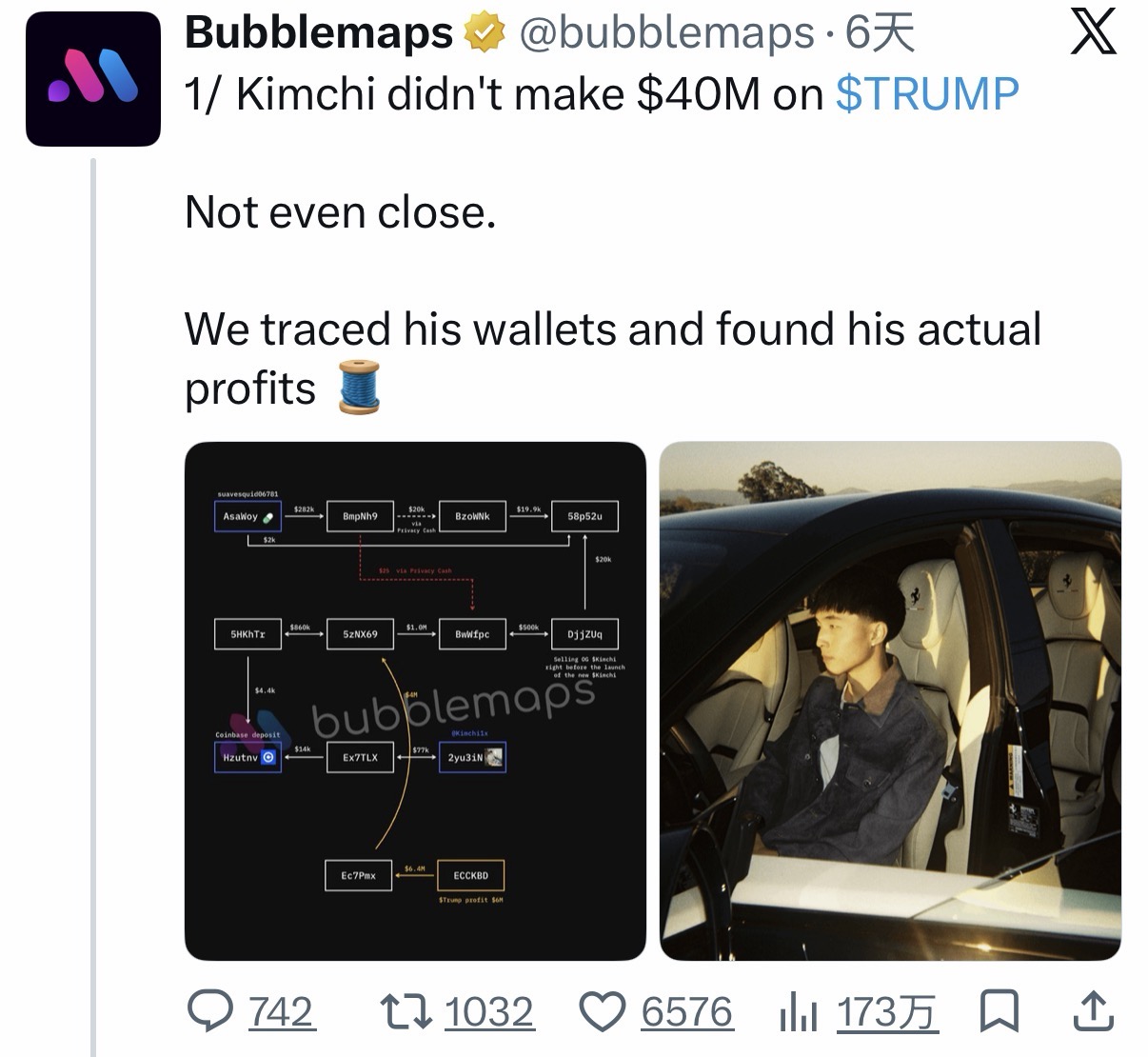
For a long time, the crypto community has repeated a claim that Kimchi made about $40 million on the TRUMP token. Bubblemaps recently traced a cluster of linked wallets starting from Kimchi’s airdrop wallet and the original KIMCHI token, including addresses that had not previously been identified, and estimated TRUMP-related profit at about $6 million. That figure is well below the number widely repeated online.
The Bubblemaps team said the investigation covered only part of the linked addresses, so it did not rule out gains in other wallets. At the same time, the team said that if a much larger profit really existed, the person involved would be more likely to disclose it. The point of the probe was to reconstruct linked holdings and profits through fund flows and behavioral clustering rather than rely on rumor.
What Bubblemaps is
Bubblemaps is an on-chain data visualization and investigation platform. Its core product turns token holder distribution and wallet relationships into bubble charts. Bubble size reflects the share of holdings, lines show historical transfers, and colors and clusters mark wallets that the algorithm considers likely to belong to the same entity.
After entering a contract address, users can quickly check whether supply is concentrated, whether coordinated buying may be present, and whether there are obvious insider clusters. That has made the product a common tool for meme coin due diligence and fast supply audits.
The project dates back to 2021, when it first launched token and visualization tools on BNB Chain under the Moonlight brand. It was formally renamed Bubblemaps in June 2022, and the company is registered in the Paris area of France.
The team was founded by three crypto enthusiasts. CEO Nicolas Vaiman entered the sector in 2017 and previously founded the data aggregator Cryptonavia. CTO Léo Pons worked with him at Cryptonavia and has a background in software engineering and AI. COO Arnaud Droz oversees operations. All three graduated from French schools including CentraleSupélec.
According to public information, Bubblemaps raised about $3.2 million in a seed round in September 2023. INCE Capital led the round, with Stake Capital, Momentum 6 and LBank Labs participating. Angel investors included Ledger’s former CTO. The team has grown from a handful of people to roughly 20 to 30, and revenue mainly comes from B2B iframe integrations and custom investigation services rather than depending only on the token.
More than a bubble chart
On top of multi-chain support, Bubblemaps has rolled out Magic Nodes, Time Travel, Bundle Checker, Bubblemaps Score and Intel Desk. These tools have been integrated into platforms including Pump.fun, DEXScreener, Etherscan and OpenSea, making Bubblemaps a regular stop for users doing pre-trade checks.
Within that product set, Intel Desk is the clearest link between Bubblemaps and its community. It is framed as a community-driven investigation platform, something like a wiki for crypto investigations, designed to organize and preserve on-chain detective work scattered across crypto Twitter. It is also tied directly to BMT, the platform token, to create an incentive loop.
BMT launched on March 11, 2025, with a total supply of 1 billion tokens and a current circulating supply of about 756 million. It was listed that month on exchanges including Binance, Bitget and Bithumb. On Aug. 21 this year, Upbit added BTC and USDT trading pairs for BMT, followed by a KRW pair on Oct. 24.
How Intel Desk works
When a hack, insider trading case, suspicious token launch or rug event appears, the platform creates a case page that gathers findings posted by on-chain analysts on X. The result is a timeline, a contributor ranking and a pool of evidence in one place.
BMT holders can deposit tokens into a voting pool and then allocate them to cases they want to prioritize. The amount of BMT assigned to a case determines its priority and multiplier. A case that receives about 80% of the vote can get roughly an 8x multiplier. A case with 20% gets about 2x, while low-support cases stay close to 1x. The higher the multiplier, the more points and visibility contributors receive, and the more likely the team is to devote investigation resources to that case.
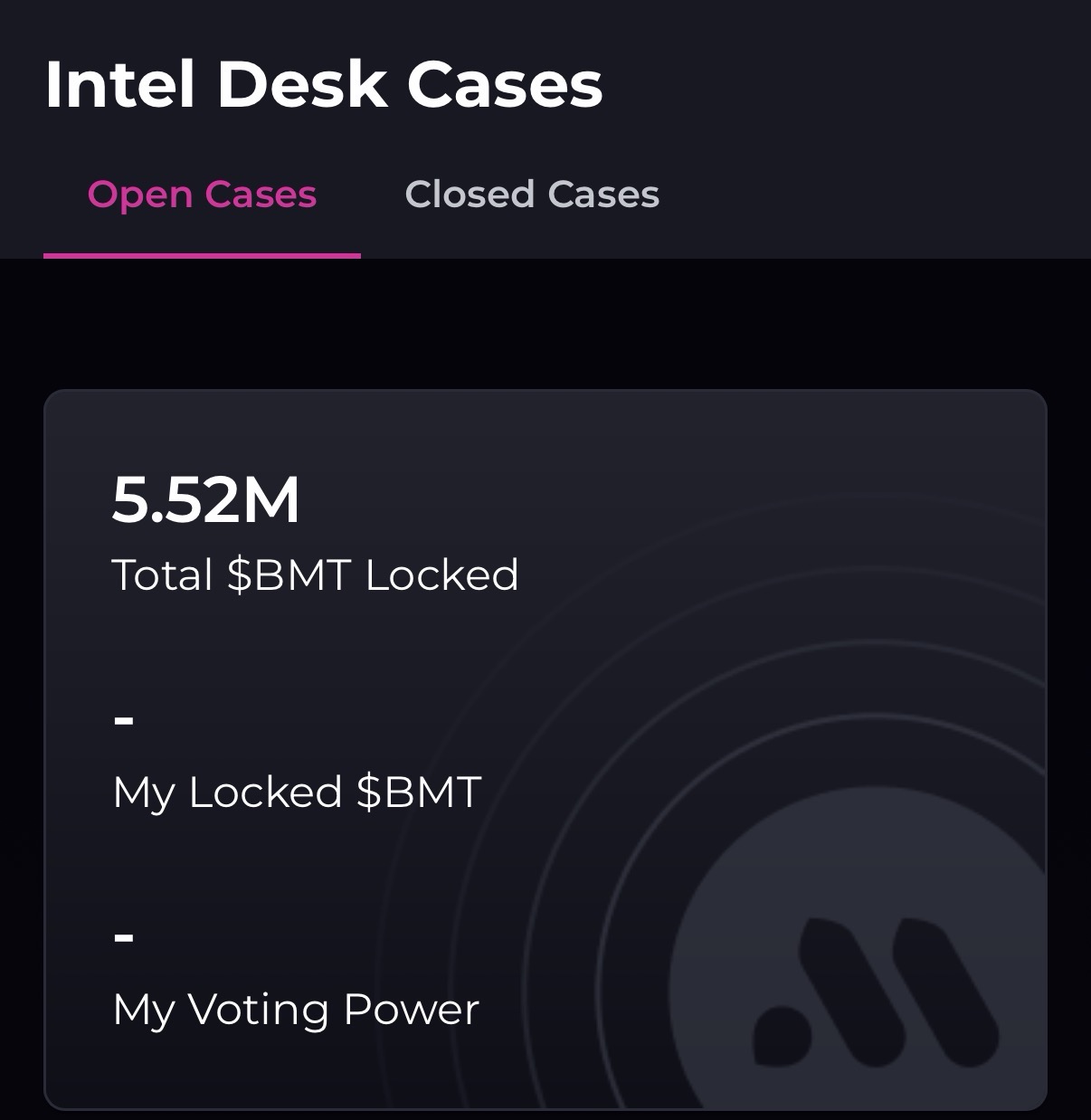
About 5.52 million BMT is currently locked, worth about $146,000.
Submitting a new case requires at least 100 BMT, a threshold meant to prevent spam. Fast withdrawals carry a temporary fee of about 20% on the first day, which falls to near zero after a few days to encourage longer participation.
The reward structure has three layers. Proposers receive BMT if their case is selected. Voters get earlier access to investigation insights. Contributors who attach X posts to a case earn points based on quality and reach, and BMT is distributed by leaderboard at the end of each season.
The platform continues to update a range of cases. Publicly visible examples mentioned in the report include a rug investigation tied to the GP and RuneScape-themed meme ecosystem, analysis of a Hunter Biden-related meme coin on Base, an abnormal minting event involving about 4 billion Harmony ONE tokens, and KOL bundling and insider cluster investigations involving tokens such as RIVER and AAVE. Each case page shows allocated BMT, multiplier, status and tags, allowing the community to see where investigation resources are going in real time.
That means Bubblemaps’ interaction with its community is not limited to team-led probes such as the Kimchi case. Token holders can vote on what should be investigated first, then take part through points and seasonal rewards. In that structure, Intel Desk is not just an analytics tool. It is also the layer where community governance and investigation incentives meet, and it is currently one of BMT’s main utilities.
BMT’s move after the Upbit KRW listing
Upbit listed a KRW trading pair for BMT on Oct. 24. According to Bitget data, BMT rose more than 130% at its intraday peak and touched $0.052 that day.
The move did not last. BMT is now quoted at $0.026, down about half from that high. CoinMarketCap data shows the token has a market capitalization of about $19.9 million, a maximum supply of 1 billion, and a ranking of No. 678 by market cap. It is listed on major exchanges including Binance, Bitget, Upbit and Bithumb.
Why comparisons with Arkham only go so far
As attention around BMT has increased, some market participants have started discussing it alongside Arkham’s ARKM because both sit in the on-chain intelligence segment. ARKM also posted a notable rally in 2024. Bitget market data shows ARKM climbed from $0.5 to $3.997 between February 2024 and early March, with a peak monthly gain of nearly 700%.
Still, the two projects are not positioned the same way. Bubblemaps is built around visual holder distribution and wallet clustering. The learning curve is lower, the product is more retail-friendly, and core functions are free, which makes it better suited to meme coin due diligence and quick supply audits. Arkham is centered on entity attribution, linking addresses to real people, funds or exchanges, then combining that with fund-flow tracking and the Intel Exchange bounty marketplace. That makes it more geared toward professional investigations and institutional use.
The business models differ as well. Bubblemaps uses a token-based model to unlock advanced functions, while most of its revenue comes from B2B integrations and investigation services. Arkham has a free layer on its core platform, but it charges custom fees for enterprise tracking, risk scoring and case management, bills API access by usage, and takes a cut on Intel Exchange transactions settled in ARKM. In practice, the two can be used together: Bubblemaps shows structure and clusters, while Arkham helps identify who is behind an address.
English-language blogger Domba.Eth argued that as Arkham starts charging for some analytical functions, Bubblemaps could become an alternative for users looking for free on-chain analysis tools. If more users shift toward free products, BMT could attract more attention.
The report says that logic may make sense, but the bigger issue is what actually drove ARKM’s rally in 2024. Based on public information, three factors stood out beyond the broader market backdrop. First was its strong tie to the AI narrative, including gains alongside WLD during the period when OpenAI’s Sora was released. Second was the expectation of business expansion tied to plans for a retail-focused crypto derivatives exchange. Third was brand exposure from tracking high-attention events such as German government selling, Mt. Gox and celebrity wallets.
Arkham’s funding lineup also included Sam Altman, Peter Thiel, Tim Draper, Coinbase Ventures and Binance Labs, now YZi Labs, giving that narrative stronger backing.
By comparison, Bubblemaps’ current strengths lie in product practicality, broad integrations and strong community visibility, with cases such as the Kimchi investigation continuing to generate attention. But according to public information cited in the report, Bubblemaps does not have public investment from figures or institutions comparable to Sam Altman, Peter Thiel or Binance Labs. It also lacks the combination of AI narrative and business expansion expectations that supported Arkham at the time.
The original article also carried a risk warning, saying the market involves risk and the piece does not constitute investment advice. Readers should decide for themselves whether any opinion, view or conclusion fits their own circumstances and bear responsibility for any investment decisions made on that basis.