


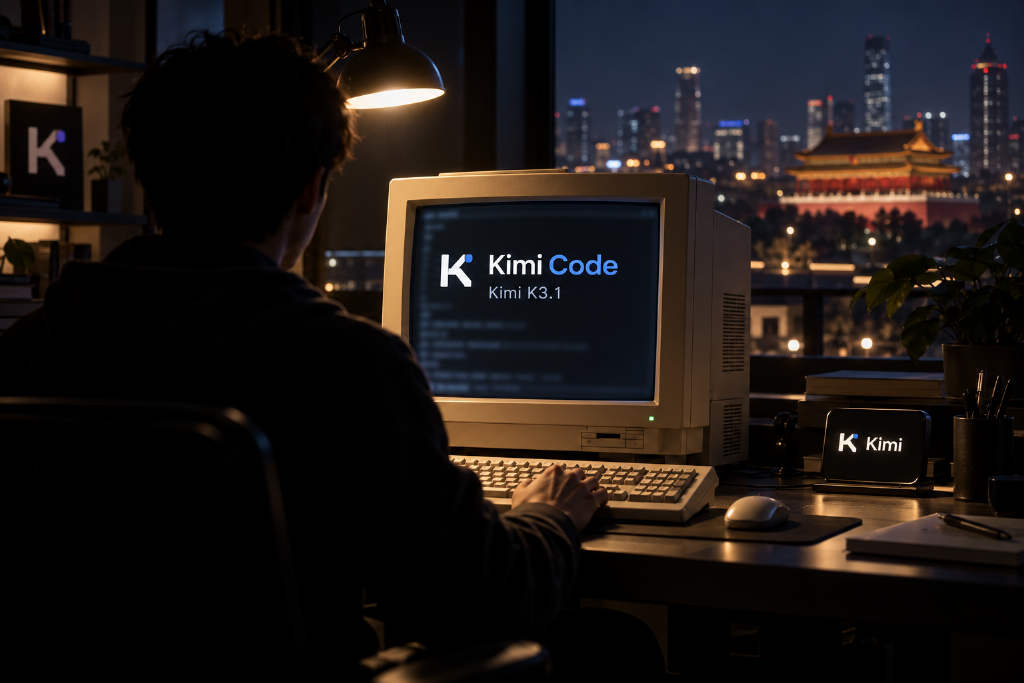
Moonshot AI has yet to formally unveil Kimi K3.1, but the company has now shown the name publicly. At 9:41 a.m. UTC+8 on Oct. 23, its official X account, @Kimi_Moonshot, posted a 24-second video with no accompanying text. Inside the clip, a terminal interface clearly displays the model name Kimi K3.1. The company did not provide a launch date, specifications, pricing, or benchmark data.
What appears in the teaser
The video opens on a beige retro desktop computer. On screen is the terminal interface of Kimi Code, Moonshot AI’s coding agent tool, where a user enters a prompt for the AI to write code.
The Model field shows Kimi K3.1, with version 2.2.0. A status bar at the bottom lists reasoning intensity as high and context usage as 0% (0/1M, or 1 million tokens). The prompt entered is 「Build a complex procedural 3D scene in Three.js」.
The clip then shows a file named scene.js being generated. A comment at the top says all geometric forms are produced by the program itself, without relying on prebuilt 3D model assets. The screen then shifts into a glitch effect, followed by a rapid montage of point-cloud terrain, a radio telescope, a DNA double helix, a galaxy, and aerial shots of animal herds. It ends with 「KIMI」 in white text on a black background.
Why some expect an announcement soon
A similar teaser came before K3
The first reason is precedent. Before K3 was officially announced, @Kimi_Moonshot posted another text-free teaser. At 6:33 a.m. on July 16, the account shared a 36-second clip featuring folders, magnetic powder, and a scale. Midway through the video, one folder marked 「3」 appeared, and the ending used the same 「KIMI」 wordmark.
The formal K3 announcement followed at 2:58 a.m. the next day, roughly 20 hours later. Based on that timing, K3.1 could arrive around early Oct. 24, but that remains an inference from an earlier rollout pattern, not an official schedule.
An Oct. 21 configuration leak referenced K3.1
The second reason comes from a settings leak on Oct. 21. According to the article, Linux DO forum user Astralyn posted at 7:19 p.m. that a request sent to a configuration endpoint under Moonshot AI’s api.kimi.com domain returned content showing old names such as 「k3」 and 「kimi-k3」 being switched to 「k3.1」. The response also included a prompt warning that switching to Kimi 3.1 in an existing session could affect model performance and asking the user to choose how to proceed.
In practical terms, that suggested Kimi Code was preparing a confirmation window for users moving from K3 to K3.1.
The same day, the Kimi Code 2.3.0 changelog described that exact feature: when switching models, users would see a confirmation dialog with options to start a new work session, continue after compression, continue directly, or cancel. At 9:08 p.m., Astralyn sent another request and the endpoint had already begun returning 404. As of the morning of Oct. 23, it was still returning 404.
New anonymous models appeared on Arena
The third reason comes from Arena. Early on Oct. 22, the AI blind-testing site Arena, formerly LMArena, showed two anonymous models on Code Arena: Kibitz and Kalmia. Companies sometimes place unreleased models into blind tests under codenames before a public launch.
Linux DO users compiled what they described as Kimi’s earlier naming pattern: K2.5 as Kiwido, K2.6 as Kiwire, and K3 as Kivine. On that basis, Kibitz appears to fit the same convention, and K3 reportedly entered Arena about 30 hours before its announcement. The article notes that this codename mapping comes from forum users, not from Moonshot AI.
What is still unknown
No clear sign of an upgrade yet
The biggest gap is what K3.1 actually improves.
On Sept. 28, a developer claimed to have seen 「kimi-k3-1」 in a model list on Moonshot AI’s API backend. The K3.1 specifications that later circulated described a 1 million-token context window, three reasoning levels — low, high, and max — and pricing identical to K3, though the article says that may have been placeholder text.
That is where the uncertainty starts. According to K3’s official documentation page, K3 already supports a 1 million-token context window. It already offers low, high, and max reasoning intensity, with max as the default, and its thinking mode is always on. The high setting and 0/1M context display shown in the teaser are also part of K3’s current setup.
In other words, the leaked 「new specs」 look the same as K3’s existing configuration. As of the morning of Oct. 23, there was still no visible indication of whether any upgrade involves coding ability, speed, or pricing. K3.1 also did not appear in the model list on Kimi’s developer documentation page at that time.
Pricing has not been disclosed
The second open question is pricing. There is still no official word on how K3.1 will be priced, even though that is one of the main issues developers care about.
In a Linux DO discussion thread about Kibitz, one user wrote that 「kimi is really too expensive, and the plan quota is too small」, while others said they hoped the company would also release a cheaper Flash model.
Open-source plans are also unclear
The third unknown is whether K3.1 will be open-sourced. K3 first went live through the API on July 17, and its model weights were not released until late on July 27, a gap of about 10 days. For K3.1, there is still no statement on whether weights will be released or when that might happen.