
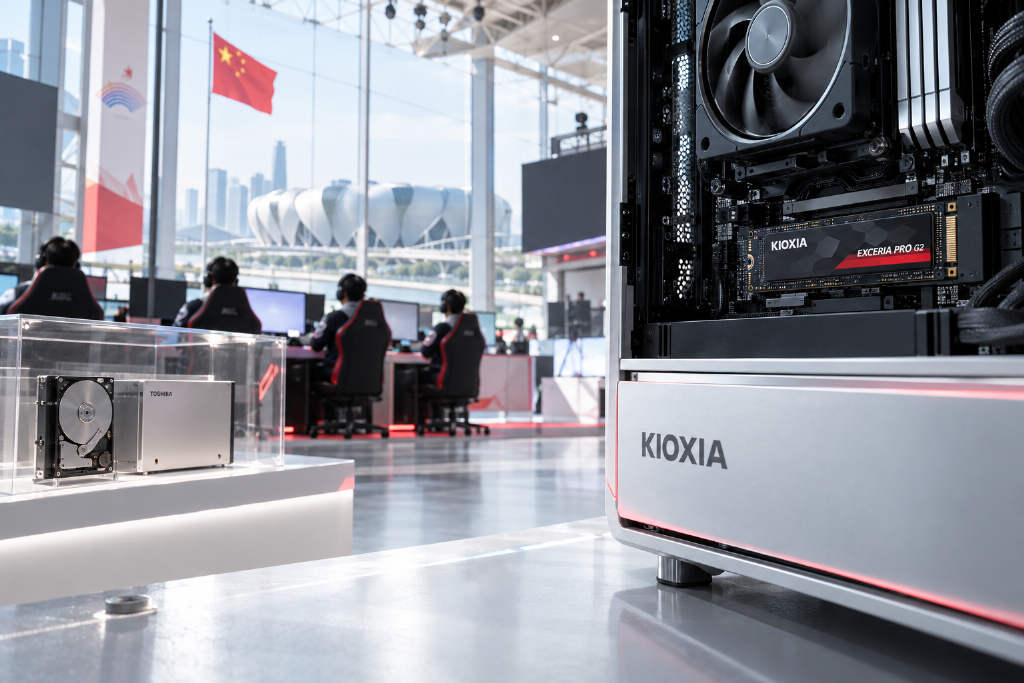
China topped the medal table at this edition of the Asian Games, but the article points to another development that deserves attention: esports officially became a medal event.
The esports program featured 11 disciplines and 13 sub-events, making it smaller only than athletics and swimming. Kioxia, the storage company formerly known as Toshiba Memory, signed on as the event’s official gaming solid-state drive supplier and installed its EXCERIA PRO G2 SSDs in the competition systems.
Most sponsorship discussions around esports focus on peripherals such as mice, keyboards and monitors. The report argues that storage chips sit much deeper in the stack and form part of the basic infrastructure behind esports as a digital sport.
In a League of Legends match, every player action depends on data being read and written within milliseconds. In Counter-Strike 2, map loading speed can directly affect how quickly a team can execute tactics. Demands around latency, read/write speed and stability are pushing storage vendors to move consumer products toward what the article calls a competitive-grade standard.
From that perspective, Kioxia’s strategy is straightforward. The Asian Games esports event gave the company a live environment to demonstrate reliability under extreme workloads. The sponsorship was not only about visibility, but also about trust. The article adds that as esports moves into the Asian Games and toward the Olympics, a broader track for event-grade digital infrastructure is taking shape, spanning storage, networking and cloud rendering. In that race, companies that define standards stand to gain pricing power.
From logo placement to hardware inside the system
For much of the past decade, esports sponsorship followed a simple formula: brands placed logos and bought exposure. Red Bull sponsored teams to sell energy drinks. Logitech sponsored players to sell mice and keyboards. That was a classic consumer-facing model, built around brand recognition and retail conversion.
Kioxia took a different route. Rather than backing a team or an individual player, it became the official gaming SSD supplier for the Asian Games esports competition and placed its core hardware directly into the tournament systems. That means the players, the match machines and the production environment behind the broadcast all ran on Kioxia products. In the framing of the original article, that is closer to technical certification than advertising.
The shift reflects a broader move in esports sponsorship from the consumer side to the business side. Once a brand embeds its hardware into the competition system, sponsorship changes from buying traffic to shaping standards. Through the Asian Games stage, Kioxia was effectively showing PC makers, game developers and tournament organizers that its SSDs could operate stably in a demanding match environment. The article says that kind of validation is worth more than a conventional ad campaign.
It points to similar patterns elsewhere. AMD’s sponsorship of the League of Legends Pro League, or LPL, is described not as an effort to sell CPUs directly to viewers, but as a way to encourage developers and tournament operators to treat AMD platforms as recommended official configurations. NVIDIA’s sponsorship of esports teams is presented in similar terms, with the goal of making RTX graphics cards the default rendering standard in game development. In this model, sponsorship produces not one-off traffic, but longer-term influence over the industry.
How Toshiba ended up selling its memory business
The article then turns back to Kioxia’s origins. Toshiba invented NAND flash in 1987 and for years stood alongside Samsung and SK Hynix as one of the world’s most important flash memory manufacturers.
The reversal began with an expensive diversification bet. In 2006, Toshiba spent $5.4 billion to acquire U.S. nuclear power company Westinghouse Electric, hoping to benefit from a global nuclear revival. After the 2011 Great East Japan Earthquake, however, the nuclear industry entered a downturn and several Westinghouse projects ran far over budget.
By 2017, Westinghouse had accumulated $9.8 billion in debt and filed for bankruptcy. The fallout left Toshiba facing losses of as much as 1 trillion yen and pushed the company to the edge of insolvency and possible delisting.
The pressure worsened in 2015, when Toshiba was hit by an accounting scandal and admitted to overstating operating profit by a cumulative 151.8 billion yen over multiple years. That damaged its credibility in the market and weakened its financing capacity.
To plug the financial hole left by Westinghouse and escape negative net worth before the end of the fiscal year in March 2018, Toshiba moved to sell its most valuable asset: the memory business.
In 2018, Toshiba sold most of Toshiba Memory, later renamed Kioxia, for about $18 billion to a Bain Capital-led consortium that included South Korea’s SK Hynix. The deal helped Toshiba preserve its listing status for a time, but it also meant giving up what the article describes as its best chance to regain ground in semiconductors.
As the AI era drove a surge in demand for storage chips from data centers, Kioxia’s performance and share price climbed sharply, according to the article. Its market value at one point surpassed Toyota’s, making it the most valuable company in Japan. Toshiba, by contrast, was taken private and delisted in 2023 after prolonged operating difficulties.
Esports-grade storage is being framed as an underestimated market
The article argues that storage chips have become highly relevant to esports because the hardware demands of professional competition are approaching, and in some cases exceeding, extreme performance thresholds seen in traditional sports environments.
In a professional League of Legends match, average APM, or actions per minute, exceeds 300. That translates to more than five precise clicks every second. Each click depends on millisecond-level data reads, command transmission, frame rendering and result feedback. If an SSD cannot deliver enough random read/write performance, operation delay can appear: the player presses a skill key, but the screen responds a fraction late. In the article’s wording, that half-beat can decide life or death in a pro match.
The pressure is even clearer in first-person shooters such as Counter-Strike 2 and Valorant. Match maps can run to several gigabytes, and players need to complete loading within the first few seconds of a round. If sequential read speed is not high enough, loading can fall out of sync, leaving one player stuck on a progress bar while teammates are already in position. The article describes that kind of mistake as fatal on a professional stage.
Those demands are pushing vendors to launch esports-grade SSDs. Kioxia’s EXCERIA PRO G2, the article says, delivers sequential read speeds of 7,300 MB/s, random read/write performance of more than 1 million IOPS, and latency controlled at the microsecond level. In ordinary office use, those specifications may be excessive. In esports competition, the article presents them as necessary.
On market size, the report cites industry data showing the global esports SSD market at about 5 billion yuan in 2024, with projections of more than 20 billion yuan by 2028 and a compound annual growth rate above 40%. It also says margins on esports SSDs are higher than on standard consumer products because the competitive-grade label carries a higher technical threshold and stronger brand premium.
In that reading, Kioxia’s Asian Games sponsorship is only one visible example. The larger shift is that esports’ entry into the Asian Games and its move toward the Olympics are giving rise to a full event-grade digital infrastructure track.
This article was originally published by the WeChat public account "Jinrong Bagua Nü Pindao" (ID: baguanvpindao) and written by Jianshan.