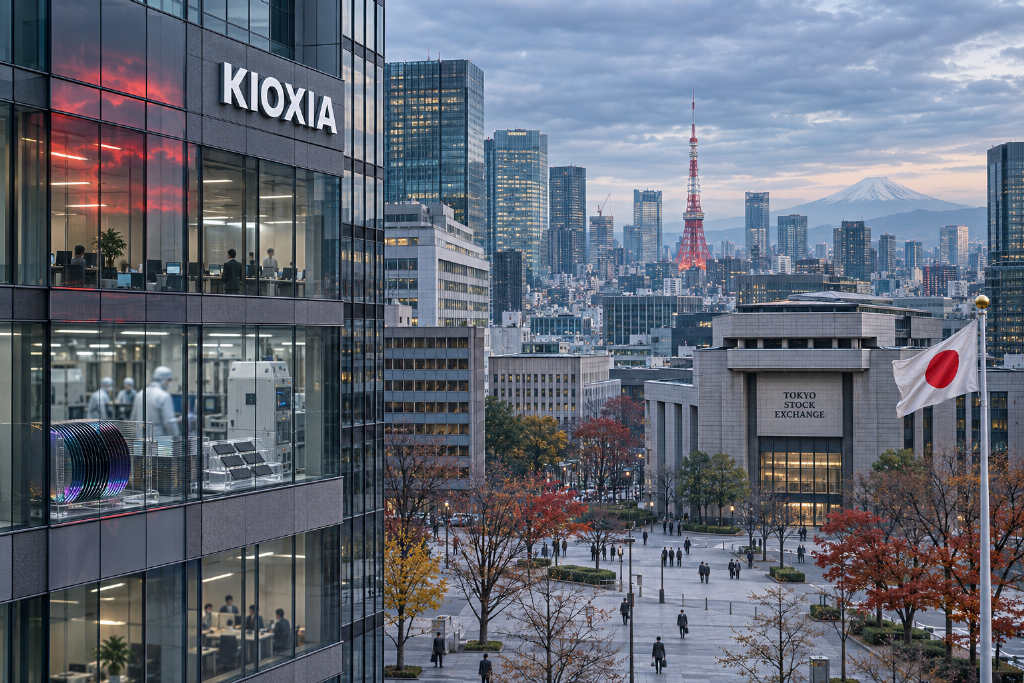
Kioxia projected only 0.8% quarter-on-quarter revenue growth for the October-to-December period, and its shares sold off sharply in the first trading session after the earnings release.
On Nov. 2 in Tokyo, the stock closed at JPY 11,345, down 15.78%. It fell as low as JPY 11,135 during the session, a drop of about 17.3%. The close was Kioxia’s lowest since late April and stood about 70% below its June 22 intraday high of JPY 37,566 on a split-adjusted basis.
Kioxia released its first-half results after the Tokyo market closed on Oct. 30. The stock had already fallen 7.14% that day.
July-September revenue reached JPY 2.48 trillion as pricing drove growth
Revenue for July through September came in at JPY 2.48 trillion, up 40.3% from the prior quarter and 5.5 times the level a year earlier. Operating profit was JPY 1.9947 trillion, about 23 times the year-earlier figure. Net profit attributable to the parent company was JPY 1.3557 trillion, up about 60% from the previous quarter.
In its earnings presentation, Kioxia said the quarter’s growth was driven mainly by price increases. Blended average selling prices rose about 25% from the prior quarter. On a like-for-like product basis, prices were up a little more than 30%, with increases across all application categories. Bit shipments, measured by capacity, rose by a little more than 10%, led mainly by data center and enterprise customers.
The SSD and storage segment, which includes SSD products for data center and enterprise use, generated JPY 1.616 trillion in revenue and accounted for 65% of total sales. The smart devices segment, which includes smartphones and tablets, posted JPY 788.9 billion in revenue, up 50% quarter on quarter. Kioxia said most of that increase also came from sharply higher selling prices.
The company added that revenue for the quarter exceeded the full-year revenue it recorded in its previous fiscal year ended March 2026.
Kioxia also announced its first dividend. Based on a Sept. 30 record date, it will pay JPY 90 per share on a pre-split basis, for a total of about JPY 47.9 billion, with payment scheduled for Dec. 8. In August, the company had already repurchased JPY 800 billion of treasury stock.
Next-quarter outlook was nearly flat as yen strength offset demand
Kioxia forecast revenue of JPY 2.5 trillion for October through December, up 0.8% from the prior quarter. Operating profit is expected at JPY 1.995 trillion, almost unchanged sequentially, while net profit attributable to the parent company is projected at JPY 1.36 trillion, up 0.3%. In the previous quarter, revenue had grown 40.3% from the quarter before.
The company said data center demand should remain strong, but foreign exchange is turning into a headwind, leaving the overall earnings outlook broadly in line with the prior quarter. Its forecast assumes USD/JPY at 157, versus an average of 161 in the previous quarter. That roughly JPY 4 appreciation in the yen is expected to reduce adjusted operating profit by about JPY 55 billion.
In the earnings Q&A, Kioxia said bit shipments for October through December are expected to be broadly flat from the prior quarter. Some volume was already sold in the previous quarter, while another portion will shift into January through March because the product mix is moving toward data center and enterprise customers, where lead times are longer.
The company also said smart devices will account for a larger share of revenue this quarter, and blended average selling prices are expected to rise moderately. For January through March next year, Kioxia expects bit shipments to increase sharply, citing strong demand and the carryover of some volume from the current quarter.
Kioxia expects shortages through 2027 and says over half of 2028 shipments are under long-term contracts
In its presentation, Kioxia said global NAND bit demand growth is expected to land in the upper end of the 10% range in 2026 and at a little above 20% in 2027. The company said demand from data centers and enterprises can offset weakness in smartphones and PCs.
According to Kioxia, smartphone NAND demand is not expected to change much through 2027. PC shipments, by contrast, are being pressured by rising component costs, and NAND demand tied to that market is expected to decline through 2027.
Kioxia CEO Hiroo Ota said in September that memory prices had already risen enough and told the sales team not to push for large additional price hikes with data center customers. In the latest earnings Q&A, the company said it expects supply shortages to continue through all of 2027, with average selling prices basically staying on an upward trend, while it continues to watch the pace of increases.
On long-term agreements, Kioxia said its 2027 capacity is largely allocated already. For 2028, well over 50% of bit shipments have been locked in through multi-year contracts. At customer request, the company has also started discussing long-term cooperation frameworks for 2029 and 2030.