
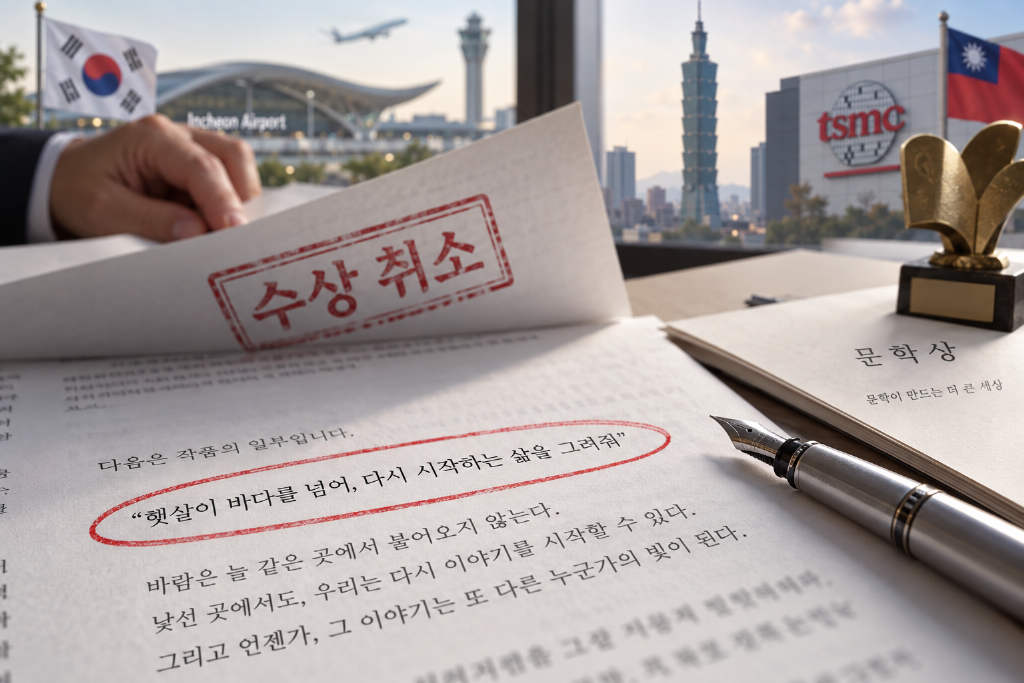
Two recent literary award fights in South Korea and Taiwan have crashed into the same ugly question: can a literary prize still prove a work was written by a human?
In one case, a Korean novel that won a prize still had an AI prompt sitting inside the manuscript, and that text made it all the way into print. In the other, a Taiwanese student fiction prize changed the ranking of a winning piece because judges suspected AI involvement, even though one of them plainly said there was no way to produce evidence.
An AI prompt was printed inside a Korean prize-winning novel
On Sept. 18, Boo Seung-chan, a member of South Korea’s National Assembly Land, Infrastructure and Transport Committee from the Democratic Party, revealed materials submitted by the Ministry of Land, Infrastructure and Transport. Those documents showed that a manuscript that won an excellence award in the general fiction category of last year’s 11th Korea Aviation Literature Prize still included a conversation between the author and a generative AI system. Pressian reported that the printing house later found the text in the manuscript used for the prize anthology.
Several Korean media outlets published the full prompt: “Make the characters and content a bit more emotional, with a style somewhat like Dan Brown, Keigo Higashino, Han Kang, a slight Haruki Murakami feel, and a slight Orhan Pamuk feel as well, while showing the thinking process.”
BlockTempo described that as an instruction to make the characters and content more emotional, with touches of Dan Brown, Keigo Higashino, Han Kang, Haruki Murakami and Orhan Pamuk, while also showing the thinking process.
The manuscript also contained the AI’s reply: “Of course. I will focus on the characters’ inner lives and narrative, incorporate the distinctive textures of the writers you named, and rebuild the story.”
According to MBN, those lines appeared in the novel’s final paragraph and looked obviously different from the rest of the piece.
And that was only part of what made people stare. The bigger problem was that the manuscript had already gone through the whole prize pipeline. The Korea Aviation Association handled submissions. Judging was outsourced to the Korea Writers Association, which charged the association a fee. Then the work was compiled into an anthology, printed, and distributed. Nobody in that chain seems to have caught it.
The winner had already received 700,000 won in prize money, about NT$16,000, plus a domestic round-trip airline ticket in South Korea.
Organizers did not discover the problem themselves. A private citizen filed a complaint in June through South Korea’s online civil grievance platform, People’s Sinmungo. The ministry started investigating in July. In August, the award was revoked, and the prize money and ticket were clawed back. The judges involved were permanently banned from serving again, and two staff members were disciplined.
The Korea Aviation Association did not apologize. It posted only a notice on its website saying works created with generative AI could not be submitted. The anthology for the 11th edition is now labeled “preparing” on the website and is no longer publicly available. That also means the works of other legitimate winners cannot be viewed there.
Boo Seung-chan said the leftover lines were plainly part of a conversation asking AI to revise the text, and that the fact they were not flagged showed there had not been “even the most basic inspection.” He added that it looked as though AI had been used as the judge.
The prompt named five writers: Han Kang, Orhan Pamuk, Dan Brown, Keigo Higashino and Haruki Murakami. The article pointed out that Han Kang won the 2024 Nobel Prize in Literature and Pamuk won in 2006.
Taiwan’s dispute moved in the opposite direction
A different controversy broke out around the 23rd TSMC Youth Student Literature Award in Taiwan, organized by the TSMC Education and Culture Foundation and the United Daily News literary supplement. Here, the issue was not an obvious AI prompt. It was suspicion. Nothing direct.
The fiction entry “Shi Bai” was first chosen as the first-prize winner during the first final judging meeting.
According to a summary by Initium Media, before the winners list was announced, organizers got a signed complaint alleging that the work had been created with the help of “a program model that can set parameters, ingest required information, and is designed around literary awards as the target.” Put more simply, as the article did, that meant AI combined with a framework built for literary competitions.
The judging panel met again and asked organizers to contact the author directly. The author denied using AI in the creative process and said AI had been used only to fix typos. Judge Gu Yu-ling called that answer “too clever.” She said it was evasive and that the author refused to openly discuss how AI may have been used in the writing process, offering only a confession about typo correction.
Another judge, Lin Chun-ying, also said he did not accept the author’s explanation. But he also admitted this in public: “We actually have no way to produce evidence that the author used AI assistance.” He went further and said that without hard proof, the panel could only lean on subjective judgment, and that AI collaboration could not easily be treated as plagiarism. His label for it was “high-level ghostwriting.”
After a new vote, “Fish” was moved into first prize, while “Shi Bai” was pushed down to one of five merit awards. The United Daily News published that result on July 20. Then, on Aug. 13, the full records of the award’s three meetings were released, and the argument spread.
The author of “Shi Bai” later objected through a friend’s social media account, saying the competition rules had included no AI provisions, that judges changed the ranking without evidence, and that publishing the meeting records harmed the author’s reputation. The author asked for the first prize to be restored and for an apology. On Sept. 1, the organizers posted an official statement on social media saying “Shi Bai” would instead receive a “jury prize.”
Later, organizers edited the post containing the final-round records and removed wording that made personal accusations against the author. The article also said the entrant was a high school student, and that the complaint had been sent back to a judging panel that had already formed views on the work, even though no AI rule existed before the submission.
Records collected by Mirror Fiction said Wang Sheng-hung, director of the United Daily News literary supplement, argued that the process should go back to the written contest rules. His worry was simple: if one entrant admitted using AI and another did not, changing rankings on that basis could create a different kind of unfairness. Hsu Chun-lang, executive director of the TSMC Education and Culture Foundation, passed along the position of TSMC board member Tseng Fan-cheng, saying the prize should still maintain fairness when facing AI-related doubts.
What exactly is a literary prize certifying?
The article sets both disputes beside a much older literary thought experiment. In 1939, Argentine writer Jorge Luis Borges published the short story “Pierre Menard, Author of the Quixote” in the magazine Sur. In that story, Menard, a French writer, tries to produce chapters identical to Cervantes’ Don Quixote, not by copying but by writing them word for word out of his own memory and life context. The point is blunt and unsettling: if the text is the same, but the author and the circumstances are different, is it still the same work?
BlockTempo says literary prizes have long handed out two kinds of value at the same time. One says a work is good. The other adds prestige to the author’s name. Those two things could sit together when people assumed a strong novel was something only a human could produce. Once AI pushes the cost of producing polished structure and fluent prose close to zero, that neat alignment starts to break.
The article also brings up Roland Barthes’ 1967 essay “The Death of the Author,” which argued that once a text is written, meaning belongs to the reader and the author can step aside. More than half a century later, literary prizes may be among the last places still insisting that the author must not only exist, but must be personally present in the work. And the article’s point is harsh: this is now exactly what prizes are least able to verify.
The burden has shifted to judges
So the pressure lands on judges. Writer Chu You-hsun wrote on Facebook that this had been the most painful year of his time serving as a literary award judge. He estimated that around 40% of the hundreds to thousands of fiction submissions he reviewed were written by AI.
Chu said that preliminary judging used to mean choosing the best work. Now judges have to rank entries while also deciding whether humans wrote them. In his own description, if 20 AI-written pieces are mixed into a batch of 200 submissions, the mental effort feels like reading 400 to 500 pieces.
He also said he can be wrong. Even with an accuracy rate as high as 95%, a pool of 1,000 submissions would still leave 50 mistaken judgments. That is why, the article says, the position of “Shi Bai” is so awkward. It could fall into that 5%, and right now nobody can say for certain.
In an interview with Public Television Service, Chu described one clue he watches for: “Out of more than a hundred works, you suddenly see about 20 that very clearly read like translated American literary prose, yet the subject might be something like a Hakka rural story.”
He was just as blunt about entrants who submit AI-generated work: “Cherish the last few chances you have to swindle prize money. The day the literary award system collapses, you won’t even know where you can submit work or where you can still be seen.”
The article closes by returning to Lin Chun-ying’s line that there is “no way to produce evidence.” It treats that sentence as more revealing than the panel’s final decision. For decades, literary prizes could lean on a loose confidence that “you know it when you read it.” But that confidence, the article argues, no longer produces practical proof, and the day may be coming fast when judges read a text and still cannot tell whether AI wrote it.
Timeline of the two disputes
- Korea Aviation Literature Prize: the issue centered on a fiction manuscript from last year’s 11th edition. A public complaint was filed in June, the ministry investigated in July, the award was revoked in August, and Boo Seung-chan disclosed the materials on Sept. 18.
- TSMC Youth Student Literature Award: “Shi Bai” was first selected as the top winner in the initial final-round meeting. But the published winners list on July 20 already showed it demoted to a merit award. Full meeting records were released on Aug. 13, and organizers reclassified it as a jury prize on Sept. 1.