
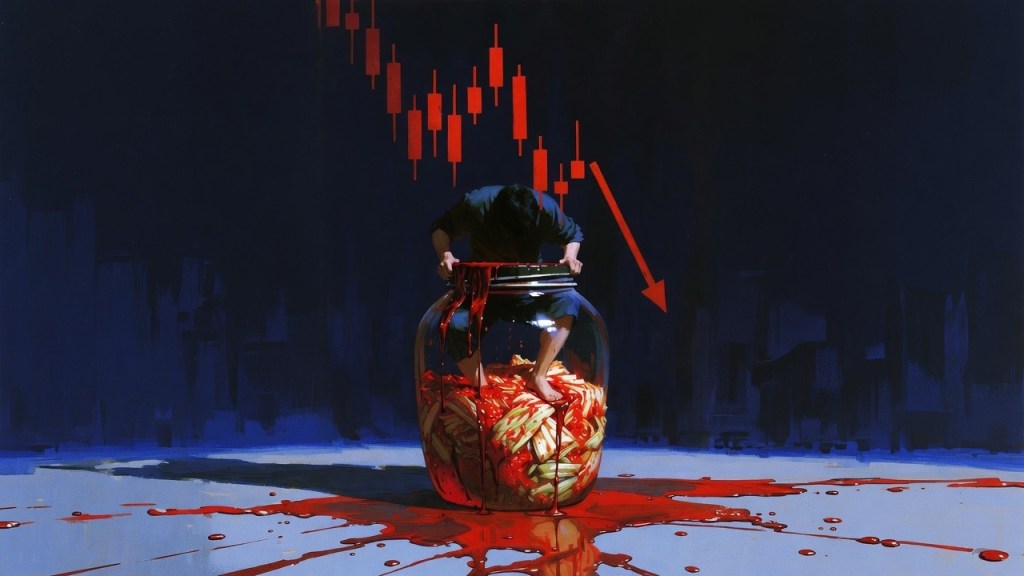
South Korea’s stock market has entered bear-market territory after a steep one-month correction, with the Kospi Index down 20% and semiconductor bellwethers SK Hynix and Samsung Electronics leading the decline.
Bloomberg data cited in the report showed the market’s 12-month forward price-to-earnings ratio has fallen to about 6, a record low. The report said trading dynamics tied to leveraged exchange-traded funds, or ETFs, have added to the recent swings and contributed to multiple circuit breakers in the local market.
Chip stocks drove the sell-off
Recent weakness in South Korean equities has been linked to concerns over capital spending and stretched valuations across global chip stocks. SK Hynix fell 15% in the previous session and continued to decline the next day.
Analysts at Samsung Securities said that periods of rising volatility were once treated as signals of the business cycle, but should now be seen as a normal feature of structural change in the stock market. SK Hynix has recorded daily swings of 5% in more than 50 trading sessions this year.

Valuations reset as retail investors turn sellers
As the broader market fell, Kospi valuations also dropped sharply. According to Bloomberg data cited in the report, the South Korean market’s forward P/E has declined to around 6.
Investor behavior has split. On July 13, South Korean retail investors sold about 2 trillion won, or roughly $1.3 billion, in stocks, moving away from their recent dip-buying pattern. Foreign institutional investors, on the other hand, returned to buying after a run of net selling.
Strategists at JPMorgan Private Bank said the current valuation level suggests potential opportunities in South Korea relative to other emerging and developed markets.
Leveraged ETF rebalancing adds to market stress
The report said part of the market’s repeated turbulence can be traced to strong demand for semiconductor-linked leveraged ETFs. Rebalancing trades generated by those products have amplified short-term moves and pushed the number of trading halts in South Korea to a record high.
Analysts at CLSA Securities said traders once relied on U.S. tech indexes to gauge South Korean stocks, but South Korea has now become a barometer for global artificial intelligence development. South Korean financial regulators have called on asset managers to tighten risk controls for related products.