
WuBlockchain’s WhiteLine Daily said AI compute funding and hardware orders are still moving forward, while the cost of higher rates is becoming more visible in public finances.
Lambda raises about $1 billion to buy Nvidia GPUs for Microsoft capacity leases
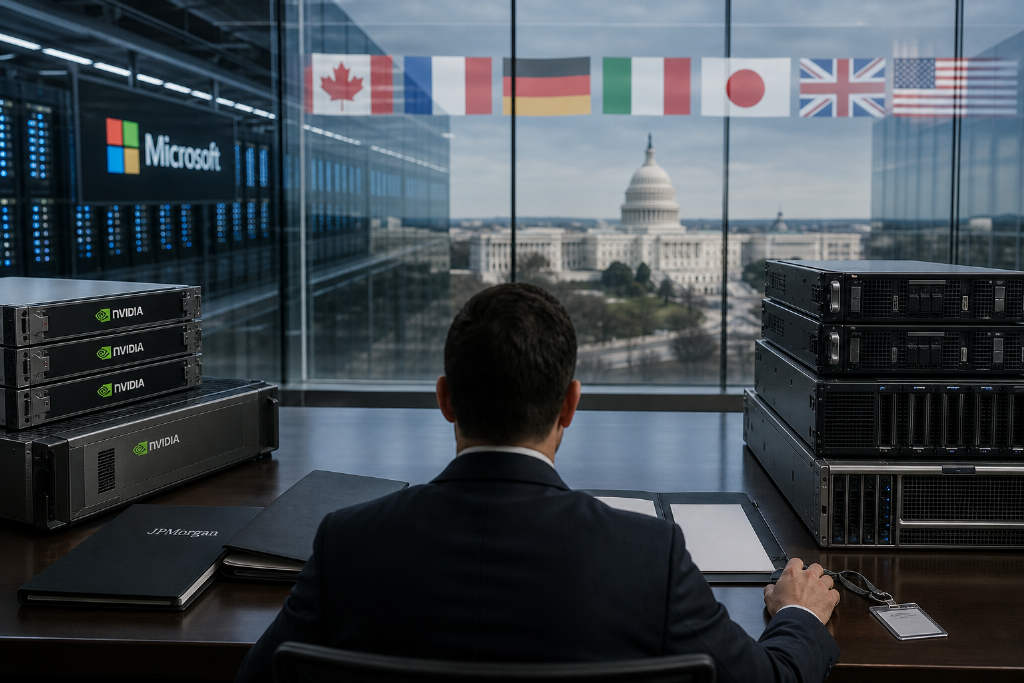
According to Bloomberg, Lambda, an AI cloud provider backed by Nvidia, has raised about $1 billion in short-term private debt arranged by JPMorgan. The proceeds will be used to purchase Nvidia AI GPUs, and the related compute capacity will then be leased to Microsoft.
Lambda also completed a separate $926 million senior secured loan this week to support GPU deployments for already contracted customers. That loan received a Baa2 investment-grade rating from Moody’s and was priced at SOFR + 3%.
In May this year, Lambda also completed a $1 billion senior secured credit facility as it kept expanding GPU and data center capacity through debt financing.
WhiteLine Daily said the latest financing already appears to be backed by Microsoft’s demand for compute, with GPU purchases increasingly financed through signed customer contracts and future rental income.
FT says higher yields have already added about $16 billion to G7 funding costs
According to Financial Times calculations, the rise in bond yields since February this year has added about $16 billion in government financing costs across the G7. The United States accounts for about $10.6 billion of that total, or close to two-thirds.
If current yield levels remain in place through the first quarter of 2027, the G7 could face another roughly $34 billion in added financing costs, including about $21.7 billion for the U.S.
FT said inflation, geopolitics, higher government spending, and competition for global capital from AI investment are all supporting elevated bond yields.
WhiteLine Daily’s takeaway was that high yields are no longer only a question of bond prices and equity valuations. They are now flowing directly into government budget costs, and if yields stay where they are, the interest bill on new sovereign borrowing will keep climbing.
SuperX wins order for 128 Nvidia B300 AI servers in Australia
Nasdaq-listed AI infrastructure company SuperX said one of its subsidiaries signed an equipment and services supply agreement with Australian compute service provider Ezisight and secured an initial order for a cluster of 128 Nvidia B300 AI servers.
The systems are scheduled for delivery in the fourth quarter of 2026 and will be deployed in a local Australian data center for large model training and AI inference. The deal marks SuperX’s first substantive entry into the Australian market.
Three days earlier, the company had disclosed a $38.8 million Nvidia B300 server order from Japanese customer Woodman.
WhiteLine Daily said the back-to-back B300 orders from Japan and Australia within three days at least suggest that the B300 has entered the actual procurement stage among Asia-Pacific customers. The report also stated that the Australian batch is planned for delivery in Q4 this year.
Toyota plans to start next-generation EV production in Shanghai in 2027
According to Nikkei, Toyota plans to begin producing a next-generation Lexus electric SUV at a new Shanghai plant in the fall of 2027. Initial output is expected to be about 1,000 vehicles per month, with plans to expand to annual production of tens of thousands from 2028.
The vehicle will use next-generation manufacturing technology including Gigacast integrated die-casting, allowing multiple aluminum body parts to be formed in a single process to cut components and assembly steps.
The report said Toyota has typically first developed and manufactured vehicles using its latest technologies in Japan before rolling them out overseas, making the decision to mass-produce the next-generation EV in China first relatively unusual.
At the same time, Toyota and Lexus sales in China fell 24.3% year over year in July, marking a sixth straight month of decline.
WhiteLine Daily said Toyota usually introduces new models and production technology in Japan first, but this time is taking both its next-generation EV and Gigacast production directly to Shanghai. With China sales down about 24% year over year, the company is clearly accelerating its local R&D and manufacturing pace in China.
Main thread of the day
The day’s main thread is split between compute expansion and rising rate costs. On one side, AI compute financing and order flow are still being executed, with Lambda directing about $1 billion of new debt toward Nvidia GPU purchases and SuperX landing an order for 128 B300 servers. On the other side, higher rates are already hitting balance sheets: rising bond yields have added about $16 billion to G7 financing costs, and that interest burden on newly issued government debt rises the longer current yield levels hold.