
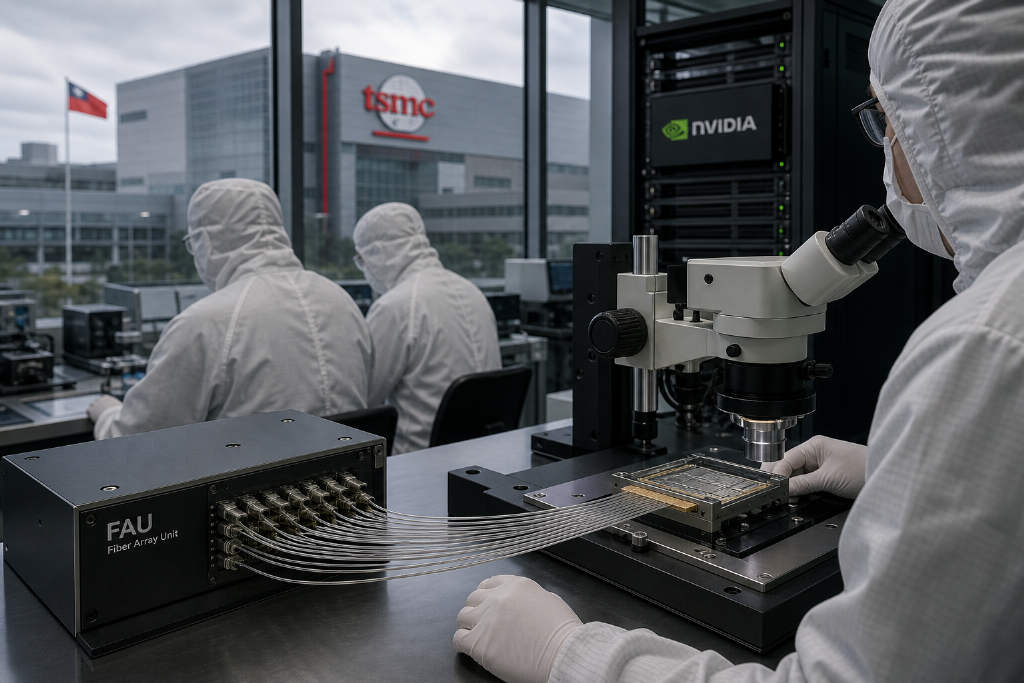
Largan Precision is said to have expanded from FA, or fiber arrays, into FAU, the fiber array unit, in a move that would lift its role in Nvidia’s optical communications supply chain from indirect supplier to direct supplier, according to supply-chain sources cited in the report. The same report says the company has entered Taiwan Semiconductor Manufacturing Co.’s COUPE process ecosystem, while products tied to Nvidia’s next-generation Rubin Ultra platform could reach mass production as early as the second half of next year.
AI data-center demand is pushing CPO higher on the roadmap
The article says AI demand continues to drive sharp growth in data traffic across AI data centers, exposing the limits of traditional pluggable optical modules in short-reach, high-bandwidth and low-power settings. Co-packaged optics, or CPO, places optical components next to the chip package and is being treated as a key route for improving energy efficiency in AI network upgrades.
Nvidia’s Spectrum and Quantum CPO switch families are described as core products in the build-out of scale-out networking. Nvidia recently said its Spectrum-X Ethernet silicon photonics switches had entered full production. Using this year’s estimated Spectrum-X shipment volume of about 20,000 systems, the report calculates that the related optical engines would require roughly 600,000 to 700,000 FAUs. By 2027, that figure is expected to climb into the millions. The report adds that current supply-chain capacity is not enough to cover the gap, leaving the market looking for suppliers that can produce at scale.
Largan is said to have moved from FA parts to end-to-end CPO integration
Quoting supply-chain sources, Economic Daily News said Largan had extended its business from FA into downstream FAU and completed vertical integration in the CPO field from core components to functional modules. FAU combines FA with MLA, or microlens array, and serves as a key unit for precision optical alignment and signal transmission inside a CPO system.
Those sources also said Largan has been integrated into TSMC’s COUPE process ecosystem and now participates directly in Nvidia’s optical communications supply chain as an FAU supplier. The report names Taiwan-based Applied Optoelectronics? No. It specifically names the Taiwanese company Phoenix? No. The report names Shang Chuen (3363) and China’s TFC Communication among the suppliers listed alongside Largan. It says mass production across the three companies could begin as early as the second half of next year, with the market speculating that Nvidia Rubin Ultra will be the first platform involved.
Largan, for its part, said it remains focused on advancing FA research and development at this stage. Chairman Lin En-ping said at the company’s June shareholder meeting that Largan had secured FA mass-production orders and was open to FAU. At a July investor conference, he said FAU alignment was highly difficult and that the company was still observing developments. The report says the latest supply-chain information points to faster progress than the market had previously understood.
Sub-0.3 micron alignment is presented as the key differentiator
The report says FAU manufacturing becomes much harder as CPO moves into 64-channel and even 128-channel designs. Traditional V-groove structures can arrange and secure optical fibers inside FA, but in very high channel-count setups, the positional error of each fiber has to be compressed into an extremely small range for the full FAU to be aligned precisely at production scale.
Multi-channel active alignment is described as the main technical barrier in FAU manufacturing, with existing suppliers broadly struggling on yield in mass production. According to the report, Largan’s edge comes from process control: matching an imperfect V-groove with an imperfect optical fiber precisely enough to produce a “perfect FA.” That approach is said to give Largan alignment precision of less than 0.3 microns, while outside rivals cited in the article are currently at 0.5 to 0.8 microns at best.
The article says market analysis sees Largan as one of the supply-chain players most likely to break through FAU mass-production yields first. It also says the company’s automated manufacturing system helps customers identify problems more quickly during debugging, and that some customers have already urged Largan to speed up FAU line deployment.
Higher ASP and margins could change the earnings mix
On the financial side, the report says FAU, as an integrated module, carries higher average selling prices and better gross margins than supplying FA parts alone. For Largan, moving downstream within the same supply chain would allow it to face end-customer demand with products that have higher added value, which the article says could improve its profit structure.
The same report adds that if Rubin Ultra shipments expand in line with market expectations, the combination of a large FAU supply gap and Largan’s technical lead could become a major driver for the company’s earnings mix in the second half.