LayerZero on Aug. 25 announced ATLAS, short for Aggregated Trading Liquidity and Settlement, as a trading infrastructure product built to operate behind exchanges rather than compete with them on the front end.
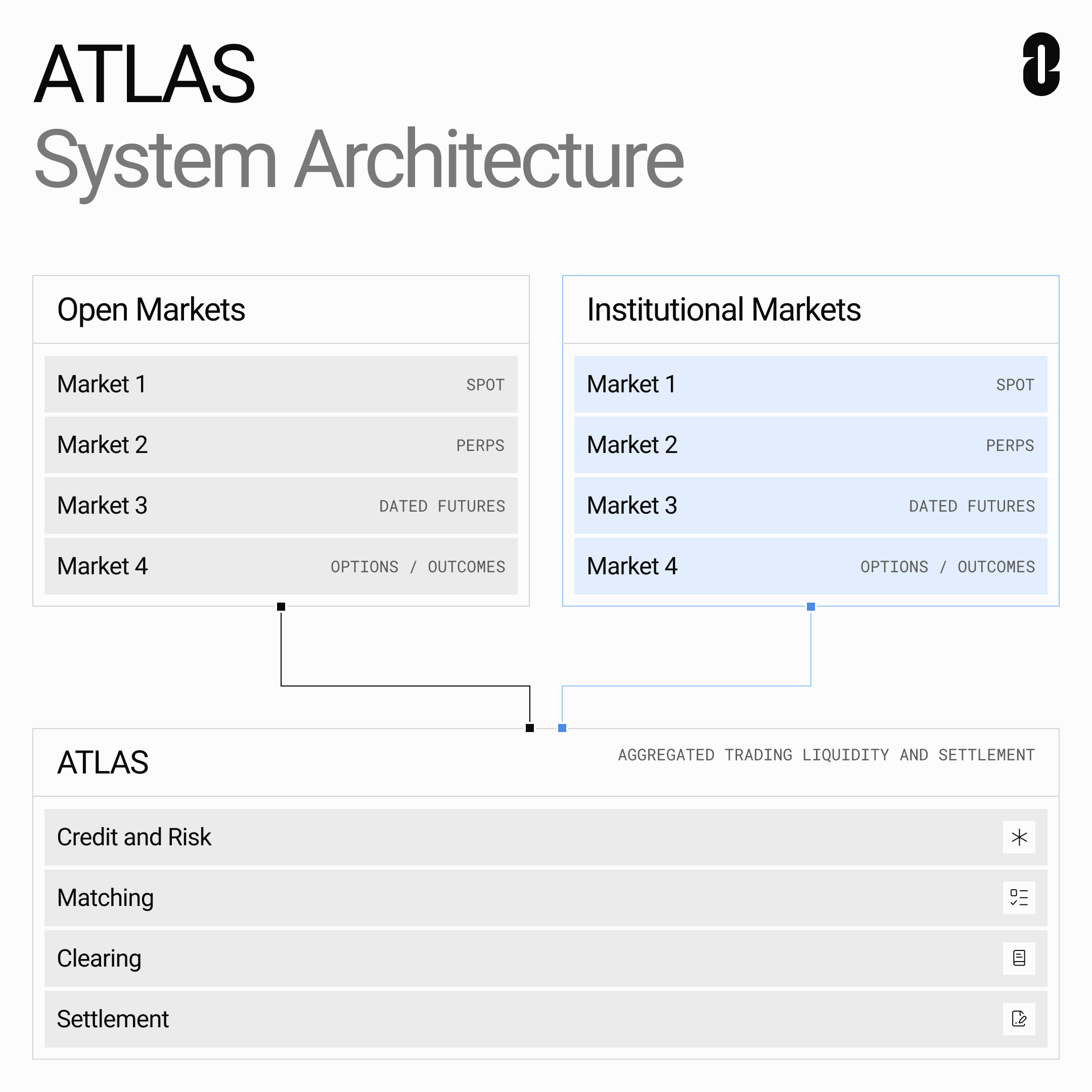
The company describes ATLAS as a headless exchange. It does not offer a consumer trading interface and does not directly run a retail venue. Instead, it is meant to handle matching, clearing, settlement and risk management while partner platforms manage the product interface, user relationships and market operations.
What ATLAS is built to do
For crypto trading platforms, the hard part is often not just building a trading screen. It also includes maintaining a matching engine, margin systems, liquidation logic, risk controls and settlement infrastructure. ATLAS is pitched as a single backend stack that outside platforms can plug into.
Instead of building the full system from scratch, a venue would connect to ATLAS, choose or create markets, and then build its own front end and user services on top. ATLAS handles core trade processing. The connected platform keeps its brand, user base, product experience and distribution channel.
LayerZero said ATLAS connects three groups of participants:
- venues, which provide the user interface and trading services;
- market creators, which define tradable assets and market parameters across perpetuals, spot, stocks, commodities, bonds, meme assets and prediction markets;
- market makers, which provide liquidity.
Built on Zero
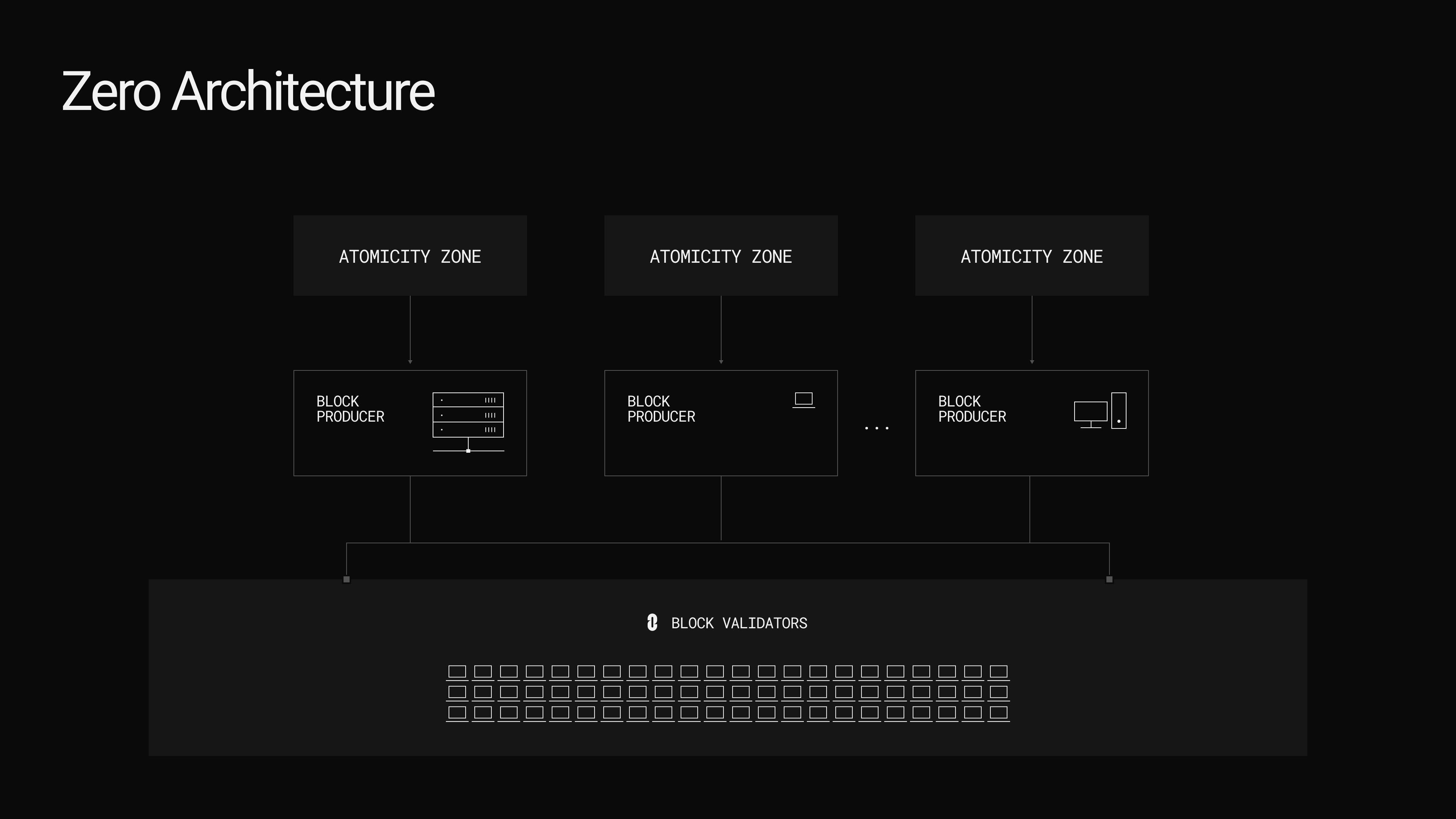
ATLAS will run on Zero, the blockchain LayerZero disclosed in February 2026. Zero uses a multi-core design that places different workloads into Atomicity Zones that can run in parallel, with the goal of preventing trading, payments and other applications from competing for the same block resources.
In that design, high-performance block producers execute trades and generate zero-knowledge proofs, while block validators verify those proofs without rerunning the full computation. For ATLAS, LayerZero said that setup allows the engine to pursue higher throughput while submitting results to Zero as a final state verified by cryptographic proofs.
LayerZero published benchmark figures alongside the launch announcement. In the current environment used to simulate a public deployment, ATLAS posted median latency below 1 millisecond, P95 latency of 1.418 milliseconds and P99 latency of 2.641 milliseconds. The system is planned to launch with capacity for 200,000 transactions per second. In a co-located data center environment, the team said it expects latency to fall into the double-digit microsecond range.
Two configurations on one engine
LayerZero said one fixed rule set would not fit both open crypto markets and institutional markets, where access, asset coverage and trading rules differ. So it built two versions on top of the same core engine: Open ATLAS and Institutional ATLAS.
Open ATLAS is aimed at crypto-native trading apps, prediction markets and other open financial products. Teams can launch their own trading platforms on top of ATLAS while keeping their brand, front end, user entry points and fee model.
Institutional ATLAS is intended for exchanges and financial institutions. It uses the same underlying engine, but markets can run under rule sets selected by the relevant institutions.
The Information, citing LayerZero co-founder and CEO Bryan Pellegrino, reported that ATLAS plans to start with spot and perpetual crypto trading before expanding into prediction contracts, futures and options.
How fees are split and where ZRO fits
Because ATLAS does not directly operate the user-facing venue, it relies on connected trading platforms for users and volume. The fee structure released so far sets out separate economics for venues, market creators and ZRO.
Under the current Open ATLAS fee design, ATLAS charges a bundled trading fee on each trade. Exchanges can receive rebates ranging from 20% to 65% depending on ZRO staked and total trading volume. After the venue rebate is deducted, 25% of the remaining fees goes to market creators and 75% is used to buy back and burn ZRO.
That 75% does not refer to 75% of the full trading fee. It refers to 75% of the remainder after exchange rebates are paid, which is a key distinction in the token economic model.
Pricing for Institutional ATLAS has not been disclosed, so it is not yet clear whether the same fee, rebate and ZRO buyback-and-burn structure will apply there.
Beyond buybacks and burns, ZRO is also set to serve as the gas asset on Zero, help secure the network through delegated proof of stake, and take part in governance over protocol upgrades and the addition or modification of Zones. Exchanges can also stake ZRO to move up the rebate tiers, with the highest tier requiring as much as 1% of total ZRO supply.
Partners and launch timeline
LayerZero named GTE, Bullish, Defined and TrueNorth as the first partners for Open ATLAS.
- GTE plans to launch its AI trading platform on the first day Open ATLAS goes live;
- Bullish will participate with its spot trading business and its operating experience in open and regulated markets;
- Defined brings spot, perpetuals, prediction markets and on-chain data analysis into one trading terminal;
- TrueNorth will integrate Open ATLAS to offer AI-supported research, trade execution and trade analytics tools.
Institutional relationships are less clearly defined at this stage. Citadel Securities, the Depository Trust & Clearing Corporation, or DTCC, and Intercontinental Exchange, or ICE, the parent company of the New York Stock Exchange, were previously listed as partners in LayerZero's Zero initiative. Citadel Securities also made a strategic investment in ZRO. LayerZero has not yet released a full partner list for Institutional ATLAS.
ATLAS is still pre-launch. LayerZero said it expects the product to go live later in 2026. The Information added that the target is fall 2026. Pellegrino also said major market makers will provide liquidity on day one, but did not identify the firms.
Security issues remain part of the discussion
LayerZero's earlier security controversy remains part of the backdrop. In April 2026, KelpDAO's rsETH cross-chain bridge was attacked, with losses of 16,500 rsETH, worth about $292 million at the time. The attack involved LayerZero Labs' internal RPC environment and a DVN operated by the company. KelpDAO's single-validator setup also meant forged messages were not blocked by independent validators. The two sides later disputed responsibility.
LayerZero later said a DVN operated by the company should not be used as the sole validator in high-value transactions, and tightened related security configuration requirements.
A move beyond cross-chain messaging
ATLAS marks a clear expansion of LayerZero's business scope. The company has mainly focused on moving assets across blockchains. With ATLAS, it is pushing into where those assets trade, how orders are matched and how settlement is completed.
Whether ATLAS can become a shared engine for global markets will depend on factors that can be tested in the market after launch: whether real-world performance matches the published targets, whether market makers supply enough liquidity and whether institutional markets adopt the system under compliance requirements.