
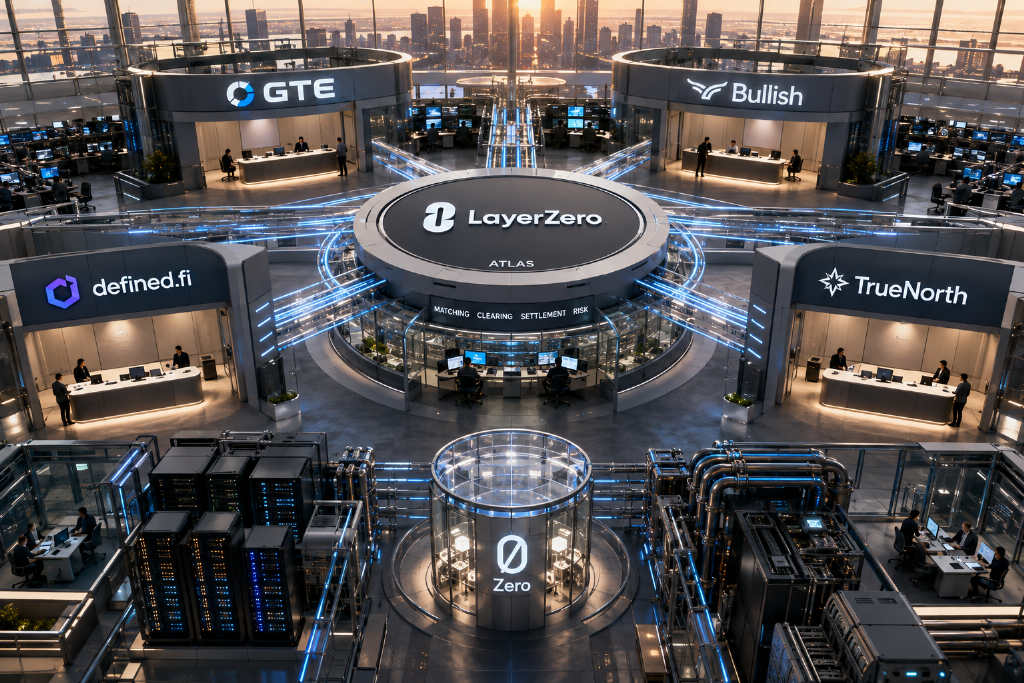
LayerZero said on Aug. 25, 2026 that it is launching ATLAS, a headless exchange engine built on Zero and aimed at becoming the exchange layer underneath a wide range of trading venues. The name stands for Aggregated Trading Liquidity and Settlement. The product has no consumer-facing app of its own, and LayerZero said it is planned to go live later in 2026.

Under the setup, venues keep their own interfaces, users, and distribution channels. Market creators decide what gets listed and how markets are structured. Market makers supply liquidity. ATLAS handles matching, clearing, settlement, and risk, while Zero records final ownership and verifies execution.
That shifts the adoption question away from end traders and toward operators. Exchanges, brokers, wallets, and market operators would need to trust LayerZero’s backend instead of infrastructure controlled by a direct competitor. In the Alea Research piece translated by TechFlow, the argument is that ATLAS is not limited to crypto perpetuals and could extend to a broader set of markets, with institutional demand potentially feeding into ZRO’s economic design.
Why now: tokenized markets are pushing past existing infrastructure
LayerZero’s earlier thesis was that assets and ledgers would become multichain. ATLAS extends that thesis from the asset layer into price discovery and settlement.
The report says stablecoins, tokenized stocks, prediction markets, perpetual contracts, and private credit are now trading around the clock. Yet the systems that match buyers and sellers often separate risk management from clearing and final settlement. Each handoff adds reconciliation costs and balance-sheet dependency.
The broader market has already shown signs that distribution and exchange infrastructure can be separated. Orderly said on July 24, 2026 that more than 400 branded perpetual DEXs were using its shared order book. Hyperliquid released HIP-3, allowing builders to deploy standalone perpetual markets after staking 500,000 HYPE. Injective launched a module that manages the order-book lifecycle from execution through settlement.
Those systems show that the distribution layer and the exchange backend do not have to be bundled together. ATLAS takes that model across a wider trading lifecycle and into institution-configured markets.
How the structure works
In ATLAS, the venue owns the user experience and the order flow. Market creators choose assets and oracles, then set market rules. Liquidity providers quote prices and take inventory risk. ATLAS serves as the shared exchange engine.
Zero separates execution by block producers from proof verification by settlement-layer validators. LayerZero described two configurations built on that architecture:
- Open ATLAS, for permissionless products including crypto-native applications and prediction markets.
- Institutional ATLAS, which uses the same engine while allowing institutions to enforce access controls and define product and market rules.
LayerZero’s pitch is that the headless design removes a conflict that has weakened many exchange-builder projects. Front ends built on top of exchanges often add another fee layer on top of exchange fees and then compete with the exchange’s native app for the same mature users. ATLAS does not have a native app. The venue itself is the native route.

On performance, LayerZero reported a median perpetuals latency of 965 microseconds. In a simulated public deployment environment, the company said p95 latency was 1.418 milliseconds and p99 latency was 2.641 milliseconds. ATLAS is set to be configured for 200,000 transactions per second at launch.
Each trade will be verified on-chain through zero-knowledge proofs. More technical detail traces back to the Zero paper published on Feb. 10, 2026, which said Jolt Pro had achieved succinct proofs and placed zero-knowledge proofs on the near-term roadmap.
Fee design: 75% of the post-rebate remainder goes to ZRO buybacks and burns
ATLAS charges an all-in trading fee. Open ATLAS venues can receive rebates of 20% to 65%, based on a combination of ZRO staked and total trading volume. The highest tier may require as much as 1% of ZRO supply, according to the report.
After venue rebates, the remaining fees are split with 25% going to market creators and 75% used to buy and burn ZRO.
Using 100 units of gross fees and a 20% venue rebate as an example, the venue receives 20, market creators receive 20, and 60 is used to buy and burn ZRO.
At a 65% rebate, the venue receives 65, market creators receive 8.75, and 26.25 goes to ZRO buybacks and burns.
That 75% figure does not apply to gross fees. It applies only after venue rebates. Based on the disclosed rebate range, Alea Research said ZRO’s effective capture of gross fees runs from 26.25% to 60%. The actual level will depend on four undisclosed variables: the effective fee rate, trading volume, how venues are distributed across rebate tiers, and how the buy-and-burn program is executed.
The model lines up revenue by role. Venues are paid for distribution. Market creators are paid for market expertise. ZRO is tied to shared infrastructure usage through the buy-and-burn mechanism. Higher venue rebates may improve distribution and liquidity, but they also reduce the share of gross fees that flows to ZRO.
The report says ATLAS gives ZRO a more direct function. The token is used to secure Zero through delegated proof of stake, pay gas, govern upgrades and regions, qualify venues for rebates, and absorb buy-and-burn demand from residual trading fees.
In the bullish case described in the report, staking ZRO improves unit economics for venues. Better economics draws in distributors, then market makers and creators. More trading volume increases buy-and-burn demand and also raises the value of reaching higher rebate tiers.

The downside path comes from the same mechanism. Large venues may demand the highest rebates. Liquidity could concentrate, smaller venues may struggle to compete with dominant order books, and token capture could fall even as system activity rises.
LayerZero’s pitch centers on neutrality
The report argues that performance is only the entry threshold. LayerZero’s strategic edge is neutrality combined with distribution reach.
LayerZero already sits beneath applications rather than directly in front of users. It has integrated cross-chain assets, built relationships with issuers and financial institutions, and positioned itself commercially as infrastructure. The headless exchange model extends that stance.
LayerZero said GTE, Bullish, defined.fi, and TrueNorth are the first venues for Open ATLAS, with institutional partners expected to follow. The company is also sharing 20% to 65% of per-trade economics with venues, a choice that reflects a lesson many exchanges have resisted: the party that wins customer trust and owns the customer relationship needs a durable business model.
What to watch before launch
ATLAS is expected to launch later in 2026, but LayerZero has not disclosed a precise date.
Compressing the trading lifecycle removes handoffs, but it also centralizes responsibility. A failure in matching, risk, proof generation, data availability, governance, or settlement could affect every venue using the shared backend.
Another layer of risk sits with market creators. New assets require reliable oracles, margin rules, and a clear path from liquidation to final settlement. Open access broadens the product set, but it also raises the cost of weak controls.
Institutional ATLAS faces a different constraint. Institutions need configurable rules. Counterparties and regulators need clarity on who operates the market, who bears losses, where assets sit, and which entity can reverse or upgrade the system. The report says technical verifiability does not answer those legal questions on its own.
In Alea Research’s framing, ATLAS is a test of whether trust in LayerZero’s messaging layer can carry over into exchange operations. If it works, LayerZero would move from transmitting messages and assets across markets to running part of the machinery inside them.
