
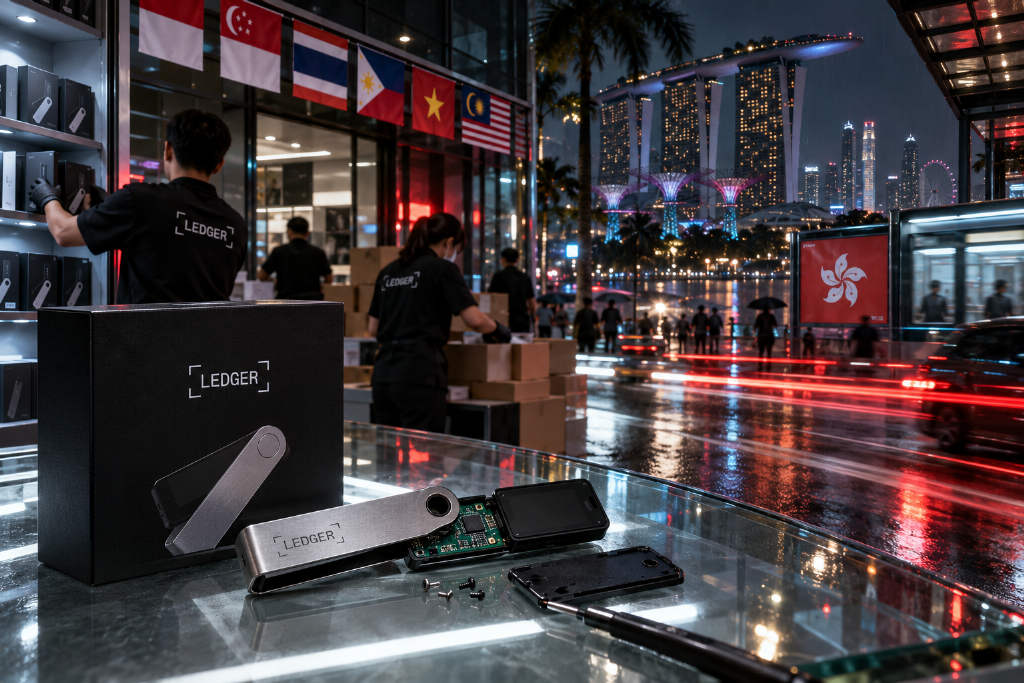
Ledger has widened its response to a suspected supply-chain attack, telling resellers and distributors in six Southeast Asian countries and Hong Kong to immediately suspend sales of Ledger devices and pull related products from both offline and online channels until its investigation is finished. The affected markets are Indonesia, Singapore, Thailand, the Philippines, Vietnam, Malaysia, and Hong Kong.
The step is broader than Ledger’s earlier request for CryptoBilis to stop sales. It also shows the company has not fully determined at what point in the supply chain the devices may have been modified. Ledger said the regional sales halt is precautionary and added that it has found no signs of intrusion in its internal systems, software, firmware, or official direct-sales channels.
Implanted hardware could read the 24-word recovery phrase from the screen
Ledger said unauthorized circuit boards were hidden inside the device casing and beneath the screen. When a user set up a wallet for the first time and the 24-word recovery phrase appeared on the display, a microcontroller inside the implant could identify the screen content and send the phrase to an attacker through an LTE module and a preconfigured eSIM.
Once the recovery phrase was obtained, the attacker could rebuild the wallet on another device without touching the victim’s Ledger again and without tricking the user into signing a transaction.
Ledger said the implant did not break the Secure Element, the Ledger operating system, or the transaction-signing mechanism. That also explains why a modified device could still pass Genuine Check. The feature can verify whether the secure chip is a genuine Ledger component, but it cannot prove that no extra circuitry has been added inside the device.
Bitquery estimates losses at $102 million across 324 wallets
According to Bitquery’s investigation as of Oct. 13, attackers had moved about $102 million in assets from 324 wallets across six blockchains: Tron, Bitcoin, Ethereum, Solana, BNB Chain, and Polygon. That is above earlier estimates of $86 million to $93 million.
Bitquery said Tether had frozen about $10 million in USDT across 20 addresses. As of Oct. 13, about $84 million in assets could still be tracked on-chain. Attackers also sent about 6,840 ETH into Tornado Cash and used tools including Zcash and THORChain to convert assets, making tracing and recovery harder.
Ledger has not verified the total number of victims or the final amount lost, and said the $102 million figure from Bitquery should still be treated as an independent on-chain estimate.
Questions on X focus on channel scope and compensation
Ledger’s update on X drew heavy scrutiny from consumers and security researchers.
On-chain researcher 0xQuit said CryptoBilis might not be the only reseller linked to modified devices and urged holders to inspect their devices. That remains the researcher’s personal view. Ledger has not confirmed all related cases, and ordinary users should not treat self-disassembly as an official inspection process.
User Ben Yorke said his Ledger Flex was bought in late June from Metapod at Singapore Changi Airport. He said the box had remained sealed, but after disassembly a full antenna, battery, eSIM, and LTE module were allegedly found. He criticized Ledger’s earlier description of the incident as limited to CryptoBilis, saying that may have understated the supply-chain issue.
Singapore lawyer Oscar Franklin Tan also said some devices were reportedly bought from local electronics retailer Challenger and publicly asked Ledger to provide consumer guidance that was more explicit and more urgent than simply filing a support ticket. Other users directly asked how Ledger would compensate affected customers. So far, Ledger’s public updates have not set out a unified compensation plan.
What Ledger told customers to do
For CryptoBilis customers, Ledger’s clear guidance is not to activate devices that have not yet been initialized. Users who already completed setup should move assets to a new recovery phrase created on another secure device, rather than restoring the original 24 words onto a new device.
For buyers from other reseller channels in Southeast Asia and Hong Kong, the regional sales halt means the scope of the investigation is still uncertain. Devices that have not been set up should remain unused for now, and buyers should contact Ledger support to confirm the purchase channel and the next steps.
Ledger also warned that anyone claiming to be Ledger support, sending unsolicited direct messages, making phone calls, or asking for the 24-word recovery phrase should be treated as a scam. The company said it will not ask for a recovery phrase by phone or direct message.



