
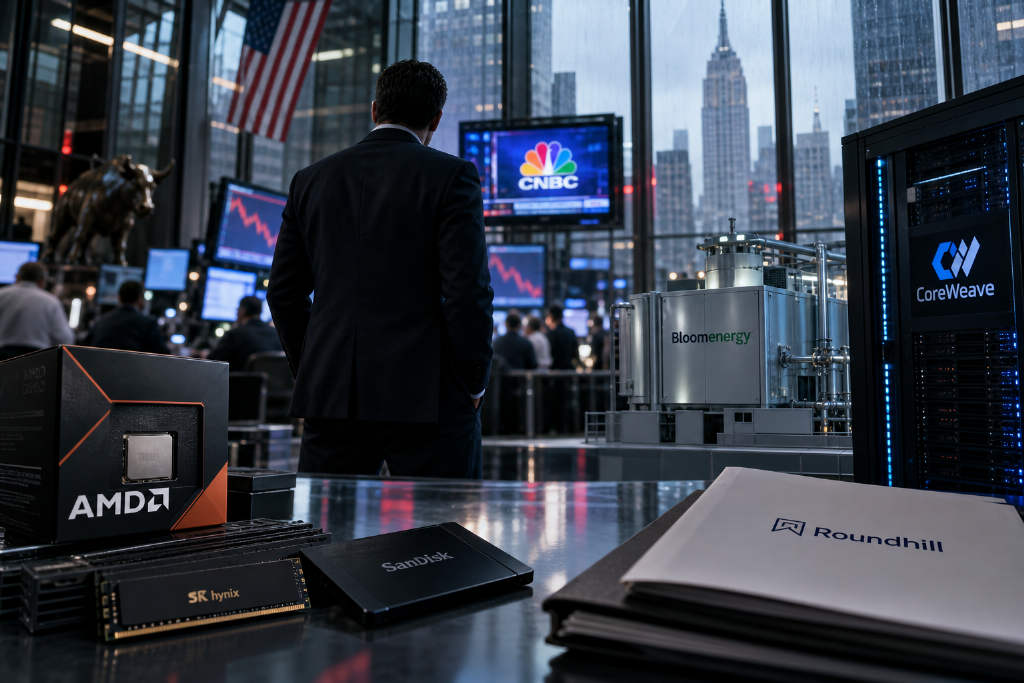
Leopold Aschenbrenner, the fund manager behind Situational Awareness, has returned to AI-linked trades after losing billions of dollars in July, and the new positions are already showing losses again.
CNBC reported Friday morning, six weeks after Aschenbrenner’s widely publicized blow-up, that Situational Awareness had been buying AI stocks and leveraged options on tech names. By Monday’s open, all six tickers tied to those trades had dropped, with declines of as much as 8% from Friday’s close.
The fund rebuilt exposure to AI names this month
Situational Awareness is the fund Aschenbrenner still runs after a July collapse in AI valuations erased billions of dollars from his portfolio.
According to Protos, the fund quietly bought options tied to AMD, Bloom Energy, and CoreWeave this month. It also added leveraged exposure to SK Hynix, SanDisk, and the Roundhill Memory ETF. CNBC sources said those purchases took place between September 2 and September 10.
The day after that report surfaced, the six names all opened lower, posting negative returns of 5% to 8% during a broader sell-off in AI stocks on Monday morning.
Sell-off tracked a wider retreat in AI trades
Protos said the drop in those six tickers was not caused by Aschenbrenner himself. Instead, it came alongside a broader AI sell-off after a widely shared essay by Anthropic chief executive Dario Amodei argued that AI would take over the internet within 6 to 12 months. Elon Musk said he agreed with that view, and Sam Altman also backed it.
Broader market coverage on Monday framed the move as a rotation out of crowded AI trades. Donald Trump also weighed in on the debate.
The market learned on Friday that Aschenbrenner was buying these names again. By Monday, every stock and fund linked to those positions was lower.
- AMD closed at $516.13 on the day CNBC published its story and opened Monday around $486, down roughly 6%.
- Bloom Energy fell 7%.
- CoreWeave and SanDisk each lost roughly 7%.
- SK Hynix and the Roundhill Memory ETF each fell about 8%.
Situational Awareness had expanded rapidly before the July collapse
Aschenbrenner, a former OpenAI researcher, launched Situational Awareness in 2024 with about $225 million. Backers included Stripe co-founders Patrick Collison and John Collison, former GitHub chief executive Nat Friedman, and investor Daniel Gross.
Using leverage as high as 400%, he expanded the portfolio and attracted follow-on financing. By the start of July, the fund was managing more than $45 billion. Within weeks, it had lost the majority of those assets.
July losses triggered margin calls and forced unwinds
In July, AI stocks gave back a substantial part of the gains they had posted during the first half of 2026. Shares of Nebius, SanDisk, Micron, and CoreWeave each dropped by more than one-third that month, triggering margin calls and unwinds across tech-focused funds.
After the positions were liquidated in what Protos described as a fire sale, Ken Griffin’s Citadel bought most of Situational Awareness’ portfolio at a substantial discount. Reports said the fund’s holdings had already fallen to roughly $10 billion by then. The Financial Times called it the largest dollar loss in hedge fund history.
JPMorgan Chase, which had financed the fund’s leverage, later cut it off. Aschenbrenner then moved his prime brokerage relationship to the boutique firm Clear Street.
This time the fund reportedly used flex options
Protos said the comeback trade was supposed to look different. Instead of relying on traditional margin, Situational Awareness reportedly used “flex options,” or fully paid contracts that cap losses at the premium paid.
The change in instruments was tied to Aschenbrenner’s promise of a more conservative risk model. Even so, the timing has not looked good after this weekend’s sell-off, regardless of the fund’s leverage ratio.