
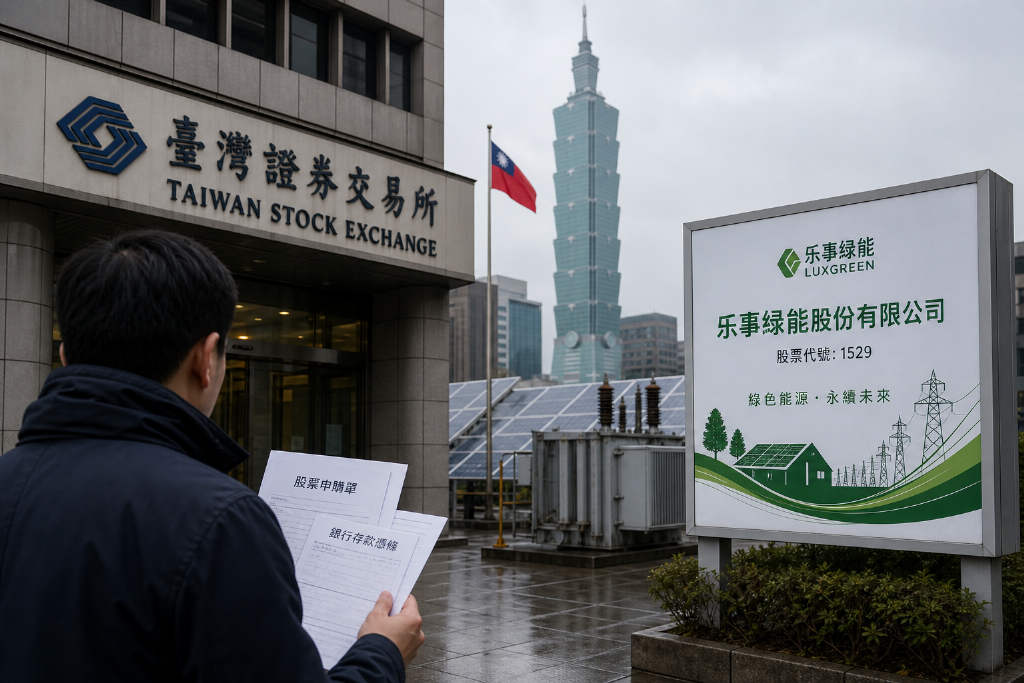
Leshi Green Energy (1529) is set to open a public share subscription from Sept. 2 to Sept. 4. Using its NT$14 underwriting price and the latest quoted market price of NT$17.6 in the source article, a successful allotment would translate into a potential gain of about NT$7,130, or roughly 25%.

Leshi Green Energy’s business profile
Leshi Green Energy was founded in 1978 and later transformed from a traditional power distribution equipment maker into a green energy technology company. Its main operations cover heavy electrical equipment, including transformers, switchgear and distribution panels, as well as solar power plant investment, ownership and operations, and turnkey public engineering projects.
According to the source, the company’s core business has benefited from Taiwan Power’s grid resilience plan and green energy policy opportunities. Revenue is mainly driven by heavy electrical equipment, while earnings support comes from solar power sales, where gross margin was cited at 30% to 40%.
The article listed full-year 2025 EPS at NT$1.01. For the first half of 2026, it said core business earnings remained steady and EPS reached NT$0.51. As debt was repaid, the debt ratio fell to what the source described as a stable 40% to 42%.
How the share lottery works
The article explained that what investors commonly call a stock lottery is formally known as a public subscription. It is a mechanism for companies to raise funds by issuing new shares to the public. When a company conducts an initial public offering or a post-listing cash capital increase, a portion of the deal must be made available for public subscription.
Investors apply through their brokerage trading platform and must make sure the settlement account has enough funds for the subscription payment and related fees on the designated debit date. If total applications exceed the number of shares available, the Taiwan Stock Exchange conducts a computerized random draw.
Costs and risks for investors
The main attraction in a public subscription is the spread between the underwriting price and the market price. The lead underwriter usually offers a discount to help attract subscriptions.
Still, applicants face a capital lock-up cost. After the subscription deadline, the full subscription amount is debited in advance and frozen for several trading days. Funds are released only on the refund date for unsuccessful applicants.
There are also direct participation costs. Each application carries a NT$20 processing fee and a NT$50 mailing fee for the winning notice. If an applicant does not win, the subscription funds and the NT$50 mailing fee are refunded, while the NT$20 processing fee is not.
Details of the Leshi Green Energy offering
Leshi Green Energy was listed in 2000, and this transaction is a cash capital increase. The source article said that makes the price spread relatively more stable.
A total of 3,400 board lots will be offered in this round. Because the subscription unit is two board lots at a time, the estimated winning rate is only slightly above 1%, according to the source.
To take part, investors need to enter the stock lottery section in their securities app before 2 p.m. from Sept. 2 to Sept. 4 and deposit NT$28,070. Results are scheduled to be announced on Sept. 8.