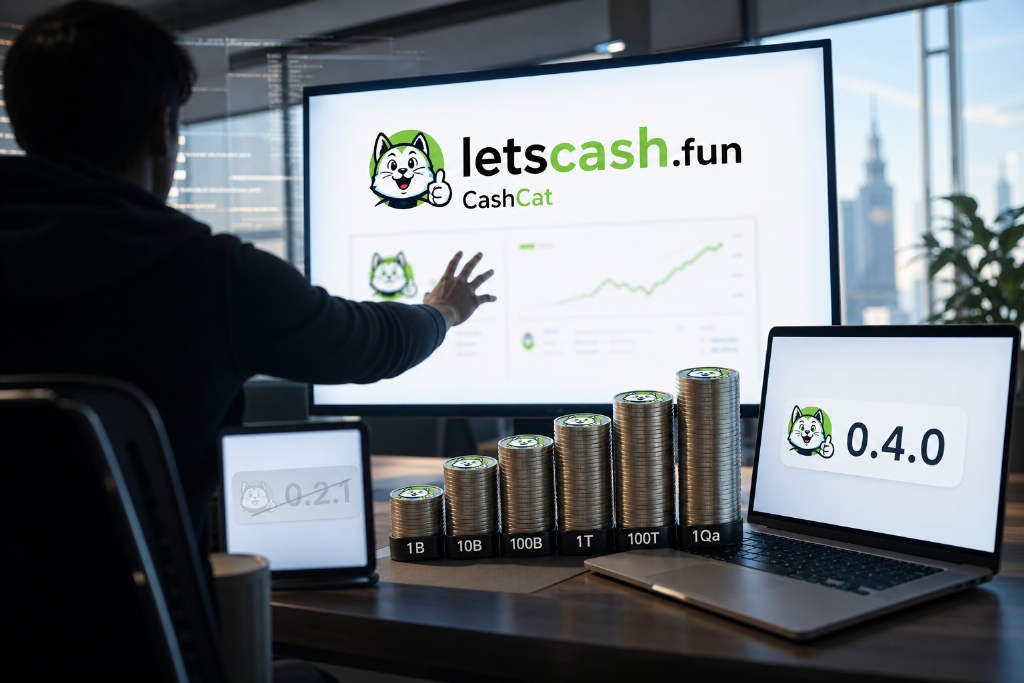
Letscash.fun, the meme token launch platform backed by the CashCat community, has announced changes to its new token supply mechanism. The fixed supply feature has been removed, and users may now select any integer between 1 billion (1B) and 1 quadrillion (1Qa) tokens when setting a token's total supply. Let's break that range down: 1B equals 1,000,000,000, and 1Qa equals 1,000,000,000,000,000. That gives token creators a wide band of options. The project also issued a new version of its SDK. Integrators are required to upgrade to version 0.4.0, as all function signatures have been changed. Anyone who stays on version 0.2.1 will see their calls fail, the project said. The platform did not explain in detail why the supply mechanism was altered or what prompted the breaking SDK update. The exact effective date of the supply change was not specified, and no further details have been shared at this time. The announcement was made via a tweet.
Meme token launch platform letscash.fun, driven by the CashCat community, tweeted that the fixed supply option for new token launches has been removed. Users can now choose any integer between 1 billion (1B) and 1 quadrillion (1Qa) tokens as the total supply.
The platform also said integrators must upgrade their SDK to version 0.4.0. All function signatures have changed, and calls made from integrations still using version 0.2.1 will fail.
This article was originally published by Bit.Fan. For more cryptocurrency news and market insights, visit www.bit.fan. Disclaimer:
The market information, project data, and third-party content displayed on this platform are for industry information sharing only and do not constitute any form of investment advice or return commitment.
Cryptocurrency trading carries high risks. Users should fully assess their risk tolerance and make independent decisions. All profits, losses, and legal responsibilities are borne by the users themselves.