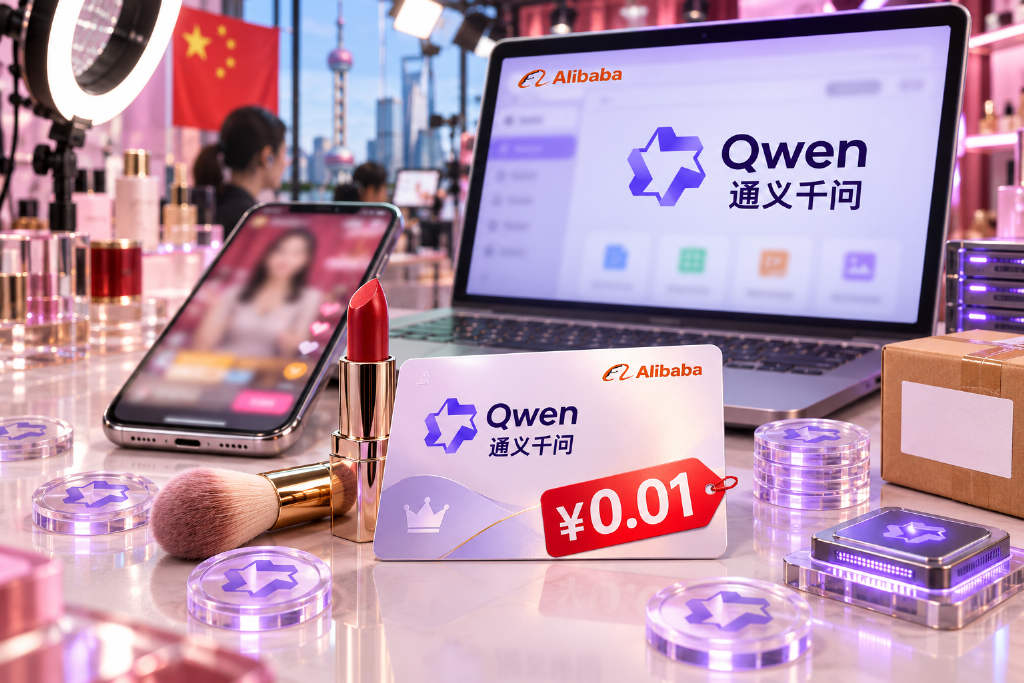
On Nov. 2, Li Jiaqi’s livestream featured an unusual item: Token-based AI access. During the session, Qwen Office’s personal membership monthly pass was offered for RMB 0.01, and about 100,000 units were sold within half an hour. Related reports estimated that the offer corresponded to roughly 2 trillion Tokens of AI computing usage.
Alibaba Vice President and Qwen Office CEO Chen Yusen also appeared in the livestream, demonstrating AI office-product scenarios and previewing a later benefit worth 20 trillion Tokens. Li Jiaqi’s storefront, long known for cosmetics and personal-care products, added another category this time: AI memberships.
A monthly AI pass sold for RMB 0.01
The personal basic monthly pass for Qwen Office normally costs RMB 28. In Li Jiaqi’s livestream, it was presented as a promotional giveaway, with buyers only covering the minimum required portion of shipping costs, or RMB 0.01.
A Token is the unit used to measure consumption when users call large-model services. Both input processing and output generation consume Tokens, and usage can vary by model and task. For ordinary consumers, Token is not an intuitive concept. A monthly membership, a usage period and a list of functions are easier to understand. By demonstrating AI office scenarios, the livestream turned model calls and Token consumption into a retail product format familiar to shoppers.
The pass includes 500 points per month as a base benefit. After adding promotional bonus points and first-registration benefits, a user can receive as many as 900 points. In practical terms, RMB 0.01 bought one account and one month of trial access.
Upstream prices are rising while retail promotions continue
At the same time, upstream Token pricing has been moving higher.
The article says Zhipu canceled the first-purchase discount for its Coding Plan in February, with overall package price increases starting from 30%. In March, the company launched GLM-5-Turbo and raised API pricing by 20%. Alibaba Cloud Bailian’s Coding Plan Lite stopped accepting new purchases on March 20 and stopped renewals on April 13. Doubao began charging in May, with three pricing tiers at RMB 68, RMB 200 and RMB 500. A report released by the China Academy of Information and Communications Technology in October also said model-service prices in China and overseas had risen noticeably in 2026 after two years of price wars.
Demand is one driver behind those increases. China’s National Data Administration disclosed that average daily Token calls in the country exceeded 140 trillion in March, up from 100 billion at the start of 2024. Data from the China Academy of Information and Communications Technology showed average daily consumption reached about 500 trillion in June, nearly four times the level of December 2025. On that basis, the 2 trillion Tokens tied to the livestream promotion amounted to only 0.4% of one day’s usage.
AI agents have also pushed Token consumption higher. When large models handle complex tasks, Token usage can run dozens or even hundreds of times above that of simple question-and-answer interactions. That has tightened computing supply. The article notes that Kimi once suspended subscriptions for new users after request volume exceeded expectations.
So the market is seeing two things at once: upstream prices are climbing, computing resources are tight and costs are being passed toward users, while the retail end is still using a RMB 0.01 monthly pass to subsidize acquisition.
Alibaba is buying users, not just selling a pass
The article points to Alibaba’s earnings as a way to understand the economics behind the move.
For the quarter ended June 30, Alibaba Cloud’s external commercialized revenue rose 45% year over year. Revenue from AI-related products reached RMB 12.376 billion and recorded triple-digit growth for 12 straight quarters. In the same quarter, capital expenditure totaled RMB 67.678 billion, while group operating profit fell 57% year over year. Alibaba said the main reasons were a decline in adjusted EBITA, goodwill impairment and provisions.
On the earnings call, CEO Wu Yongming said that, based on the current average gross margin of AI products, computing investment could be paid back within three years.
That payback period depends on one condition: the computing capacity has to be used continuously. The earnings report described Qwen Office as an entry point for reaching Alibaba’s enterprise users and said it is deeply integrated with Alibaba Cloud and DingTalk. In that context, the batch of low-cost monthly passes served to bring users into that system first.
The consumer payment threshold sits around RMB 100
The National Data Administration has described Tokens as the “settlement unit” of the intelligent era. On the other side of settlement is whether users are willing to pay.
Right now, consumer payment penetration remains limited. A May survey from Tencent Research Institute found that 9.8% of AI users were paying users, with monthly spending concentrated in the RMB 30 to RMB 100 range, accounting for 44.7%. Among high-frequency users, the payment rate was 11.7%; among low-frequency users, it was only 0.9%. The article notes that the survey is constrained by its sample and should be treated only as a reference.
Pricing across products falls into a similar band. Doubao starts at RMB 68, Qwen Office’s standard version is RMB 98 and Tencent WorkBuddy is RMB 99. All three entry-level personal plans sit in the same range, and two are close to the upper end. The RMB 0.01 monthly pass gives users one month to try the service. Whether that can convert into a RMB 98 paid subscription depends on how deeply they use it.
Token retail is spreading, but the scale is still small
On Sept. 3, Tmall launched a Token top-up center called “AI Space Station,” initially connecting Alibaba Cloud, Zhipu, Kimi, MiniMax and DeepSeek. JD.com launched an AI software top-up section around the same time. Tmall President Jialuo said Token was a new category for this year’s Singles’ Day shopping festival and that almost all large-model companies were already selling Tokens on Tmall.
On the first day of Singles’ Day, Tmall said gross merchandise value for the Token category rose 450% from the previous month. The article adds that the base was small. Media tallies showed cumulative sales of about 300 Token products at Zhipu’s Tmall flagship store and a little over 200 at MiniMax’s flagship store. Most stores were not offering discounts, and Zhipu’s monthly pass was reduced by only RMB 3.
The figures from Li Jiaqi’s livestream are not directly comparable with those flagship stores. The livestream sold a RMB 0.01 monthly pass, while flagship stores were selling paid packages priced from a few dozen yuan to several hundred yuan. One point is clear, though: the livestream had more than 10 million viewers online, and third-party flagship stores do not have that kind of one-off reach.
Zhipu reported revenue of RMB 954 million in the first half of 2026, of which RMB 825 million came from MaaS and API businesses. That lifted the share of those businesses from 15.2% a year earlier to 86.5%. Shelf-based Token retail is still small, but the more revenue depends on usage calls, the more important the entry point becomes.
Where the money ultimately goes is still unresolved
Alibaba’s statement that computing investment can pay back within three years is its own estimate. For the industry as a whole, whether the economics work depends on how far the payment rate can rise from 9.8%.
Even if more users start paying, the article says there is still no clear answer on who will capture that revenue. Zhipu gets 86.5% of its revenue from usage calls. If users increasingly buy through entry points such as Tmall and Qwen Office, model companies will no longer be dealing only with end users, and they may have to share pricing power and customer relationships with the platform operators. If users continue to pay model companies directly, those companies retain more control over pricing.
In that framing, the RMB 0.01 monthly pass was Alibaba’s opening move in that distribution battle.
The original article states that the content is for reference only and does not constitute investment advice, and that markets involve risk.